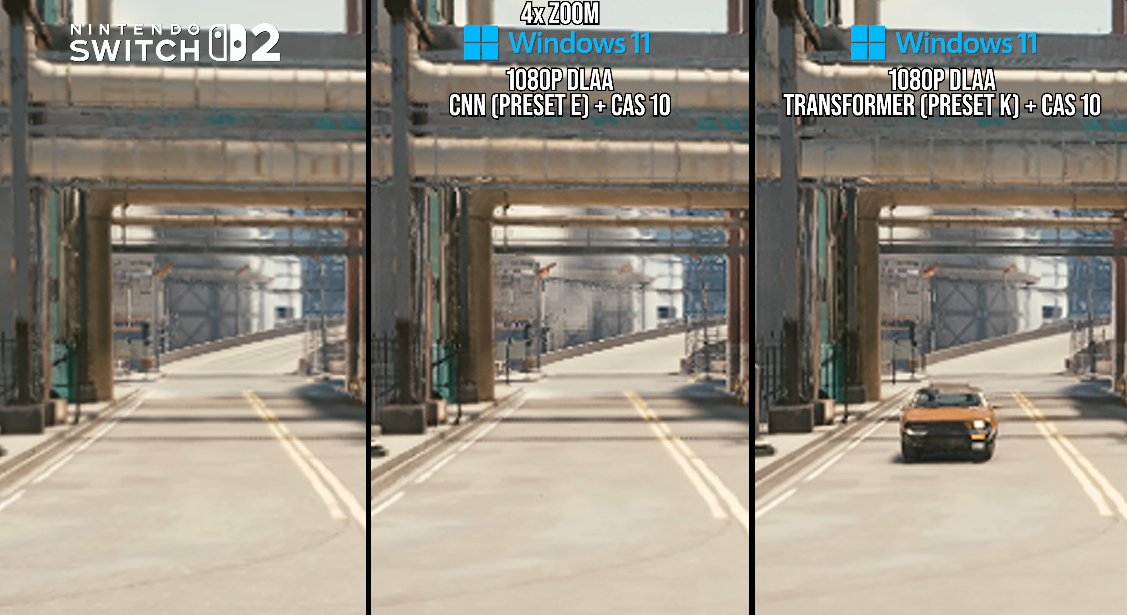
Nintendo’s next-generation console is shaping up to be a serious leap for portable visuals. According to a new technical breakdown from Digital Foundry’s Alex Battaglia, the Nintendo Switch 2 supports two distinct versions of NVIDIA’s DLSS (Deep Learning Super Sampling), giving developers more flexibility to target either pristine image quality or higher frame rates.
In tests across titles targeting the hardware—names like Cyberpunk 2077, Street Fighter 6, Hogwarts Legacy, Star Wars Outlaws, The Touryst, and Fast Fusion—Battaglia observed two DLSS presets at work. The first is a traditional, full-fat model that behaves much like the PC implementation, complete with CNN-driven reconstruction. It enhances anti-aliasing during motion, smooths out camera cuts, and delivers a notably stable image. The catch: this mode is currently showing up mainly in games upscaling to 1080p, hinting at its steeper processing cost on a handheld-class chip.
The second option, informally referred to as DLSS Light, is a streamlined variant designed to be far less demanding. It produces a crisp still image and can upscale beyond 1080p, but its compromises become visible during fast motion or heavy action. In those moments, certain reconstruction techniques appear to disable temporarily, exposing raw pixels and a less refined image. The trade-off seems intentional: DLSS Light reportedly eats about half the frame-time of the full model, making it a smarter choice when developers need headroom for high-resolution output or steadier performance.
Key differences at a glance:
– Standard DLSS: Closely mirrors the PC model; better motion anti-aliasing and cleaner camera cuts; best suited for 1080p upscaling; higher GPU cost.
– DLSS Light: Sharper static images and can push beyond 1080p; sacrifices reconstruction quality during fast motion; roughly half the frame-time cost.
To corroborate the analysis, Battaglia consulted an unnamed developer familiar with the console’s DLSS integration, who confirmed both presets are available in the development environment. That suggests the Switch 2’s GPU pipeline supports multiple DLSS configurations, letting teams pick the approach that best fits their performance targets—whether that’s maximizing clarity in slower-paced experiences or locking down smooth gameplay in more intense titles.
If these findings hold, the Switch 2 is set to become the first handheld console with native support for NVIDIA’s AI-powered upscaling. That’s a milestone for mobile hardware, where every millisecond of frame time counts and efficient image reconstruction can make the difference between a compromised port and something that looks and feels premium on the go. So far, implementation appears to be driven by third-party studios, likely because Nintendo’s internal engines are still being tuned. Once first-party teams dial in their workflows, the console could set a new bar for portable image quality and performance.
The big question now is adoption. Will DLSS Light become the default for high-resolution targets, with the full model reserved for 1080p or select showcase moments? Or will developers dynamically switch between the two based on scene complexity, motion, or whether the system is docked or handheld? With both presets available and validated by developers, studios have a meaningful toolkit to balance visual fidelity, responsiveness, and battery-conscious performance.
Bottom line: the Switch 2’s dual-path DLSS strategy looks smart for a hybrid handheld. The standard model promises cleaner motion and stability when the resolution target allows, while DLSS Light offers a faster, more scalable option for ambitious upscaling. Together, they signal a thoughtful approach by Nintendo and NVIDIA—one that could redefine what players expect from a portable console’s graphics in 2025 and beyond.