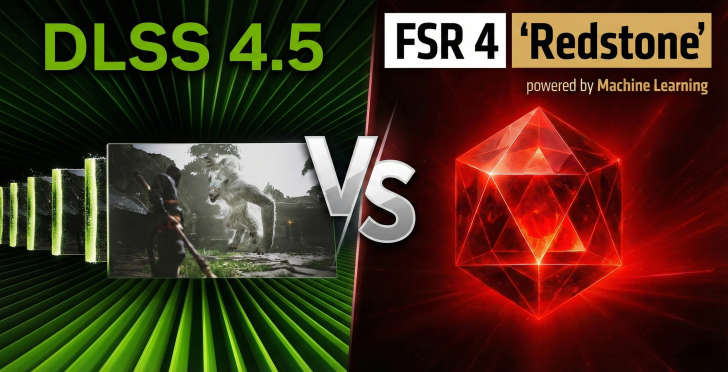
AMD’s FidelityFX Super Resolution 4 (FSR 4) arrived last year as a major turning point for PC gaming upscaling. After years of playing catch-up, AMD finally had an answer that could stand shoulder-to-shoulder with NVIDIA’s DLSS in real-world image quality. Reviewers largely agreed: FSR 4 looked competitive, often landing somewhere between DLSS 3’s older approach and DLSS 4’s newer Transformer-based direction, even if DLSS tended to hold an edge in efficiency.
Now, NVIDIA is pushing the race forward again. With DLSS 4.5 debuting around CES 2026, the company is positioning its latest model as a noticeable step up in upscaled image quality, especially in tricky scenes like foliage, disocclusion, and fast motion. The big question is simple: does DLSS 4.5 finally create clear daylight between NVIDIA and AMD, or does FSR 4 still keep the fight close?
What’s new in DLSS 4.5, and why it matters
DLSS 4.5 builds on DLSS 4 with a set of significant changes focused on reconstruction quality. The headline upgrade is a second-generation Transformer model, backed by a substantially larger, higher-fidelity training set. The catch is that this new model is much more computationally expensive, with an estimated compute cost around five times higher than DLSS 4.
To help keep performance practical, DLSS 4.5 also leans on FP8 support on newer RTX 4000 and RTX 5000 series GPUs, which helps offset some of the added workload.
How the testing was done (and how DLSS 4.5 was enabled)
To compare AMD and NVIDIA’s top upscaling solutions in a way that reflects how most players actually use them, the testing focused on 1440p with Performance mode upscaling enabled. That setting typically renders internally at 720p, then reconstructs the final 1440p output, making it an excellent stress test for stability, shimmer control, and motion clarity.
DLSS 4.5 was enabled per game through the NVIDIA App by selecting the title, scrolling to driver settings, and using the DLSS Override model preset. The focus here was Preset M (Performance). (Ultra Performance can use a different preset, but it wasn’t the target of this comparison.)
The GPU matchup was selected to keep raw rendering performance in the same neighborhood:
– AMD Radeon RX 9060XT 8GB for FSR 4
– NVIDIA GeForce RTX 5060 Ti 16GB for DLSS 4.5
The rest of the test system:
– Intel Core i7-13700K (MSI performance settings)
– MSI Z790MPower motherboard
– 32GB DDR5-7200 (2x16GB)
– Seasonic Focus V3-GX 1000W power supply
– Arctic Liquid Freezer II 420mm AIO
– 2x WD SN850X 1TB SSDs
– Windows 11 24H2
– AMD driver 25.12.1
– NVIDIA driver 591.74
Most games used native FSR 4 support, either through in-game settings or driver-level upgrades in supported titles. One exception was Forza Motorsport, where FSR 4 was tested via Optiscaler using DLSS inputs as an experiment.
One important capture note: footage was recorded using each GPU’s hardware encoder rather than a dedicated capture card, meaning the NVIDIA card’s encoder could make some scenes look a touch sharper independent of upscaler quality.
Performance expectations: demanding presets, but a fair fight
Preset M can be a tougher workload on older non-FP8 hardware because it requires precision translation, but on the RTX 5060 Ti it behaves more like the standard Transformer cost. FSR 4 sits in a similar general performance range here. With the RX 9060XT and RTX 5060 Ti delivering roughly comparable raster performance, neither side gets an “easy win” from simply having more FPS feeding motion data into the upscaler.
Game-by-game results: DLSS 4.5 vs FSR 4 at 1440p Performance mode
Cyberpunk 2077
Cyberpunk is a brutal upscaling test thanks to neon lighting, dense textures, and lots of motion over fine detail. At 1440p Performance mode, neither solution looks as crisp as higher quality settings, but both are clearly usable and generally stable.
Both DLSS 4.5 and FSR 4 showed distracting shimmering on certain elements like neon lights and textured walls. Edge aliasing was mostly contained. Where DLSS 4.5 pulled ahead was disocclusion handling, especially around foliage. With DLSS, these artifacts tend to be subtle unless you’re actively hunting for them; with FSR 4 they can be easier to spot during normal movement. Even so, overall image quality in Cyberpunk still landed close enough to call it a practical tie.
Hogwarts Legacy
This is where DLSS 4.5 starts to separate itself. Preset M’s aggressive sharpening boosts perceived clarity, and while both upscalers kept ghosting under control, FSR 4 struggled more in foliage-heavy scenes. During even mild camera pans, foliage could pick up a layer of “background noise” that took a moment of stillness to settle down.
FSR 4 has shown this behavior in some titles since launch, suggesting this isn’t a one-off edge case. DLSS 4.5 isn’t perfect in motion either, but the foliage noise was less pronounced and less distracting overall. In Hogwarts Legacy, DLSS 4.5 is the clear winner.
Clair Obscur: Expedition 33
This game is a perfect example of why upscaling quality matters, because the native presentation is already soft due to heavy processing effects. In this case, DLSS 4.5 Preset M’s extra sharpening actually helps counteract the game’s baseline blur, giving it an advantage in perceived detail.
FSR 4 leans a bit softer by comparison. That said, both upscalers delivered a near “native-like” experience (even if native isn’t particularly impressive here). Neither solution introduced major extra ghosting, shimmering, or jaggies beyond what the game already struggles with.
Both also ran into the same underlying visual problems tied to the game’s presentation: noisy, boiling reflections (linked to low-resolution Lumen), heavy disocclusion artifacts, shimmer around fine elements like hair and cloth, and occasional ghosting around small particles such as the red leaves found throughout the world. Overall, the sharpening style of Preset M gave DLSS 4.5 a narrow win here.
Call of Duty: Black Ops 7
This was one of the toughest titles to judge because the built-in benchmark is chaotic: rapid panning, constant effects, and explosions dominating the frame. In a game like this, the real test is whether motion clarity holds together at low internal resolution.
After close inspection, both DLSS 4.5 and FSR 4 looked closely matched for motion clarity. Even at a 720p internal render, both preserved impressive sharpness and readability during fast action. In this title, neither side delivers an obvious advantage.
Forza Motorsport (experimental FSR 4 via Optiscaler)
Forza Motorsport doesn’t officially support FSR 4, so FSR 4 was injected using Optiscaler through DLSS inputs. While this kind of workaround can sometimes be surprisingly effective, it also highlights why official support matters.
At 1440p Performance mode, the FSR 4 result took an unusually large hit. Tree and foliage reconstruction was weaker than expected, and there was even visible ghosting on taillights ahead—something that’s typically rare with FSR 4 in more polished implementations. DLSS 4.5 was clearly ahead here.
Because this isn’t an official FSR 4 integration, these results should be treated carefully. Still, it’s a strong reminder that community injection methods can vary wildly depending on the game, and that native, developer-supported implementations tend to be far more consistent.
Final verdict: DLSS 4.5 gains ground, but FSR 4 remains competitive
Across five games tested at 1440p Performance mode, DLSS 4.5 with Preset M comes out with a slight overall advantage. The preset’s heavy sharpening can be a real benefit in games with softer rendering pipelines, and in certain scenes—especially foliage and disocclusion—DLSS 4.5 looks more controlled.
But it’s not a runaway victory. In many situations, overall image quality remains in the same general tier as FSR 4, and there are titles where the difference is small enough that you may not notice it during normal gameplay. Where NVIDIA continues to hold a major practical edge is game support and ease of access. While tools can inject FSR 4 into unsupported games, the results can be inconsistent, as Forza Motorsport demonstrates.
For players choosing between GPUs or deciding which upscaler to rely on in 2026, the takeaway is straightforward: DLSS 4.5 appears to reclaim a small lead in upscaled image quality, but FSR 4 is still very much in the fight when implemented properly.