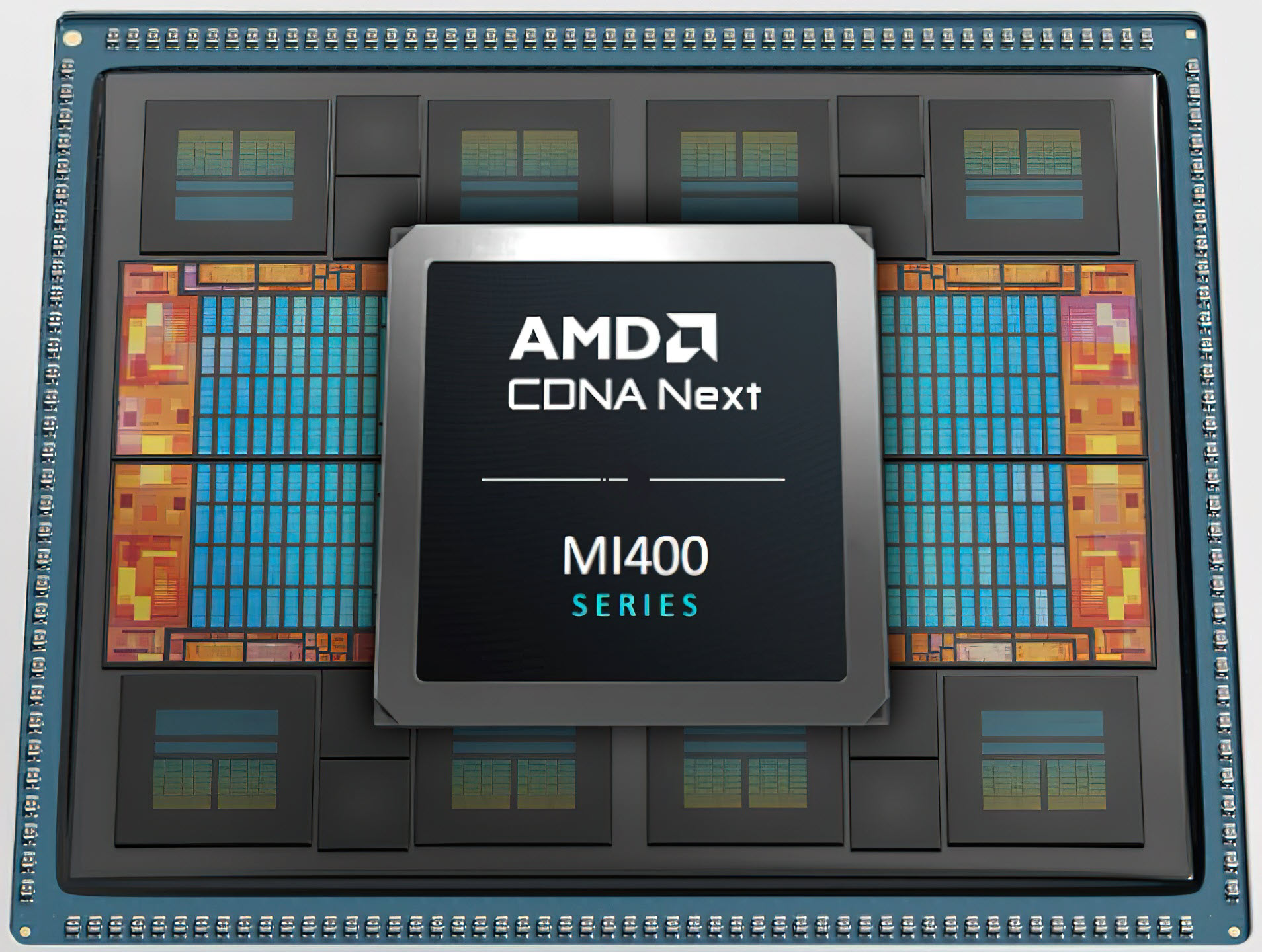
AMD is making waves with their upcoming Instinct MI400 accelerator that is poised to revolutionize their accelerator lineup. Set to launch in 2026, this new generation aims to introduce exciting changes, especially with the integration of innovative tiles and architecture enhancements.
The Instinct MI400 will be powered by the impressive CDNA Next architecture, potentially rebranded to UDNA as AMD moves towards a unified strategy with their architectures. This evolution suggests a strong focus on enhancing performance and efficiency for large-scale AI tasks. An intriguing aspect of the MI400 is the inclusion of up to eight Accelerated Compute Dies (XCDs), doubling the amount found in its predecessor, the MI300. These will sit on two Active Interposer Dies (AIDs), with added dedicated Multimedia and I/O dies for superior communication.
What stands out in the MI400 is the planned shift away from the previous infinity fabric communication, promising improved efficiency and speed. These advancements hint at the MI400 being a game-changer for AI training and inference tasks.
Meanwhile, AMD’s MI350, set to release this year, promises substantial improvements over earlier models. It utilizes a cutting-edge 3nm process node, aimed at delivering greater energy efficiency and a notable increase in AI inference capabilities. While details about the MI400’s full capabilities remain under wraps, the anticipation surrounding AMD’s announcements of its specifications and features continues to grow.
AMD’s latest efforts underscore its commitment to pushing the boundaries of AI accelerator technology. With the MI400, they are setting a new standard in chip design, promising enhanced performance, and placing themselves at the forefront of the AI and tech industry. As the countdown to 2026 begins, the tech world eagerly awaits to see how AMD’s innovative approach will influence future technologies.