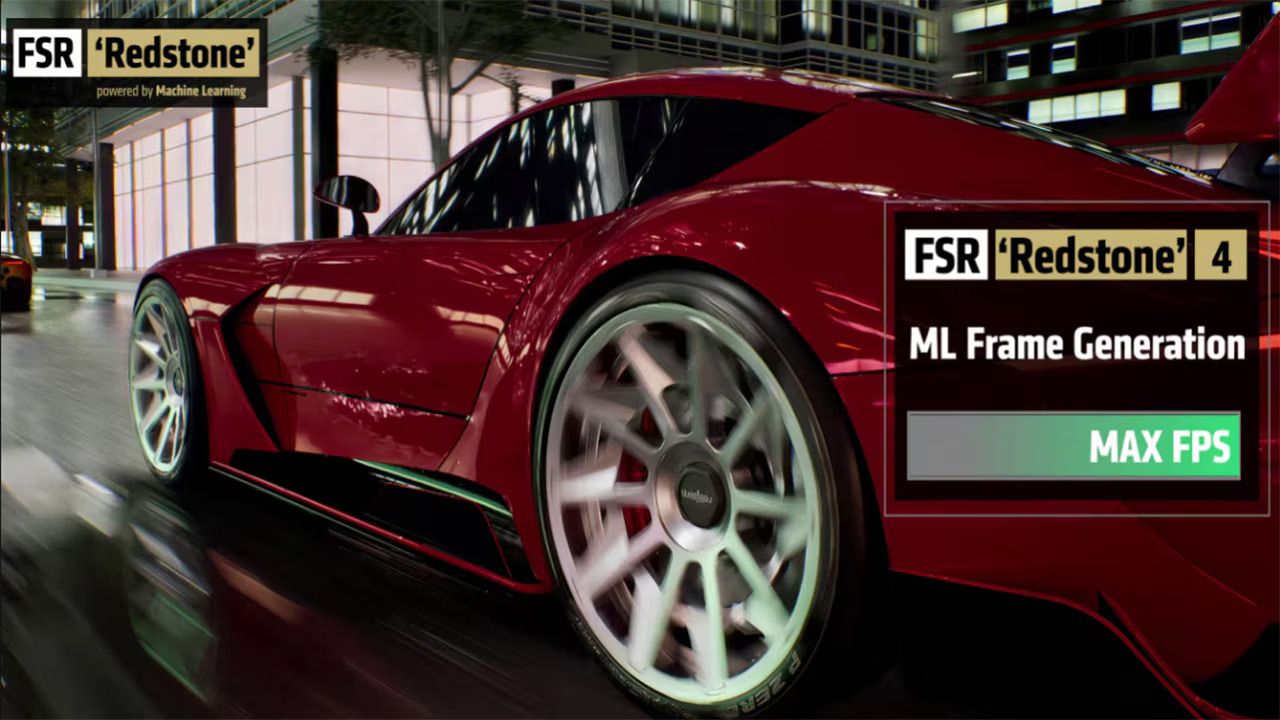
AMD FSR Redstone brings neural rendering to almost any GPU—no AI cores required
AMD is preparing a major shift in how machine learning powers game graphics. FSR Redstone, unveiled at Computex 2025, is a new ML-driven rendering suite designed to boost image quality and performance without locking players or developers into specific hardware. The standout twist: it doesn’t rely on dedicated AI acceleration at runtime, opening the door to support on a wide range of GPUs, including older models.
At the heart of Redstone is ML2CODE, a research initiative within AMD’s ROCm ecosystem. Instead of executing trained neural networks through proprietary AI cores, ML2CODE converts those models into highly optimized compute shader code. In practice, it outputs HLSL or GLSL that runs through standard graphics pipelines like DirectX and Vulkan. Because the result is shader-based and not tied to specialized tensor hardware, Redstone’s neural rendering core can run on GPUs from multiple vendors, including AMD, NVIDIA, and Intel—so long as they support modern shader pipelines.
Chris Hall, Senior Director of Software Development at AMD, explained that the company uses HIP extensively during development. HIP enables code paths that can be tuned for different generations of Radeon GPUs, and, where appropriate, can be translated for other ecosystems. That approach helps ensure Redstone’s ML features are broadly compatible, while keeping the door open for further optimization per architecture. In other words, the neural smarts happen at build time and translation, while the runtime execution is pure compute shader work.
What makes this particularly exciting for PC gamers is that Redstone isn’t dependent on AI acceleration blocks to deliver its enhancements. Instead of invoking dedicated AI silicon during gameplay, the ML logic is distilled into efficient shader code that runs on the GPU’s general-purpose compute units. Yes, there may be some performance overhead on older hardware, but access to neural rendering without needing the latest AI cores is a big win for longevity and compatibility.
This strategy also signals a meaningful pivot for AMD’s graphics stack. Where previous features sometimes targeted a narrower slice of hardware—FSR 4 notably focused on RDNA 4—Redstone’s shader-first approach suggests a far wider runway. As an ML-based first for AMD’s FSR family, it could extend meaningful benefits to RDNA 3 owners and possibly beyond, bringing sharper visuals and better performance to more players.
What this means for gamers and developers:
– Wider GPU support: Because Redstone’s neural rendering core compiles to compute shaders, it can run on AMD, NVIDIA, and Intel hardware that supports modern shader models.
– No AI cores required: ML inference is effectively “baked” into optimized shader code, enabling ML features without dedicated AI acceleration at runtime.
– Built for real engines: ML2CODE targets common pipelines with HLSL and GLSL, aligning with DirectX and Vulkan for easier integration.
– Future-ready flexibility: Underpinned by ROCm and HIP, Redstone’s architecture is designed for per-generation optimization and cross-platform reach.
FSR Redstone points to a more inclusive future for AI-enhanced graphics—one where neural rendering isn’t limited to the newest, most expensive GPUs. If developer adoption follows, expect smoother performance, cleaner frames, and smarter upscaling across a broader slice of the PC gaming landscape.


