NASA just uncovered stardust older than our solar system in material returned from asteroid Bennu, and the findings are rewriting what we know about how planets—and possibly life’s ingredients—came to be.
The samples come from OSIRIS-REx, a mission launched in 2016 to collect and return pristine material from a small, near-Earth asteroid. On October 20, 2020, the spacecraft briefly touched Bennu’s surface, scooped up dust and pebbles, and sent them home for study. Now, three independent research teams have released results that paint a vivid picture of Bennu’s deep past and the dramatic forces that shaped it.
One team traced Bennu’s building blocks back beyond the birth of the solar system. By probing the particles at microscopic scales, they identified rare presolar grains—tiny bits of stardust forged in ancient stars before the Sun ignited. They also found organic matter that likely formed in interstellar space and high-temperature minerals that originated closer to the Sun, indicating Bennu inherited a diverse mix of materials from across the early solar system. As one of the study co-leads put it, “We found stardust grains with compositions that predate the solar system, organic matter that likely formed in interstellar space, and high temperature minerals that formed closer to the Sun.”
A second team focused on Bennu’s watery history. Their analysis suggests Bennu is a fragment of a much larger parent body that once accumulated ice and dust. As that ice melted, liquid water reacted with the surrounding material, transforming it over time. The result is the complex blend of minerals and textures seen in Bennu’s samples today—evidence of chemical processes that may mirror the ones that helped deliver water and life’s precursors to early Earth.
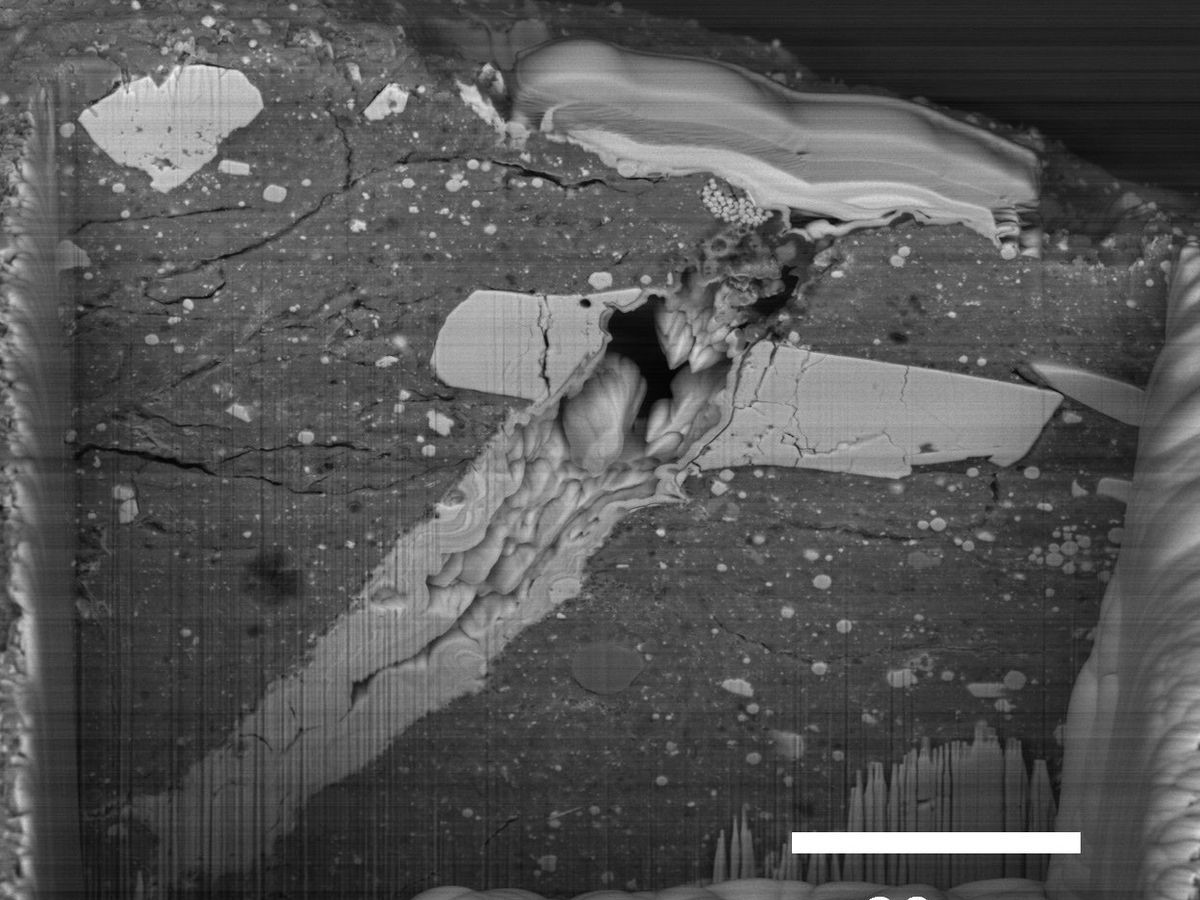
A third team examined the samples’ surfaces and found telltale signs of repeated micrometeorite impacts—tiny, glassy “impact melts” formed in split-second flashes of heat. Scanning electron microscope images reveal minuscule craters blasted into the grains. Because asteroids lack atmospheres, their surfaces are constantly battered by micrometeorites and the harsh solar wind. On Bennu, that space weathering appears to be happening at a remarkably fast pace, rapidly reshaping the outermost layers of the asteroid.
Together, these discoveries turn Bennu into a cosmic time capsule. The presolar grains point to ingredients older than the Sun. The water-altered minerals trace a history of ice, melt, and chemical change inside a long-lost parent world. And the impact melts capture a snapshot of the relentless environment of space. It’s a layered story that helps scientists reconstruct how the solar system formed about 4.5 billion years ago—and how asteroids may have carried water and organic compounds to our young planet.
OSIRIS-REx has now embarked on its next chapter under a new name, OSIRIS-APEX, as it heads for another near-Earth asteroid, Apophis. The spacecraft is expected to study Apophis up close, with coordination anticipated alongside the Ramses mission. By comparing objects like Bennu and Apophis, researchers can test ideas about asteroid evolution, space weathering, and the delivery of key ingredients across the solar system.
Why this matters goes far beyond rocks in space. Each grain in the Bennu collection is a clue to origins: how stellar dust became planets, how water moved through early worlds, and how the raw materials for biology spread through the cosmos. With every new analysis, we get closer to answering some of humanity’s oldest questions about where we come from—and what else might be possible in other corners of the universe.