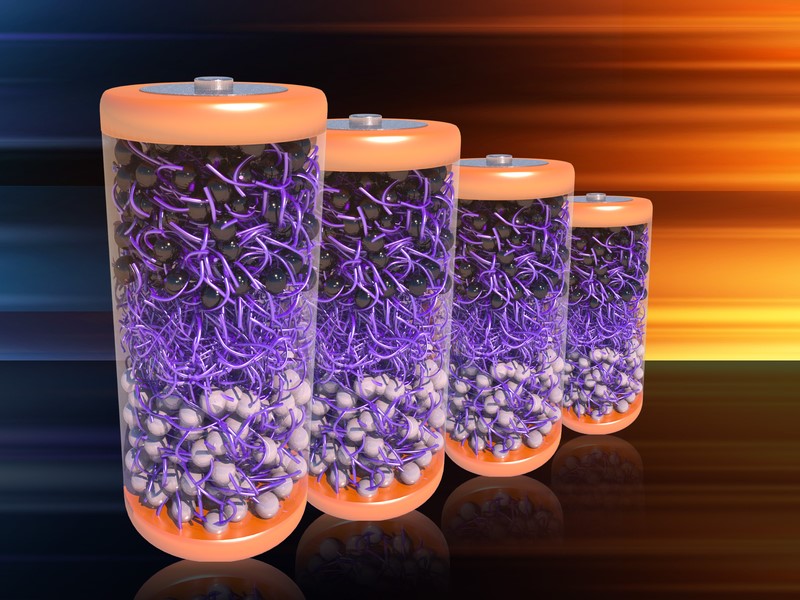
Electric vehicles promise cleaner air, but their batteries pose a growing end-of-life challenge. A new breakthrough from MIT could change that equation by making future batteries easy to take apart and recycle. Researchers have developed a self-assembling solid-state electrolyte that dissolves on command, letting an entire battery separate into its core components in minutes.
The electrolyte is built from molecules that are chemically similar to those in Kevlar. When mixed with water, these molecules spontaneously organize into millions of tough, ion-conducting nanoribbons. Pressed together under heat, the nanoribbons form a sturdy solid that sits between the positive and negative electrodes, acting as both the separator and the ion-conducting medium in a solid-state battery.
Here’s the twist: at the end of a battery’s life, you can submerge the cell in an organic solvent and the electrolyte rapidly dissolves—think spun sugar disappearing in water. As the electrolyte vanishes, the cell structure collapses and the electrodes, current collectors, and other valuable parts fall away for straightforward recovery. No shredding, no harsh high-temperature processes, and far less contamination of reusable materials.
This approach flips the typical battery design philosophy on its head. Instead of optimizing performance first and worrying about recycling later, the team started with materials that are inherently easy to reclaim and then engineered them to work inside a battery. By designing for disassembly from the beginning, the researchers are pointing toward a battery lifecycle that fits a true circular economy—one that reduces the need for constant mining of new resources and makes large-scale recycling both cleaner and cheaper.
To prove the concept, the team built a working solid-state battery using the dissolvable electrolyte. While it doesn’t yet match the performance of today’s best commercial cells, the device shows that recyclable solid-state battery components can be practical. The results, published in Nature Chemistry, suggest a clear path to further improve conductivity, stability, and energy density while preserving the instant-disassembly feature.
Why this matters:
– EV adoption is accelerating, and so is the volume of used batteries. Simplified recovery of cathode and anode materials could lower recycling costs and minimize waste.
– Solid-state designs are typically tougher to disassemble than conventional liquid-electrolyte cells; a dissolvable connector layer turns that liability into a strength.
– Cleaner, more efficient recovery of battery-grade metals supports supply security and can reduce the environmental footprint of new battery production.
If future versions scale to larger cells and pack-level systems, manufacturers could reclaim valuable components with minimal processing and re-use them in next-generation batteries. That would help ease pressure on raw material supplies and cut down on energy-intensive recycling methods.
This is early-stage research, but it reframes what a sustainable battery can be. A self-assembling, self-unlocking electrolyte offers a simple promise: when a battery’s job is done, it should come apart as easily as it went together.


