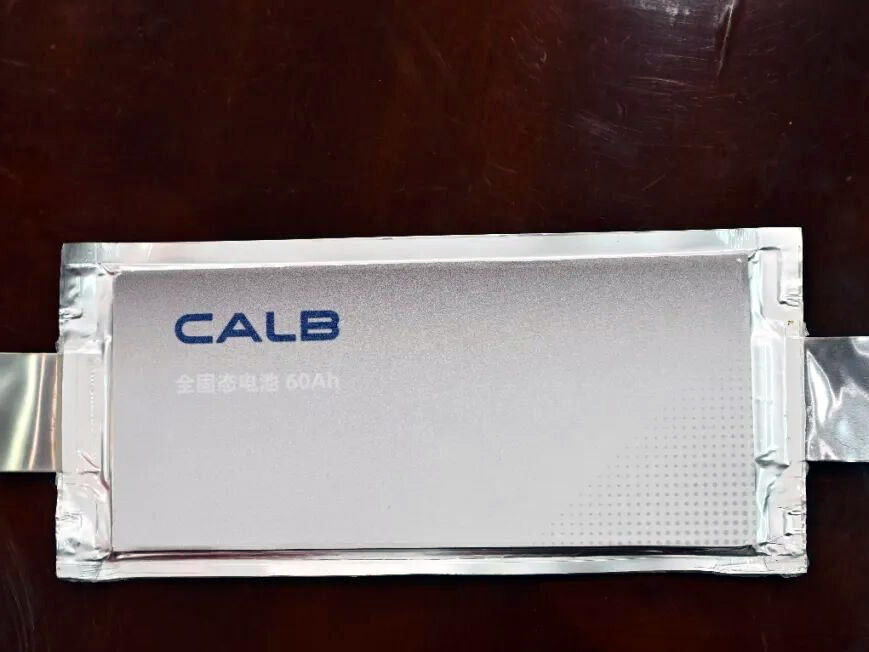
Battery maker CALB has just showcased a new 60 Ah solid-state battery cell that could dramatically change what drivers expect from an electric vehicle. The headline promise is simple and exciting: a battery with energy density above 450 Wh/kg, potentially enabling roughly double the driving range compared with today’s typical EV packs. But CALB is also being blunt about the big obstacle still standing in the way of widespread adoption: cost.
CALB’s chairwoman, Liu, cautioned that manufacturing solid-state batteries remains expensive compared with today’s mainstream lithium iron phosphate (LFP) cells. Even “hybrid” solid-liquid designs that use about 95% solid electrolyte currently cost around 12 cents per watt-hour to produce. By contrast, modern LFP cells are now below six cents per watt-hour, translating to roughly $5,800 in production cost for a 100 kWh pack. In other words, solid-state technology can deliver major performance gains, but at about twice the price of conventional liquid-electrolyte batteries.
What’s driving that jump in performance is also what pushes the price up. CALB’s new cell uses a sulfide-based electrolyte along with a nickel-rich cathode and a silicon composite anode. Together, these materials and design choices help boost energy density, improve cold-weather performance, and strengthen safety characteristics—but they also make the cell more costly to build.
Still, CALB argues the math is not all bad: double the range for roughly double the cost creates a compelling starting point for commercialization, especially in markets where space, weight, and performance matter more than price. That’s why CALB plans to deploy these high-energy-density solid-state cells first in applications like eVTOL aircraft and humanoid robots, where volumetric and gravimetric energy density can be mission-critical. After that, the company expects to begin supplying solid-state batteries to electric vehicle manufacturers in 2027.
Beyond range, CALB highlighted two areas where solid-state batteries could offer real-world advantages over today’s EV cells: charging speed and cold weather resilience. The company says its solid-state technology supports 6C+ charging—fast enough to take a battery from empty to full in about 10 minutes under the right conditions. It also claims the cell can retain about 90% of its capacity in extreme cold, while current liquid-electrolyte batteries may lose around 40% in similar environments.
Safety is another major focus. Because solid-state batteries aren’t filled with volatile and flammable liquid electrolyte, they’re generally seen as less prone to the kinds of thermal runaway events that make EV fires difficult to manage. CALB says its cell has already passed common safety evaluations such as puncture, pressure, and high-temperature tests, in line with a new national solid-state battery standard China is developing, and that it has been cleared for commercialization.
CALB’s announcement also fits into a much larger trend: China’s battery industry is pushing hard into solid-state development. Both major battery manufacturers and newer startups are working on solid-state designs, with Chinese companies responsible for a large share of global production. Even so, many of these firms are offering the same near-term reality check—solid-state batteries will likely appear first in drones, robots, and premium electric vehicles because of their high cost. True mass-market solid-state EV adoption is still expected to take longer, with broader commercialization projected to accelerate after 2030 as manufacturing costs fall and production scales up.