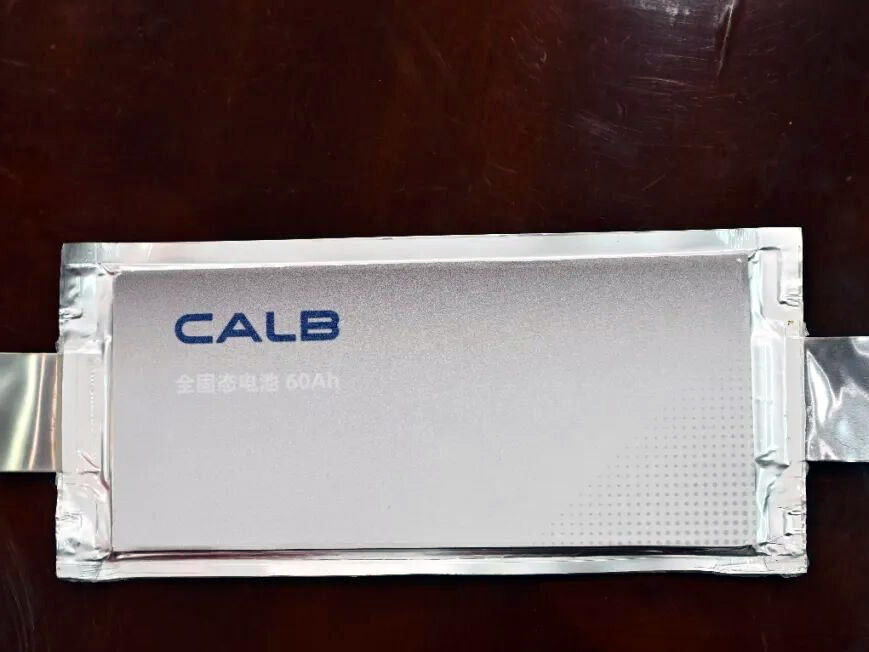
CALB has just pulled the curtain back on a new 60 Ah solid-state battery cell that could dramatically change what drivers expect from an electric vehicle. The headline claim is big: this next-generation cell is designed to deliver roughly double the driving range of today’s typical EV batteries. But CALB is also being unusually candid about the catch—solid-state batteries still cost far more to manufacture than conventional lithium-ion packs.
The new CALB cell reportedly exceeds 450 Wh/kg in energy density, a level that puts it in a different league compared with mainstream lithium iron phosphate (LFP) batteries used in many affordable EVs. Higher energy density means more energy stored for the same weight, which translates into longer range without making the vehicle heavier. That same advantage also makes the cell especially attractive anywhere weight and space are the biggest constraints.
Even so, CALB’s leadership warns that the economics aren’t ready for mass adoption yet. Chairwoman Liu says the current manufacturing cost of a hybrid solid-liquid battery—using a very high percentage of solid electrolyte (around 95%)—is about $0.12 per watt-hour. By comparison, modern LFP cells can cost under $0.06 per watt-hour. Put into pack terms, that’s roughly $5,800 to manufacture a 100 kWh LFP pack, highlighting why solid-state remains a premium technology today.
CALB’s solid-state design relies on several advanced materials to reach those performance targets. It uses a sulfide-based electrolyte, a nickel-rich cathode, and a silicon composite anode. Together, these choices help boost energy density, improve cold-weather performance, and enhance safety—but they’re also a major reason the cost remains high.
Still, the value proposition isn’t as lopsided as it might sound. If a battery can offer around twice the range for about twice the cost, that can look commercially viable in the right segments—especially where range, weight, and charging speed matter more than sticker price.
And charging speed is another area where CALB is positioning solid-state as a leap forward. The company points to a 6C+ charging rate, which could theoretically take a battery from empty to full in about ten minutes. While real-world results depend on vehicle architecture, charger capability, and battery management limits, the promise of ultra-fast charging is a major reason automakers and battery makers keep investing in solid-state research.
Cold weather performance is also highlighted as a key benefit. CALB says its solid-state cell can retain about 90% of its capacity even in extreme cold, whereas current liquid-electrolyte batteries can lose around 40% in similar conditions. For drivers in colder climates, reduced winter range is one of the biggest everyday frustrations with EVs, so improved low-temperature performance could become a major selling point.
Safety is another central argument for solid-state. Traditional EV batteries use flammable liquid electrolytes, which can complicate firefighting and increase risk during severe impacts. CALB emphasizes that its solid-state cell has undergone common safety tests such as puncture, pressure, and high-temperature evaluations. The company also notes that it is aligned with the emerging national solid-state battery standards China is developing, and that the cell has been cleared for commercialization.
As for when drivers might see this technology on the road, CALB’s rollout plan starts outside mainstream passenger cars. The company intends to deploy these high energy-density solid-state cells first in applications like eVTOL aircraft and humanoid robots, where volumetric density and weight savings can justify higher costs. After that, CALB expects to begin supplying solid-state batteries to EV manufacturers in 2027.
CALB’s timing fits the broader industry view. Many Chinese battery companies—both established giants and newer startups—are racing to develop solid-state technology, with China accounting for a large share of global production activity. The general expectation is that solid-state cells will appear first in drones, robotics, and premium electric vehicles due to pricing. Wider mass-market adoption is still viewed as a post-2030 shift, assuming manufacturing costs fall significantly.
For EV buyers, the takeaway is clear: solid-state batteries are moving from lab headlines toward real commercialization, but cost remains the biggest barrier. If manufacturers can bring pricing down while maintaining the gains in range, fast charging, cold-weather reliability, and safety, solid-state could become the next major turning point in electric mobility.