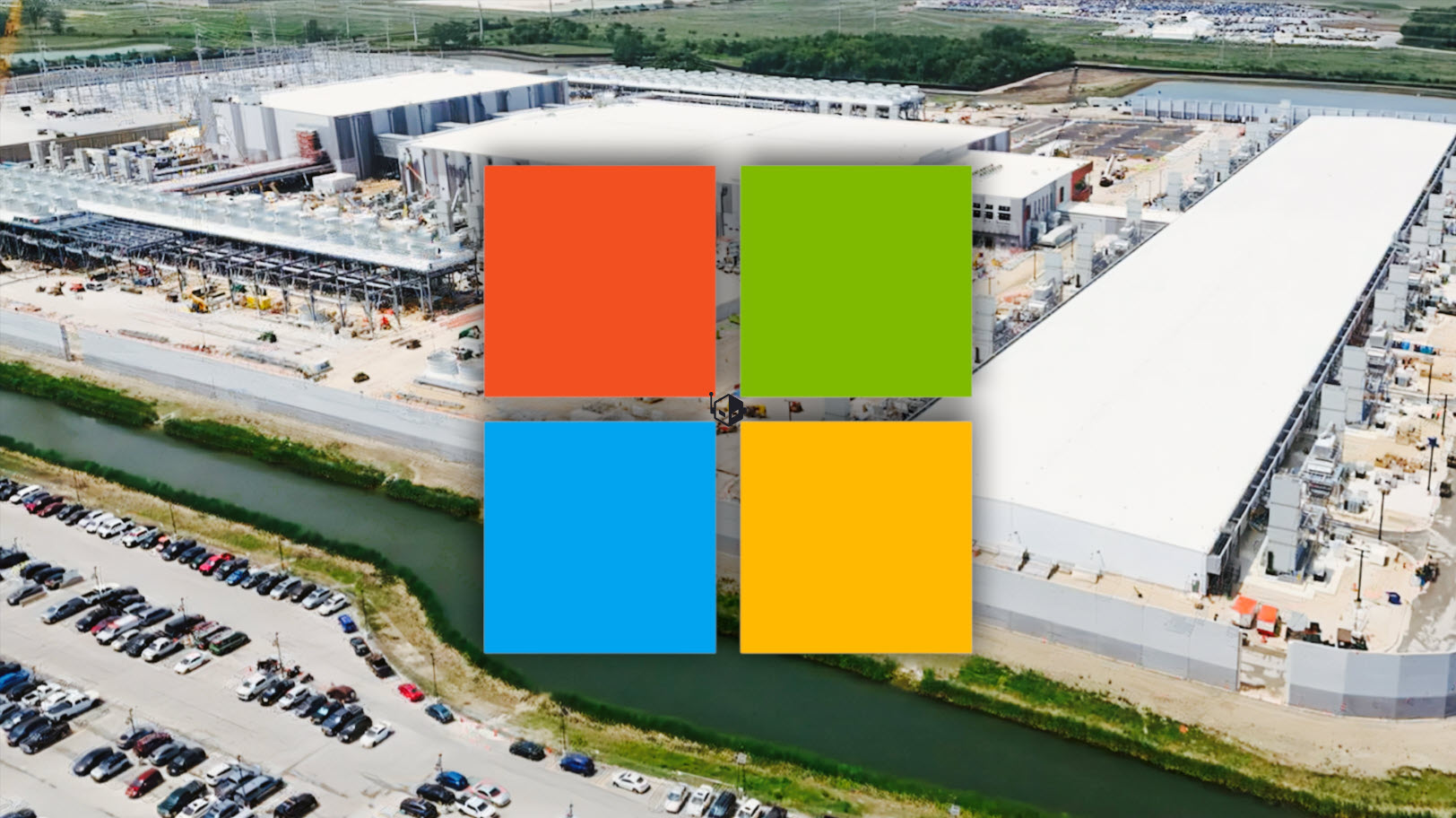
Microsoft is moving fast on the AI infrastructure race. The company has confirmed that its Fairwater facility in Wisconsin, widely positioned as the world’s most powerful AI datacenter, is going live ahead of schedule—and it’s built around NVIDIA’s Blackwell generation hardware.
CEO Satya Nadella shared the news on X, highlighting that Fairwater will unite hundreds of thousands of NVIDIA GB200 GPUs into a single, seamless cluster. That “one massive cluster” approach matters because it’s designed to support the next wave of agentic AI workloads—systems that don’t just generate outputs, but can plan, reason, and take actions across complex tasks. Training and running these models demands enormous compute density and extremely high-speed interconnects, and Fairwater is built specifically for that kind of scale.
First announced in September 2025, Fairwater has been described as a step-change leap in capability. Microsoft previously said the site was engineered to deliver up to 10 times the performance of the fastest supercomputers available at the time of the announcement. The facility’s footprint isn’t just about GPU count, either. Microsoft also pointed to a staggering amount of networking fiber in the design—enough to wrap around the Earth about four and a half times—underscoring that the datacenter is as much about moving data efficiently as it is about raw compute.
Cooling is another major piece of the design. Fairwater’s AI system is fully liquid-cooled using a closed-loop setup, and Microsoft has said it will not require additional water after construction is completed. With modern AI hardware pushing extreme power and heat densities, liquid cooling is increasingly becoming the most practical path to maintain performance and reliability at scale.
Power, of course, is the other headline challenge. Microsoft has already added 2 gigawatts of capacity to support its broader AI expansion—roughly comparable to the output associated with two nuclear power plants. For Fairwater specifically, the company says it will meet the facility’s energy needs using renewable sources. Microsoft has also stated it plans to avoid driving up local energy prices by pre-paying for energy and electrical infrastructure tied to its usage.
That commitment has already been linked to new regional energy development, including construction of a 250MW solar power plant in Portage County. Microsoft also says ecological protection will be maintained around the facility, an issue that’s drawing growing attention as hyperscale AI datacenters expand into new regions.
Fairwater is also not intended to be a one-off. Microsoft has indicated it has lined up multiple sites across more than 70 regions to expand its AI datacenter footprint, including plans for facilities modeled on Fairwater in additional locations across the United States. This comes on top of the large base of datacenters the company already operates today.
Still, the scale of this buildout raises big questions beyond performance—especially around grid capacity, construction impact, and supply chain constraints. Microsoft’s message is that it can expand AI compute while managing energy costs and improving renewable generation, but the broader reality is clear: the infrastructure needed for frontier AI is arriving faster, larger, and more power-hungry than anything the industry has deployed before.
With Fairwater going live ahead of schedule and packed with Blackwell-based GB200 GPUs, Microsoft is signaling that it intends to be ready for what comes next: larger frontier models, more autonomous AI systems, and a rapidly intensifying demand for high-performance AI training and inference at massive scale.