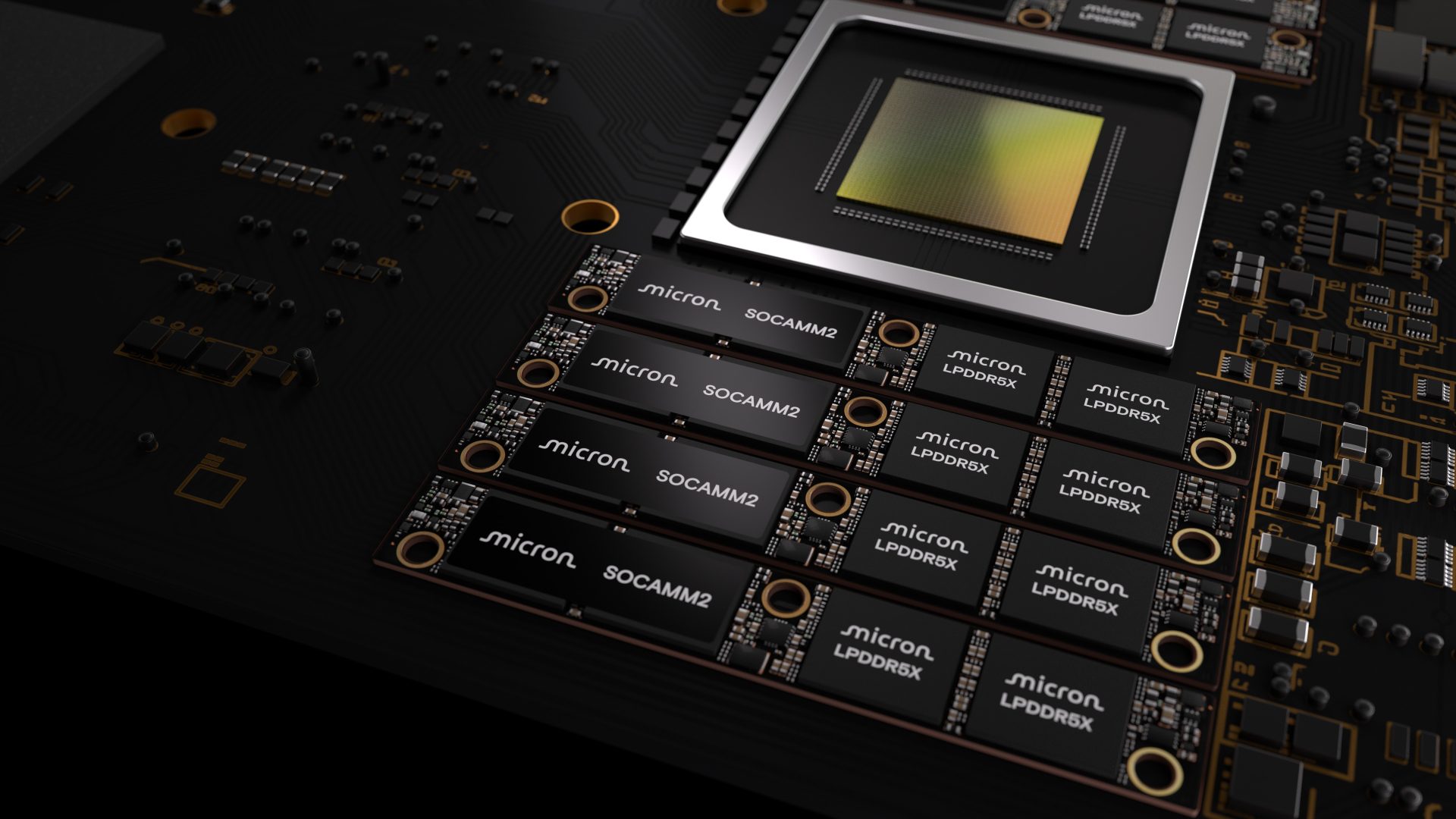
Micron is pushing AI memory forward with the debut of SOCAMM2, a new generation of memory modules designed to deliver higher capacity and better power efficiency for modern AI infrastructure. As AI models and “applications-layer” workloads continue to scale, memory limits are increasingly becoming the performance choke point—especially in tasks that rely on fast access to large context windows and low-latency data retrieval.
The big headline is capacity. Micron says SOCAMM2 raises per-module capacity to 256GB, a major step up from the previous 192GB level. That increase is aimed directly at reducing memory pressure in AI servers, where growing model sizes and longer context lengths can quickly overwhelm conventional configurations.
A key part of this upgrade is a higher-density LPDRAM monolithic die. With SOCAMM2, Micron has expanded a single die’s capacity to 32GB. In practical server terms, the 256GB SOCAMM2 configuration can provide up to 2TB of LPDRAM for an 8-channel CPU platform. That kind of memory footprint is especially valuable for long-context inference, where the system must keep more data close at hand rather than stalling while pulling information from slower tiers.
Micron is also positioning SOCAMM2 as a latency reducer for KV-cache-heavy workloads. KV-cache (key-value cache) is central to transformer-based inference, and when it becomes a bottleneck, response times and throughput can suffer. By increasing capacity and improving efficiency, SOCAMM2 is intended to keep these workloads moving with fewer slowdowns, helping AI systems sustain long sequences and more complex, multi-step interactions.
The company claims SOCAMM2 improves “time to first token” (TTFT) by 2.3x for long-context inference. TTFT is an important user-facing metric in many AI applications because it affects how quickly a system begins responding. Faster TTFT can be especially helpful for agentic workloads, where CPU-focused processes may run more independently and need quick, consistent access to memory to avoid latency spikes.
SOCAMM2 was developed in cooperation with NVIDIA and is expected to appear in upcoming AI infrastructure platforms. At the same time, expanding production of specialized AI memory products can have broader ripple effects across the DRAM supply chain. As more capacity is directed toward AI-tailored modules, it may tighten availability for general-purpose memory categories used elsewhere in the industry.
Micron says it has already shipped samples of its 256GB SOCAMM2 modules to customers, and the company plans to showcase the solution at GTC 2026.