LPDDR6 Set to Power the Next Wave of AI Datacenters as Memory Demand Surges
LPDDR6 is emerging as one of the most important memory technologies for the future of AI datacenters, especially as Agentic AI workloads place growing pressure on infrastructure. As artificial intelligence systems become more advanced, they require larger memory pools, better energy efficiency, and faster access to data. This is pushing the industry toward next-generation LPDDR memory as a key solution for AI training and inference.
Agentic AI is changing how datacenters are built. Unlike traditional AI workloads, Agentic AI systems can plan, reason, make decisions, and complete complex tasks with less human input. These workloads demand massive memory capacity and highly efficient data movement. As a result, memory is no longer just a supporting component. It is becoming a central part of AI server design.
LPDDR memory has gained strong attention in datacenter environments because it offers an attractive combination of high capacity and lower power consumption. While LPDDR has traditionally been associated with mobile devices, its efficiency advantages are now making it increasingly valuable for AI servers, where power usage and thermal management are critical concerns.
The next major step is LPDDR6. Major memory manufacturers, including Samsung, SK Hynix, and Micron, are expected to commercialize LPDDR6 around the 2028 to 2029 timeframe. However, the rapid rise of Agentic AI may accelerate adoption, as datacenter operators look for ways to increase memory density while keeping energy consumption under control.
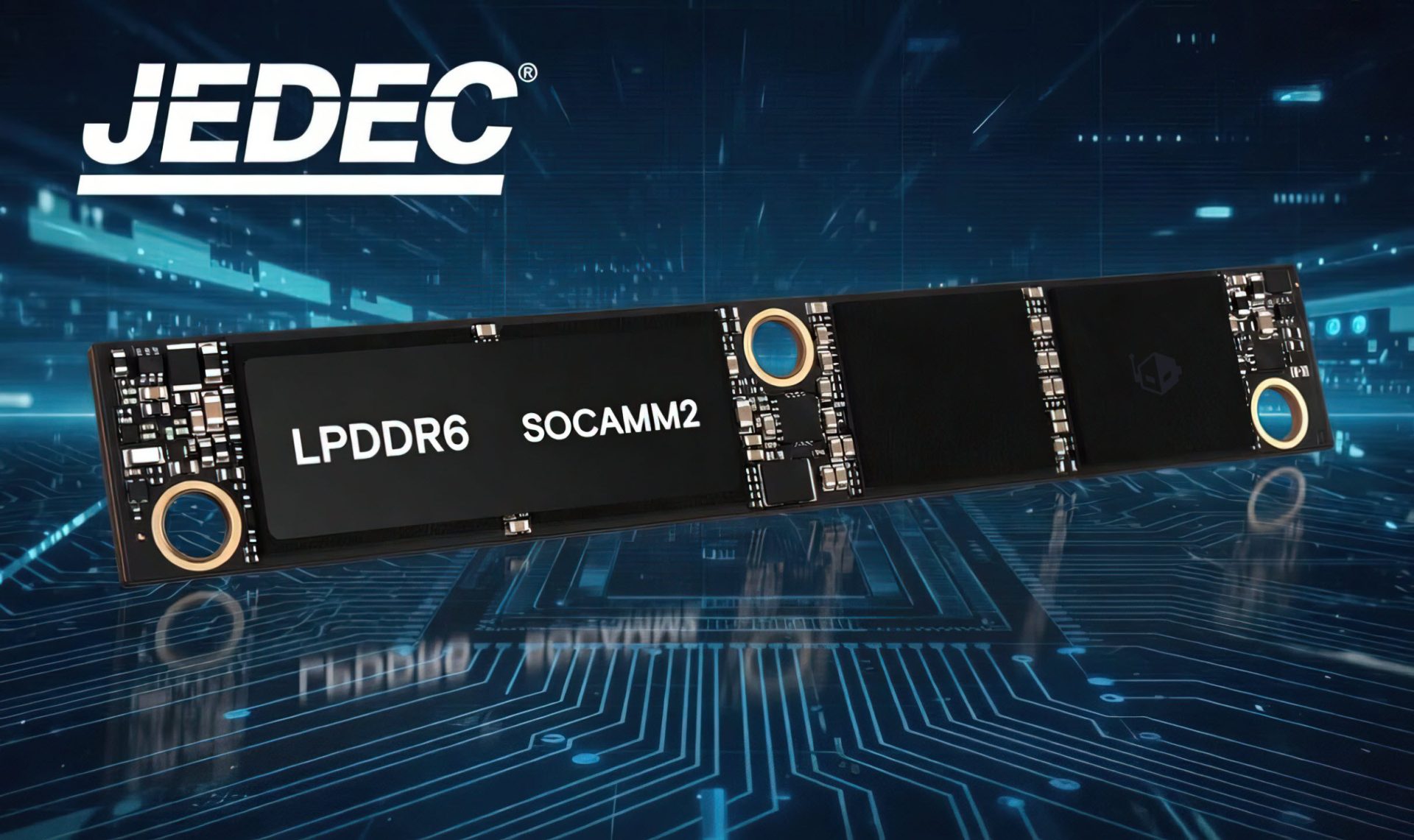
JEDEC has already previewed early details for the LPDDR6 standard, including support for capacities of up to 512GB and compatibility with SOCAMM2 modules. This is an important development for future AI servers, as SOCAMM2 is becoming a preferred memory module format for high-performance, power-efficient datacenter systems.
One of the biggest advantages of LPDDR6 will be its higher memory density. The standard is expected to introduce a narrower x6 per-die interface, allowing memory makers to increase capacity per chip. While bandwidth improvements may be more moderate, estimated at around 10% to 20% over current-generation LPDDR memory, the real breakthrough is expected to come from higher capacity.
For AI datacenters, capacity is often more important than raw bandwidth alone. Large AI models require enormous amounts of memory to handle training, inference, data retrieval, and real-time decision-making. With LPDDR6 targeting up to 512GB density, it could double the current 256GB capacity available with LPDDR5X SOCAMM2 modules.
This higher density will be especially valuable for AI inference servers, where large models must respond quickly and efficiently while serving many users at once. More memory per module can help reduce bottlenecks, improve server efficiency, and allow datacenters to support more advanced AI applications without dramatically increasing power usage.
NVIDIA has already moved toward LPDDR5X SOCAMM2 memory for its Vera CPUs, while AMD has announced LPDDR5X support for its inference-focused Verano CPUs. These moves show that the broader AI hardware ecosystem is already embracing LPDDR-based memory designs. LPDDR6 is expected to build on this momentum and become a major memory standard for next-generation AI platforms.
Power efficiency is another major reason LPDDR6 is attracting attention. AI datacenters are consuming more electricity than ever, and operators are under pressure to improve performance per watt. LPDDR memory standards are known for strong power characteristics, making them well suited for environments where energy efficiency directly impacts operating costs.
In addition to higher capacity and improved efficiency, LPDDR6 is also expected to support new capabilities such as Processing-in-Memory, often referred to as PIM. This technology allows certain calculations to be performed directly within the memory itself instead of constantly moving data back and forth between memory and the processor.
Processing-in-Memory could become a valuable feature for AI workloads because data movement is one of the biggest sources of latency and energy consumption in modern computing. By allowing memory to handle some processing tasks, LPDDR6-PIM could reduce pressure on CPUs and accelerators while improving overall system efficiency.
This approach is especially relevant for AI inference, where speed, power efficiency, and memory access all play a major role. If memory can perform certain operations closer to where data is stored, AI systems may become faster and more efficient, particularly in large-scale datacenter deployments.
The shift toward LPDDR6 also reflects a broader transformation in server architecture. As AI workloads grow more complex, datacenters are moving away from traditional designs and toward systems optimized for memory capacity, energy efficiency, and parallel processing. Memory standards like LPDDR6 will play a crucial role in enabling this transition.
Although LPDDR6 may not deliver a massive bandwidth leap compared to LPDDR5X, its higher density, improved efficiency, and advanced architecture could make it one of the most important technologies for future AI infrastructure. In many AI workloads, the ability to store and access larger datasets efficiently can be more valuable than a simple speed increase.
The growing demand for Agentic AI is likely to push memory makers and server manufacturers to accelerate LPDDR6 development. As AI companies deploy more advanced models, the need for 512GB memory modules and power-efficient server platforms will continue to rise.
LPDDR6 is shaping up to be a foundational technology for the next generation of AI datacenters. With support for higher capacities, SOCAMM2 modules, better energy efficiency, and potential Processing-in-Memory features, it is positioned to meet the growing demands of AI training and inference.
As NVIDIA, AMD, and major memory manufacturers continue investing in the LPDDR ecosystem, LPDDR6 could become a dominant memory standard for future AI servers. The race to build faster, smarter, and more efficient AI infrastructure is accelerating, and LPDDR6 appears ready to play a central role in that evolution.