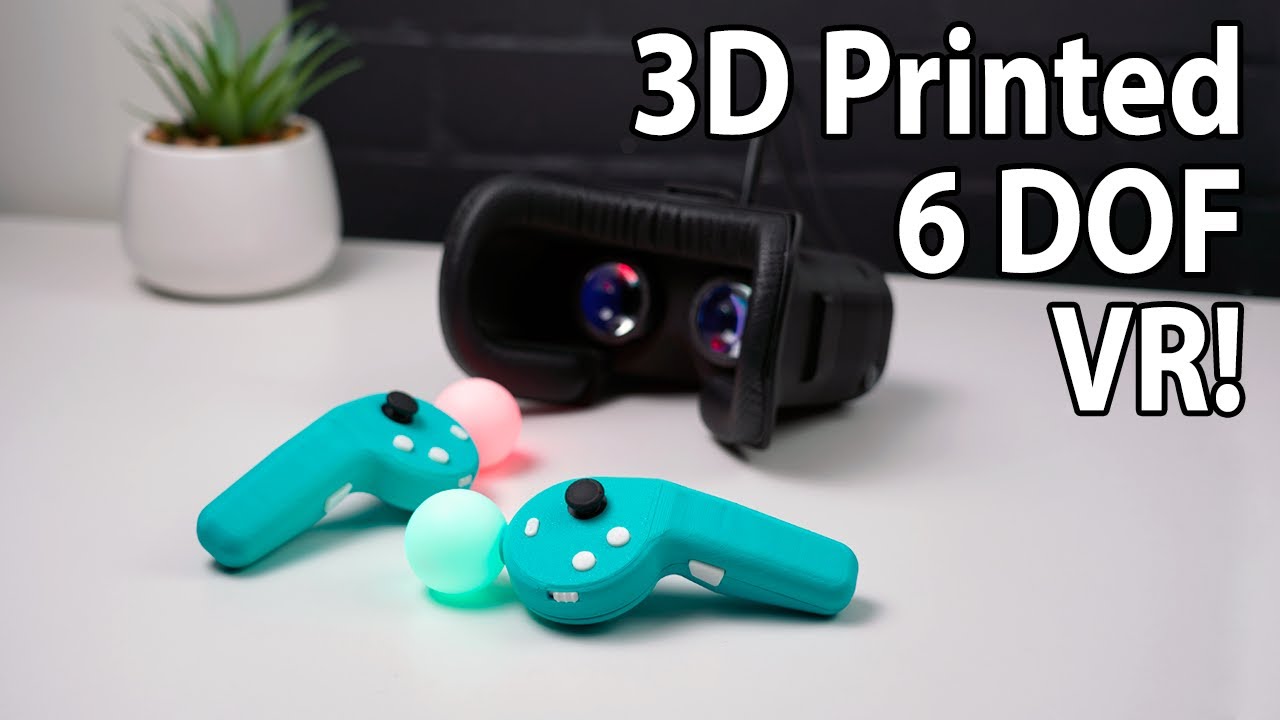
DIY creator CNC Dan has taken his homemade VR headset from a basic 3DoF prototype to a far more capable 6DoF setup, complete with wireless controllers and outside-in tracking—an impressive leap for a project built from scratch.
If you missed the first iteration, it was designed mainly for sim racing and relied on three degrees of freedom: rotation for looking up/down, left/right, and head tilt. That worked for seated experiences, but many enthusiasts pointed out the absence of positional tracking as a dealbreaker. Six degrees of freedom adds forward/back, left/right, and up/down movement—crucial for full immersion, even in racing sims where leaning and head movement can enhance realism.
Responding to the feedback, Dan upgraded the system with camera-based outside-in tracking and untethered controllers. Rather than reinvent the wheel, he leveraged HadesVR, an open-source project that provides a framework for building DIY tracking. The result is a working 6DoF VR rig that can even handle a rhythm game like Beat Saber.
There are still rough edges, as you’d expect from a one-person build. Using just a single camera limits positional accuracy, and both the headset and controllers can drift over time because they rely on IMUs. That said, the performance is surprisingly good for a DIY setup, and it clearly shows what’s possible with clever engineering and open-source tools.
What’s new
– True 6DoF tracking via an outside-in camera system
– Wireless motion controllers
– Open-source foundation powered by HadesVR
– Demonstrated gameplay in titles like Beat Saber
What still needs work
– Single-camera tracking can struggle with precise positional data
– IMU-dependent tracking introduces gradual drift
– Calibration and multi-camera support could improve stability
As with the original build, the upgraded version will be fully open source. The files and documentation are planned for release, with updates expected to be shared through Dan’s channel. For makers, modders, and VR enthusiasts, this project is a standout example of how far a homebrew headset can go—offering a compelling, low-cost path to six degrees of freedom without relying on commercial ecosystems.
If you’re exploring DIY VR, keep an eye on this project. Adding multiple cameras, refining the IMU fusion, and improving controller calibration could push it even closer to commercial-grade tracking, while keeping the spirit of open-source innovation front and center.