Most of the gaming headsets I keep within arm’s reach are wireless. It’s hard to give up the freedom to roam around an office, take a call, or step away from the desk without yanking a cable. So for a wired model to earn a permanent spot in the rotation, it has to offer something genuinely compelling beyond “it sounds fine for the price.”
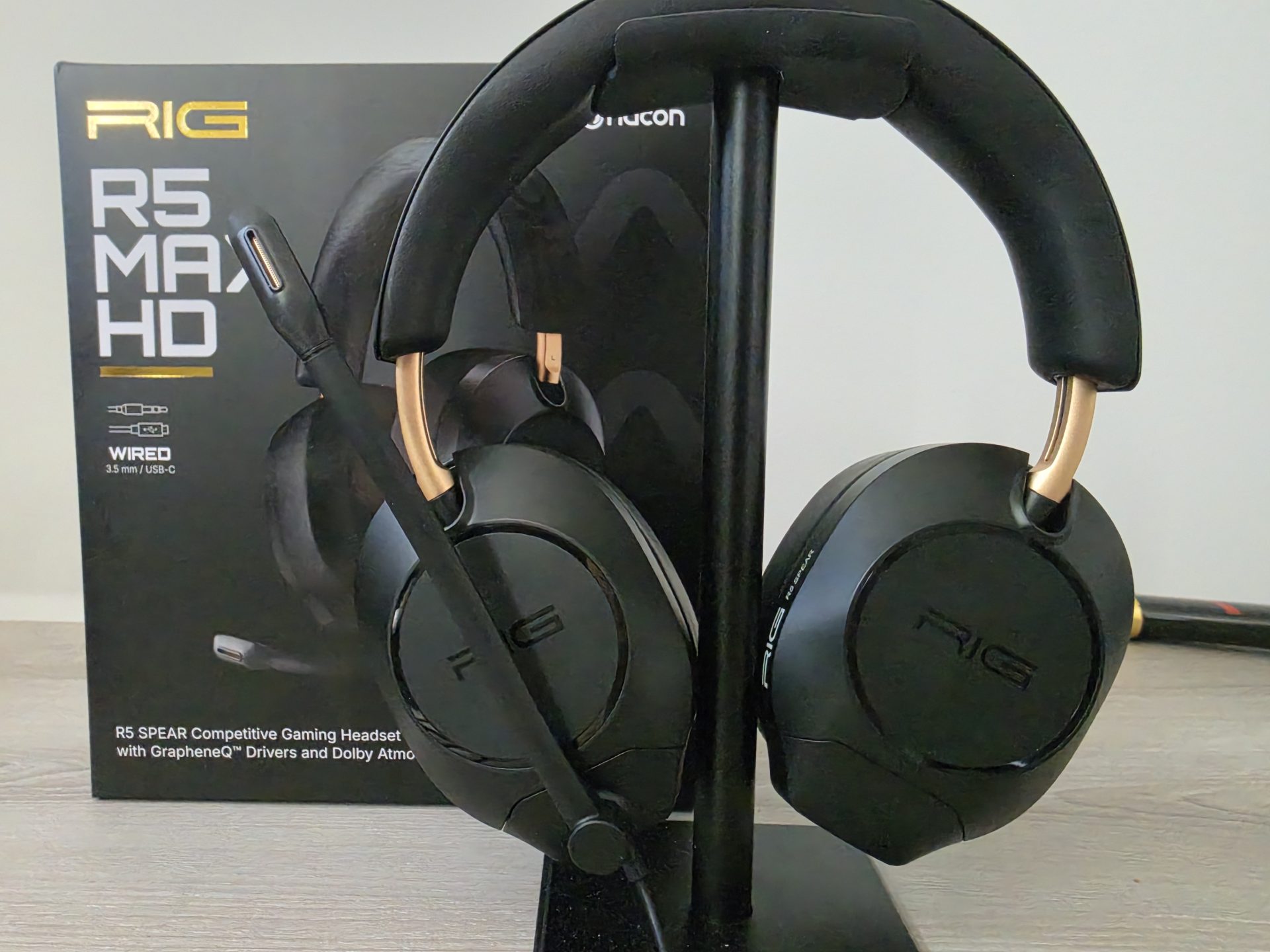
That’s where Nacon’s RIG R5 MAX HD makes its case. It takes the familiar foundation of the company’s budget-friendly RIG R5 platform and turns it into a more serious, high-fidelity wired headset package by pairing a refreshed modular design with an external USB-C DAC. The result is a setup that feels approachable for everyday players, but also surprisingly tuned for people who care about clarity, positional audio, and the kind of detail that can actually help in competitive games.
RIG as a name has been around for years, and under Nacon it has become strongly associated with gaming headsets that balance price, durability, and performance. The RIG line has served everyone from casual players buying their first headset to esports-minded users who put gear through constant wear. The R5 MAX HD is positioned as a step up from an entry-level headset, not by reinventing everything, but by improving the parts that matter most for sound quality and long-term usability.
At the heart of the RIG R5 MAX HD are the same 40mm GrapheneQ drivers (from ORA) found in the R5 series. Nacon promotes these as being made with more than 95% pure graphene, aiming for richer audio with lower distortion than typical drivers that can smear detail when a mix gets busy. In practice, the headset’s biggest strength is the way it handles layered sound. Music retains separation between lows, mids, and highs, and in games you get the kind of clarity that makes it easier to pick out critical audio cues.
Bass is present, controlled, and clean rather than exaggerated. You won’t get the room-shaking “explosions in your skull” effect some headsets chase, but you do get a low end that supports the rest of the mix instead of flattening it. When you add Dolby Atmos for Headphones on a Windows PC, spatial cues become easier to follow, especially in shooters where distance and direction are everything. That “shot from far away” effect in games like Call of Duty: Warzone still reads naturally, and positional audio holds up even when voice chat and background noise start competing for attention.
The real differentiator is the included external DAC (digital-to-analog converter). This compact USB-C device is designed to help the R5 MAX HD deliver its best sound across platforms that benefit from a stronger, cleaner wired signal. Inside, there’s an amp rated at 30mW at 32 ohms, with support up to 32-bit/384kHz. It also includes an AUX input for mixing in a second audio source, plus an 18W power passthrough that can keep a connected mobile device charged during long sessions. Importantly, the USB power is isolated enough that it doesn’t noticeably drag down audio fidelity in normal use.
For anyone looking for a wired gaming headset for PC, or a USB-C audio solution for mobile devices that no longer include a 3.5mm jack, this DAC is a key part of the value. Without it, the headset is much closer to what you’d expect from a basic RIG R5-style experience: still decent, but not nearly as open or as cohesive in how it blends complex tracks. With it, the sound becomes warmer and more “complete,” with fewer sharp edges in the highs and better overall balance.
Nacon also leans heavily into modularity, and it’s one of the most interesting parts of the R5 MAX HD. The headset uses a Snap+Lock system across most components (everything except the headband), enabling quick swaps for ear cushions, exterior plates, and cables. Nacon even provides 3D-printable files for users who want to create their own earcup plates. It’s a smart move for customization and also for extending the headset’s life, since parts that typically wear out first can be replaced more easily than on many competing designs.
That said, accessory options are still limited. Color and plate designs are available in a small range, and replacement ear cushion choices are minimal. In longer-term use, the fabric stitching on the included ear cushions can show wear, especially if you wear glasses and the frames rub the material. It’s not catastrophic, but it does highlight an opportunity for upgrades like glasses-friendly or cooling gel cushion options, which many gamers actively look for in 2026.
Cable modularity is handled well. Two cables are included: a 1.5-meter cable with a microphone attachment and a 2-meter cable for running the headset without a mic. You can also choose whether the cable plugs into the left or right earcup, which is a small quality-of-life feature that makes a big difference depending on your desk layout. There’s no obvious audio penalty for choosing one side over the other.
The microphone, however, is clearly not the star. It’s usable, and it’s good that it’s included, but performance is average. It’s unidirectional with a claimed 50 Hz to 15 kHz frequency response, yet in real use it can come through quiet even at higher levels, and it may sound tinny in calls. If you already have (or plan to use) a standalone microphone, the simpler, better-sounding approach is to use the longer cable and skip the attached mic altogether.
To get the best out of the RIG R5 MAX HD, USB-C audio support is the way to go, and Windows users get the most benefit thanks to Dolby Atmos for Headphones. It can also be a strong fit for modern smartphones and USB-C devices, especially now that so many phones have ditched the 3.5mm jack.
Overall, the Nacon RIG R5 MAX HD succeeds because it upgrades a modest headset concept into a more premium-feeling wired audio package. The GrapheneQ drivers deliver clean detail, the external USB-C DAC noticeably improves the sound experience, and the Snap+Lock modular design makes the headset more flexible than most options in its class. It’s not perfect, especially if you care deeply about microphone quality or want more official replacement parts and cushion choices, but as a wired gaming headset aimed at high-fidelity play, it offers a compelling reason to reach for a cable again.