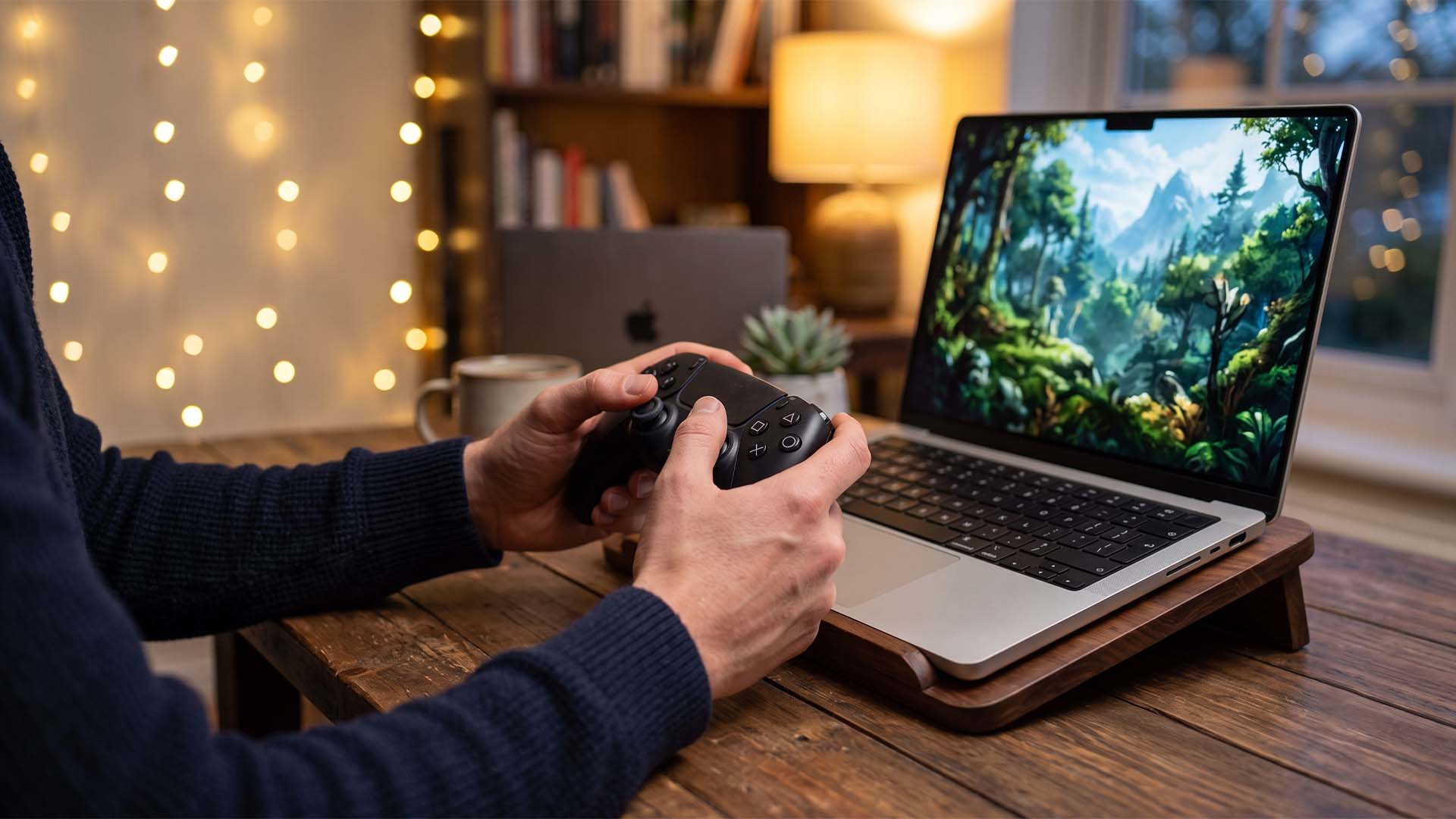
Apple’s macOS Tahoe is bringing native support for MetalFX Frame Interpolation, a feature that could make games feel smoother by generating extra frames between rendered ones. However, broad support across both older Mac games and newer releases is still limited. Until game developers adopt Apple’s technology more widely, Mac users looking for frame generation have few options.
That gap has led one independent developer to create Adrenaline, a frame generation app designed specifically for Mac. The tool aims to boost perceived frame rates without requiring game developers to add support manually. It is an interesting step for Apple Silicon gaming, but in its current form, the experience appears to be more experimental than polished.
Adrenaline’s biggest advantage is that it does not require modifying game files or changing game binaries. That matters because it avoids many of the problems associated with anti-cheat systems and direct game integration. Instead, the app works through Apple’s external screen capture technology, ScreenCaptureKit, allowing it to process what is already being displayed on the screen.
The developer has also made Adrenaline free on the App Store until August 31. Users who claim it during that window will keep it for free, rather than being pushed into a subscription later. That makes it easy for curious Mac gamers to test the app without paying upfront.
Adrenaline can also be used with Windows games running on Mac through compatibility tools such as CrossOver. In theory, this makes it useful for players who want smoother performance in games that were never officially designed for macOS. However, Mac users already have access to other frame generation utilities, so Adrenaline will need strong updates to stand out.
Under the hood, Adrenaline uses RIFE, short for Real-Time Intermediate Flow Estimation. RIFE is an open-source AI-based model designed to create intermediate frames. For use on Apple Silicon Macs, the developer converted the model to Apple’s Core ML format, allowing it to run within Apple’s machine learning framework.
In testing with Valheim on an M3 MacBook Air, the app can make gameplay appear to jump from 30 frames per second to 60 frames per second. On paper, that sounds like a major improvement. In practice, though, frame generation depends heavily on the quality of the base frame rate. Starting at 30FPS is often too low for a truly responsive gaming experience, because the generated 60FPS output can still feel delayed due to input lag.
That is one of the biggest limitations of frame generation in games. It can make motion look smoother, but it cannot replace the responsiveness of a genuinely higher native frame rate. If the original game is running too slowly, generated frames may improve visual fluidity while still making controls feel sluggish.
Another concern is image quality. Adrenaline currently relies on AMD’s older FSR 1 upscaling method, which has received criticism for producing visual artifacts, ghosting, and a softer overall image. While the technology can help boost performance, it is not known for delivering the cleanest visuals compared with more modern upscaling and frame generation solutions.
The developer explained that newer temporal upscalers require access to motion vectors and depth data from the game engine. Since Adrenaline works through external screen capture, it cannot access that kind of internal game information. That limitation helps explain why a simpler solution like FSR 1 was used, even if the image quality trade-off is noticeable.
There is also the issue of performance overhead. Adrenaline combines real-time screen capture, upscaling, and a Core ML-based frame interpolation model. That is a lot of processing for a thin and fanless machine like the M3 MacBook Air. Without active cooling, the laptop can quickly run into thermal limits, especially during longer gaming sessions.
RIFE was originally developed more for video and film processing than fast-paced gaming. That distinction matters. Movies and videos do not require instant input response, but games do. A frame interpolation system that looks good for video playback may not always feel right when applied to interactive gameplay.
For Apple Silicon gaming, Adrenaline is still an intriguing project. It shows that frame generation on Mac can be explored outside of native game support, and it gives players a way to experiment before MetalFX Frame Interpolation becomes more common. However, users should manage expectations. This is not yet a perfect plug-and-play solution for turning low frame rates into a flawless high-refresh gaming experience.
The best-case scenario is that Adrenaline continues to improve with future updates. If the developer can reduce artifacts, improve latency, optimize performance, and find better alternatives within the limits of screen capture, the app could become a useful tool for Mac gamers. For now, it is a promising but rough early attempt at bringing broader frame generation support to macOS.
Apple’s own MetalFX Frame Interpolation will likely remain the better long-term solution when developers integrate it directly into games. Native support can access the data needed for cleaner image reconstruction and better frame pacing. Still, Adrenaline gives Mac users something to experiment with today, especially while it remains free to claim.