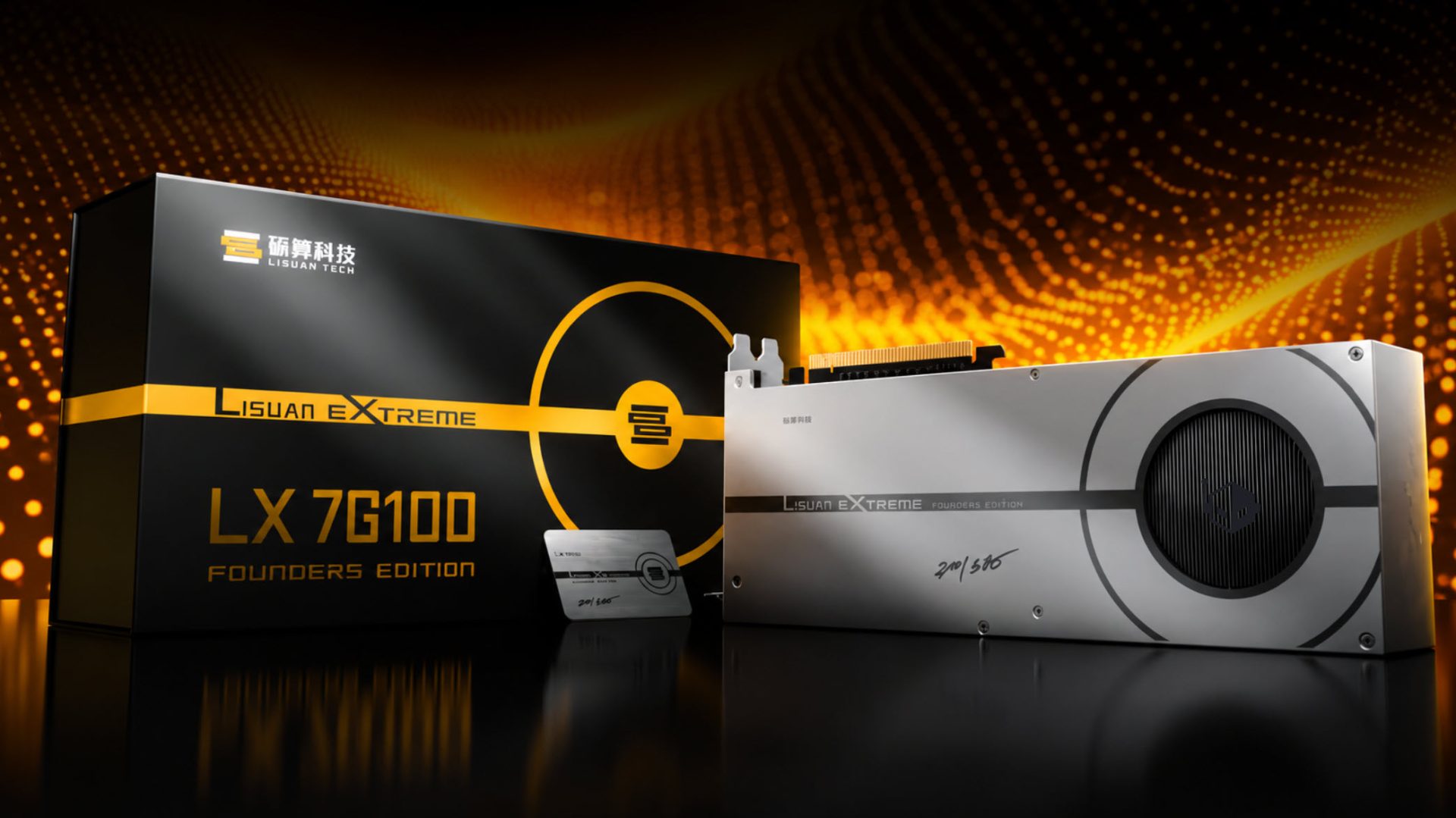
Lisuan 7G100 Extreme Founders Edition Launches in China, but Early Gaming Benchmarks Disappoint
Lisuan Tech has officially released its new 7G100 Extreme Founders Edition graphics card for the Chinese market, positioning it as a domestic gaming GPU with modern API support, 12 GB of VRAM, and a price of around 3,299 RMB, or roughly $500. On paper, the card looked like an important step forward for China’s homegrown graphics hardware scene. In real-world gaming tests, however, the results appear far less impressive.
The Lisuan Extreme LX 7G100 is based on the company’s 6nm 7G106 GPU and is designed as its first serious consumer gaming graphics card. Earlier in the year, Lisuan introduced a broader 7G106-based lineup, including models aimed at professional, AI, and workstation workloads. The LX 7G100 is the gaming-focused version, created to support modern PC games, current graphics APIs, and popular game engines.
In terms of hardware, the card features 12 GB of GDDR6 memory on a 192-bit memory bus, PCIe 4.0 x16 support, 192 texture mapping units, and 96 ROPs. It carries a maximum board power rating of 225W and uses a single 12-pin power connector. The cooler uses a dual-slot triple-fan design, with two fans partially covered by the top grille. For display output, the card includes four DisplayPort 1.4a connectors.
Media support is also part of the package. The Lisuan 7G100 supports up to 8K 60Hz HDR output with FreeSync, AV1 4K 30 FPS encoding, HEVC 8K 30 FPS encoding, and AV1/HEVC 8K 60 FPS decoding. API support includes DirectX 12, Vulkan 1.3, OpenGL 4.6, and OpenCL 3.0. The GPU has also received Microsoft WHQL certification, which is a notable achievement for a domestic Chinese graphics product.
Before launch, expectations around the 7G100 were relatively high. Previous demonstrations suggested that the card could perform close to an NVIDIA GeForce RTX 4060 in some synthetic workloads, including OpenCL and 3DMark-style benchmark tests. Lisuan also promoted support for major games such as Cyberpunk 2077, Baldur’s Gate III, Elden Ring, Black Myth: Wukong, The Witcher 3, Monster Hunter Rise, Resident Evil 4, and Sekiro.
Unfortunately, launch testing paints a much different picture. In 3DMark, the Lisuan LX 7G100 appears to perform around or below the level of the GeForce RTX 3060, a GPU that first arrived several years ago. Synthetic benchmarks are only one part of the story, but real gaming results were even more concerning.
At 1080p, the Lisuan 7G100 struggled against older mainstream graphics cards from NVIDIA and AMD. In Cyberpunk 2077 using medium settings with FSR 3 Quality and frame generation, the card averaged around 88 FPS, while competing GPUs such as the RTX 4060, Arc B580, and RX 6600 XT were far ahead. The RX 6600 XT, despite being an older card, reportedly delivered more than double the performance in the same test.
The same trend appeared across several popular games. In Black Myth: Wukong at 1080p, the Lisuan card averaged around 56 FPS, while the RTX 4060 managed around 115 FPS. In Forza Horizon 5 at 1080p low settings, the 7G100 averaged just 48 FPS, compared to more than 200 FPS on competing mainstream GPUs. Shadow of the Tomb Raider showed the Lisuan card averaging 71 FPS, while the RTX 4060 and Arc B580 pushed well beyond 170 FPS.
Other games showed similar gaps. In Assassin’s Creed Shadows, the 7G100 averaged around 37 FPS at 1080p medium with FSR Balanced and frame generation, while the RTX 4060 reached about 135 FPS. In Red Dead Redemption 2, the Lisuan GPU averaged 51 FPS, compared to roughly 181 FPS on the RTX 4060 and 172 FPS on the RX 6600 XT. Counter-Strike 2 also exposed a major performance difference, with the LX 7G100 averaging about 130 FPS while the RTX 4060 exceeded 500 FPS.
The good news is that game compatibility appears to be better than many previous domestic GPU efforts. Reports indicate that the tested games launched and ran without major crashes or severe driver failures. That is an important step for a new gaming GPU platform. However, raw performance, frame pacing, and smoothness remain major issues. Stuttering was observed in several titles, and the card does not include hardware ray tracing support.
Driver updates could improve the situation over time, especially when it comes to frame pacing, shader compilation, and game-specific optimization. New GPU architectures often need months or years of driver work before they reach their full potential. Even so, the current launch performance makes it difficult for the Lisuan 7G100 to compete with established gaming graphics cards.
Pricing is another challenge. The Lisuan 7G100 Extreme Founders Edition is listed at 3,299 RMB, which converts to around $500. A limited launch run of 1,000 units is planned, with a pre-order price of 2,969 RMB mentioned for early buyers. Shipments are expected to begin on May 22.
At that price, the card enters a very competitive segment. While the 12 GB of GDDR6 memory is a positive point, similarly priced options can offer much stronger gaming performance, better ray tracing support, more mature drivers, and wider game optimization. Even lower-priced 12 GB GPUs may offer better value depending on availability and regional pricing.
Still, the Lisuan 7G100 should not be dismissed entirely. It represents a meaningful step forward for China’s domestic GPU industry. Earlier local graphics solutions often lacked strong game support, reliable drivers, or modern feature sets. The fact that the LX 7G100 can run modern AAA games, supports current APIs, and ships with WHQL certification shows that progress is being made.
The bigger question is whether that progress is enough for gamers today. Based on early benchmarks, the answer is likely no for buyers who care primarily about performance per dollar. The Lisuan 7G100 Extreme Founders Edition is interesting as a domestic technology milestone, but as a gaming graphics card at around $500, it falls short of the competition.
For Chinese gamers looking for a homegrown GPU, the 7G100 may still attract attention, especially as China continues to push domestic hardware development. But for broader gaming value, Lisuan will need stronger drivers, better optimization, improved frame pacing, and significantly higher performance in future products if it wants to challenge NVIDIA, AMD, or Intel in the mainstream gaming graphics card market.


