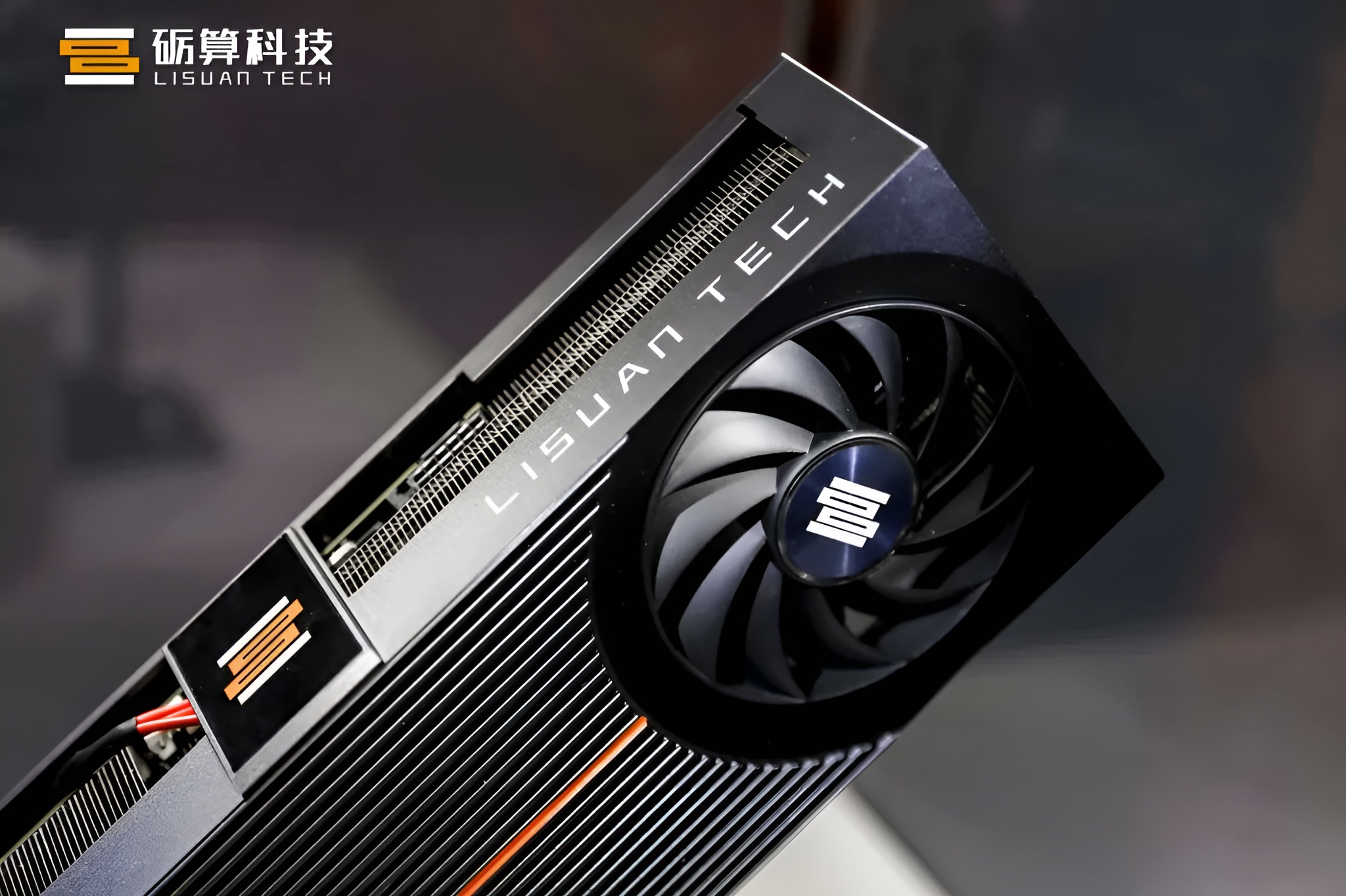
Lisuan’s G100 GPU lineup, billed as a serious homegrown challenger to NVIDIA and AMD, has reportedly begun shipping to customers in China. That’s a meaningful milestone for anyone watching China’s push to build a competitive discrete graphics card ecosystem, and it also suggests that broader retail availability could be getting closer.
Early shipments appear to be focused on professional deployments rather than mainstream gaming. The first batch is said to be headed to “digital twin” customers, a category that typically involves simulation, industrial visualization, and large-scale 3D environments used in engineering and enterprise settings. In other words, Lisuan seems to be prioritizing commercial workloads first, likely to validate stability, drivers, and real-world performance before attempting a larger consumer rollout.
Even so, the G100 family hasn’t been positioned purely as an enterprise product. Lisuan has shown the platform in a gaming context before, which keeps the door open for consumer-focused models to follow. With mass production reportedly underway as of September 2025, expectations are building that these GPUs could start appearing more widely in China’s domestic market around Q1 2026—though a firm retail date remains unclear.
One of the most discussed models tied to this effort is Lisuan’s 7G106, a 6nm discrete GPU that has drawn attention for aiming at the same general performance territory as popular midrange graphics cards. On paper, the 7G106 includes 12GB of GDDR6 memory on a 192-bit bus, PCIe 4.0 x16 connectivity, and a configuration listed at 192 TMUs and 96 ROPs. Power is described at up to 225W, supplied via a single 8-pin connector. The chip is said to be built on TSMC’s N6 process, a key factor behind the performance expectations, at least based on early impressions.
Lisuan is also emphasizing a deeper internal software and hardware stack, including a self-developed GPU architecture and an in-house upscaling technology referred to as NRSS. For a new discrete GPU brand trying to win mindshare, that full-stack approach matters: in modern gaming and professional graphics, performance isn’t only about raw hardware specs—driver maturity, upscaling quality, and platform-level optimization often decide whether a GPU is truly competitive.
Another interesting angle is platform compatibility. The G100 series is being discussed as potentially among the first discrete GPU platforms to support Windows on ARM in a meaningful way, allowing ARM-based systems to pair with a dedicated GPU for higher-end graphics performance. That’s notable because Windows on ARM is becoming a more serious focus across the industry, and ARM CPU adoption is particularly relevant in China. If Lisuan can deliver reliable Windows on ARM support with strong drivers, it could become a real differentiator and help the G100 platform stand out beyond pure benchmark comparisons.
For gamers in China, the biggest question is whether Lisuan can translate promising specs and early benchmark chatter into a stable, widely available retail product with solid game compatibility. If the company can follow professional shipments with consumer-ready cards—and back them with consistent drivers and software updates—the 7G106 and the wider G100 family could become some of the most compelling locally available alternatives in the midrange GPU market.


