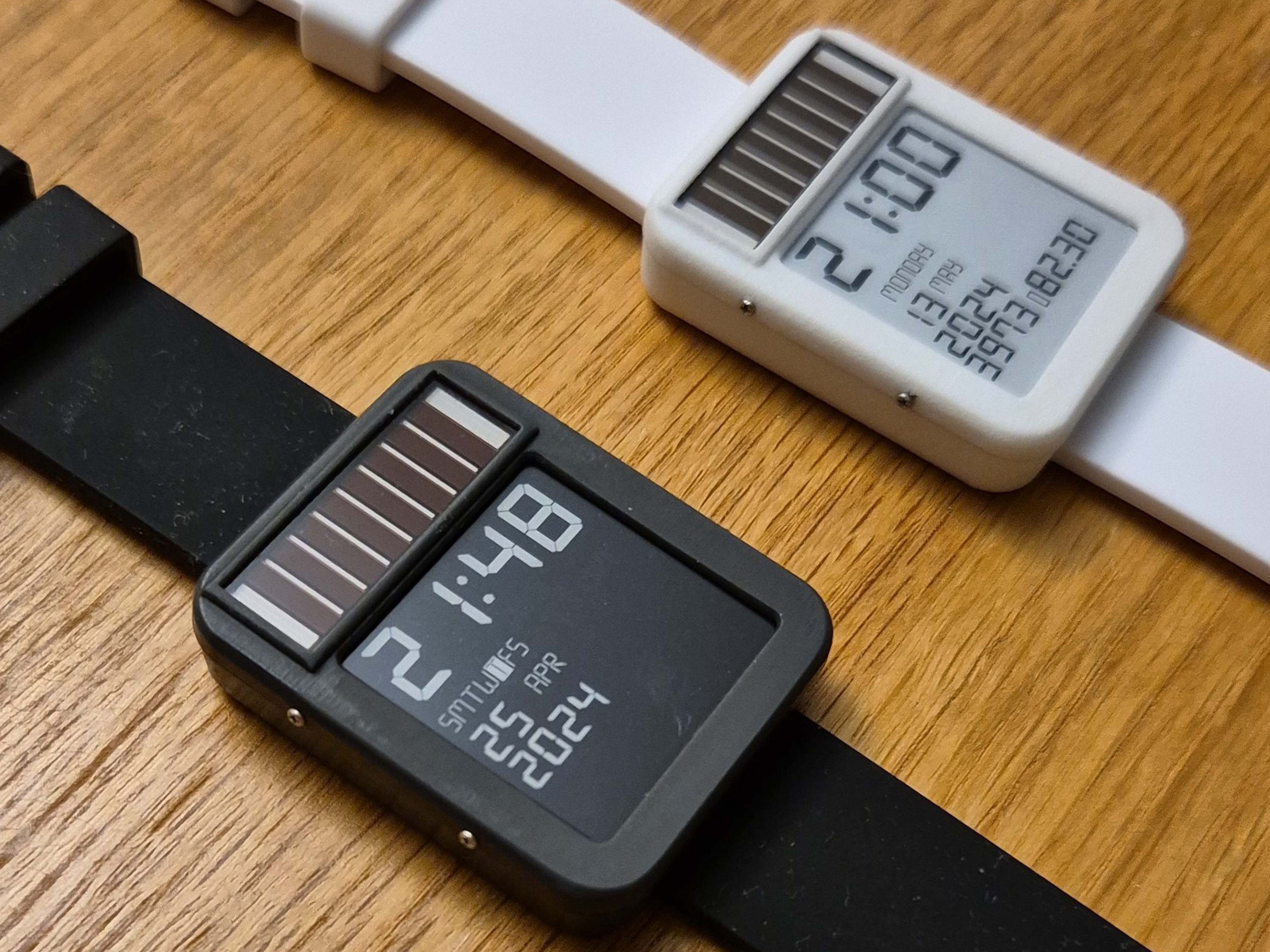
LightInk DIY Solar Smartwatch Promises Up to 10 Months of Battery Life
A new DIY smartwatch project called LightInk is gaining attention for a simple but ambitious idea: a wristwatch that can run for months without needing a traditional recharge. Instead of relying only on a charging cable, LightInk uses a visible solar panel, an E Ink display, and ultra-low-power hardware to deliver battery life that could reach up to 10 months.
Solar-powered smartwatches are still a small part of the wearable market, but LightInk takes a very different route from mainstream models. Many premium outdoor watches hide their solar charging layer within the display. LightInk does the opposite by placing a clearly visible solar panel separate from the screen, making solar charging a central part of the design.
The result is a smartwatch that looks more experimental and practical than polished, but that is exactly the point. LightInk is not a mass-market wearable you can buy from a store. It comes from the DIY hardware community, meaning anyone interested in owning one will need to build it themselves.
To assemble the LightInk, users typically need to order a custom circuit board, access a 3D printer for the case, and handle some soldering. A detailed build guide is available for makers who are comfortable with electronics projects, but this is not a plug-and-play smartwatch for casual buyers.
The biggest appeal is battery life. LightInk is designed to last for several months on a tiny 100mAh battery, with the creator estimating up to 10 months of use depending on conditions. The built-in solar panel can help extend runtime even further when exposed to light.
To achieve that kind of efficiency, the watch avoids certain power-hungry components. For example, there is no accelerometer, since constant motion tracking would drain energy too quickly. That means LightInk is not intended to compete with fitness-focused smartwatches that track steps, workouts, sleep, and activity all day.
Instead, LightInk focuses on features that fit its low-power mission. It uses an E Ink display, which is highly readable in bright sunlight and consumes very little power when showing static information. For darker environments, the display also includes a backlight.
The watch also includes LoRa support, giving it long-range, low-power communication capabilities that are unusual in typical consumer smartwatches. GPS is included as well, making the device more capable than a basic digital watch. A speaker is also part of the hardware package.
However, LightInk still sits somewhere between a traditional wristwatch and a full smartwatch. One major limitation is that there is currently no companion app, so users should not expect the kind of polished phone integration found on commercial wearables. Notifications, fitness dashboards, app syncing, and advanced health tracking are not the main focus here.
LightInk is better described as an experimental solar-powered E Ink smartwatch for makers, outdoor enthusiasts, and low-power technology fans. Its strengths are long battery life, sunlight readability, GPS, LoRa connectivity, and open DIY construction. Its weaknesses are the need for self-assembly, limited convenience features, and the absence of a consumer-ready ecosystem.
Still, the project is an interesting look at what smartwatches can become when battery life takes priority over constant tracking and app-heavy features. While most modern wearables still need charging every few days or weeks, LightInk shows that a different kind of smartwatch is possible: one designed to stay on your wrist for months with help from the sun.