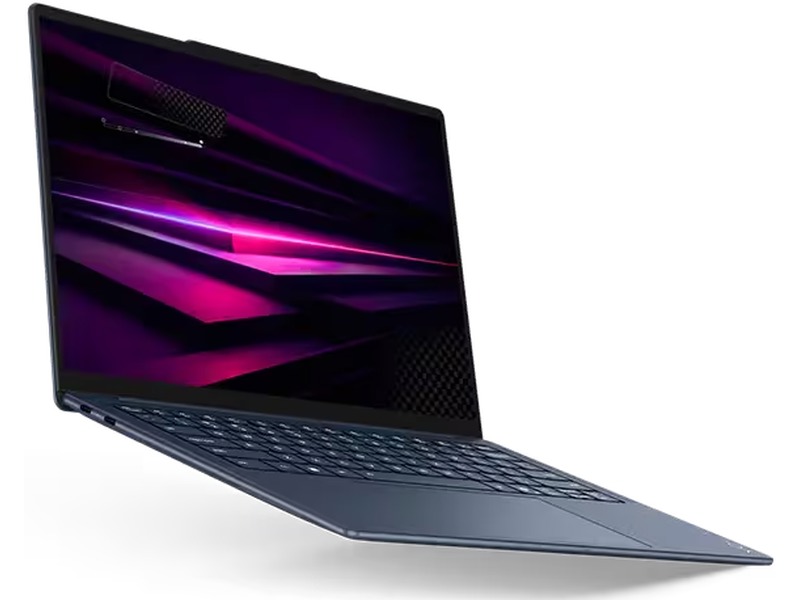
A new preview of Lenovo’s Yoga Slim 7x (2026) powered by Qualcomm’s Snapdragon X2 Elite is turning heads for one major reason: battery life. In an early look shared by YouTuber Dave2D ahead of his full review, the laptop delivers endurance numbers that are not only impressive for a thin Windows machine, but also strong enough to challenge the MacBook Air in typical use cases.
In certain local video playback scenarios, Snapdragon X2 Elite systems can reportedly reach as high as 31 hours. In Dave2D’s testing with the Yoga Slim 7x and its 70 Wh battery, real-world results landed closer to nearly 25 hours. That’s short of Lenovo’s initial top-end claims, but still a standout figure—especially considering this was a pre-production unit. Even more notable is the generational jump: battery life is said to be around six hours longer than earlier Snapdragon X Elite laptops from 2024, showing just how much efficiency has improved.
Performance is also shaping up to be a key selling point. In Cinebench 2024 multi-core results shown in the preview, Snapdragon X2 Elite comes out ahead by roughly 20% versus current rivals in the same class, including AMD’s Ryzen AI 9 HX 470 and Intel’s Core Ultra X9 388H, and it even edges past Apple’s M5 in that specific multi-core benchmark. Single-core performance doesn’t surpass the M5, but it does beat the comparable AMD and Intel chips shown.
Synthetic benchmarks are one thing, but the preview also touches on practical workloads. In Blender, the Snapdragon X2 Elite reportedly outperforms competing platforms, while in Adobe Premiere Pro it stays mostly in line with AMD and Intel alternatives. One of the most important real-world advantages, however, is consistency: the chip appears to deliver the same performance whether the laptop is plugged in or running on battery. That kind of unplugged performance parity is still uncommon in many Windows laptops, where power limits often reduce speed on battery.
On the software side, Windows on ARM continues to mature. Dave2D notes that many apps now run natively, and the compatibility issues that affected earlier 2024-era models appear to be largely addressed. Gaming remains more complicated. Many titles still rely on Prism emulation, though the integrated GPU seems capable enough for 1080p gaming at medium settings in supported games. The biggest blocker is anti-cheat: some major competitive titles still won’t run due to anti-cheat systems, including Apex Legends, Valorant, and League of Legends.
Lenovo also made several hardware tweaks to the Yoga Slim 7x for 2026. Despite changes, the laptop stays impressively light at around 1.17 kg. Lenovo slightly reduced the display size from about 14.5 inches to 14 inches, but the screen itself is upgraded: a 2.8K OLED panel with a 120 Hz refresh rate, full coverage of P3 and aRGB color spaces, and up to 1100 nits peak brightness. Cooling is handled by a flat heatpipe design, and in Quiet mode the system reportedly stays cool and restrained, topping out around 28 dB under load. Switch to Performance mode and fan noise may climb to about 43 dB. Audio is improved as well, moving from a dual-speaker setup to four speakers.
Pricing could be the wildcard. Lenovo initially suggested the 16 GB RAM version could start around $900, but ongoing RAM and storage supply constraints may push real-world pricing beyond $1000 by the time the Yoga Slim 7x (2026) becomes widely available.
If the early preview holds up in final retail testing, the Snapdragon X2 Elite version of the Lenovo Yoga Slim 7x could become one of the most compelling thin-and-light Windows laptops of 2026—especially for buyers prioritizing all-day (and then some) battery life without sacrificing serious performance.


