Lenovo Legion Challenger Mini PC Debuts With Intel Panther Lake, 64GB RAM, and Dual 2.5GbE Ethernet
Lenovo is expanding its compact desktop lineup with a new mini PC built for users who want serious performance in a small form factor. The upcoming device, currently known by translations such as Laiku Warrior, Cool Fighter, or Legion Challenger, is expected to launch first in China and brings Intel’s next-generation Panther Lake platform into a compact metal-bodied design.
The Lenovo Legion Challenger mini PC appears to be aimed at power users, creators, office setups, home labs, and anyone who needs a space-saving desktop with strong connectivity. While Lenovo has not yet confirmed global availability, the specifications shared so far suggest this could become one of the more interesting Intel Panther Lake mini PCs to watch.
At the heart of the system is Intel’s Panther Lake architecture, with Lenovo confirming up to 180 TOPS of AI performance. That figure strongly suggests the mini PC may be offered with higher-end Panther Lake processor options, potentially including chips with up to 16 cores. This would place the Legion Challenger above typical entry-level mini PCs and make it suitable for multitasking, AI-assisted workloads, productivity software, media use, and light creative tasks.
Memory is another key highlight. Lenovo says the device will support up to 64GB of LPDDR5X RAM, giving it enough capacity for demanding desktop workloads, heavy browser use, virtual meetings, content creation apps, and multiple productivity tools running at the same time. For a mini PC, that amount of memory makes the Legion Challenger especially appealing to users who want desktop-class responsiveness without a bulky tower.
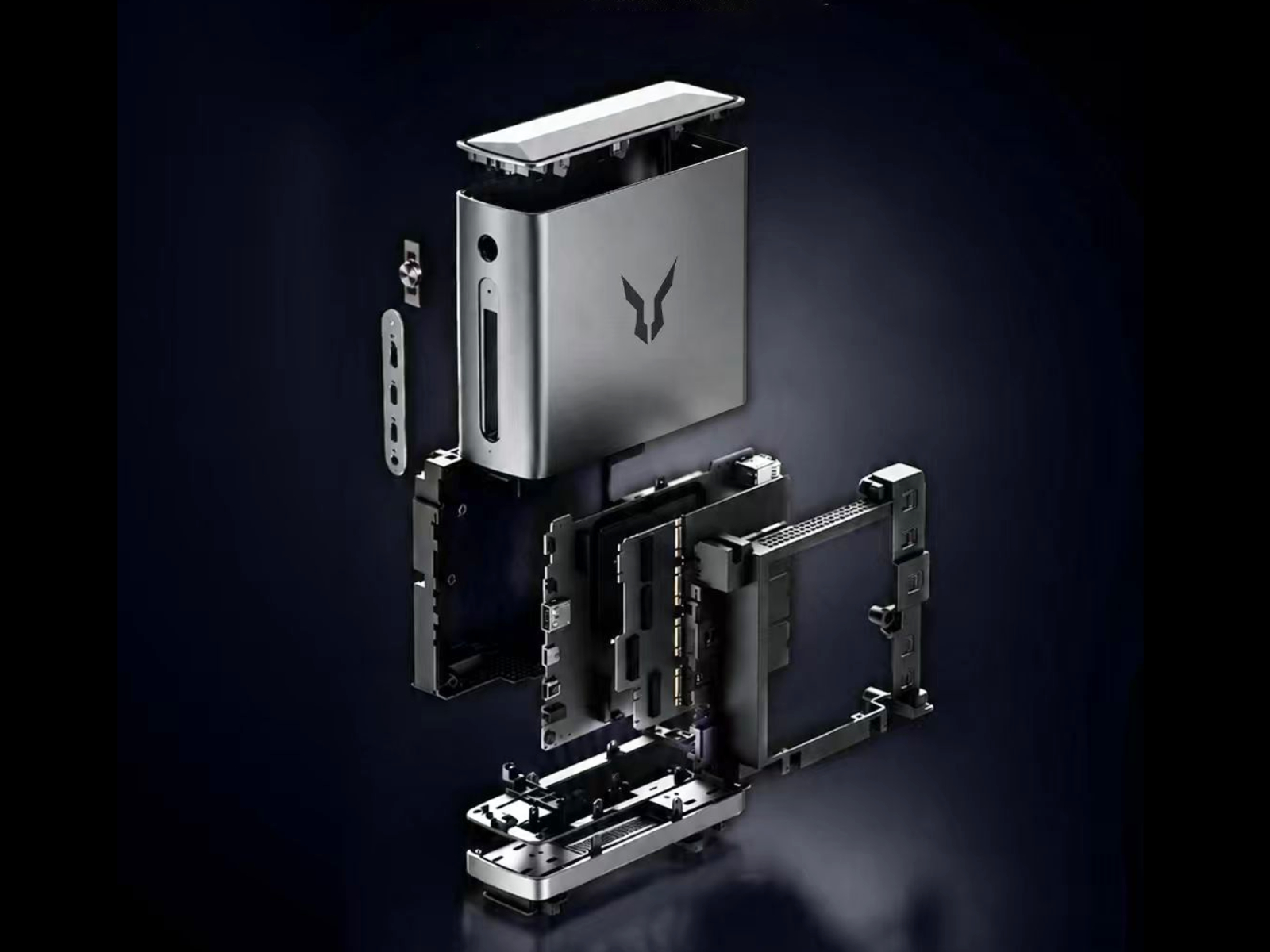
Connectivity also looks strong. Based on Lenovo’s early images, the Legion Challenger mini PC includes a 3.5mm audio jack, DC power input, DisplayPort, HDMI, two RJ45 2.5GbE Ethernet ports, four USB Type-A ports, and one USB Type-C port. The inclusion of dual 2.5GbE Ethernet is particularly useful for advanced networking setups, small business environments, NAS connections, home servers, and users who need faster wired network performance.
The compact system also appears to feature a metal chassis, which should help with durability and heat dissipation. Thermal design will be important, especially if Lenovo uses higher-performance Panther Lake chips inside such a small enclosure. Although full cooling details have not been revealed yet, the exploded view suggests Lenovo has focused on internal layout and airflow.
Lenovo has been actively refreshing its desktop and mini PC lineup, and the Legion Challenger adds another performance-focused option to the company’s growing portfolio. Unlike basic office mini PCs, this model appears designed to combine next-generation processing power, AI acceleration, high-speed memory, and rich connectivity in a compact footprint.
Pricing has not been announced, and Lenovo has not shared an exact release date. For now, the Legion Challenger is expected to arrive soon in China, with details on configurations, storage options, graphics capabilities, and wider availability likely to follow closer to launch.
If Lenovo prices it competitively, the Legion Challenger could become an attractive choice for buyers looking for a powerful Intel Panther Lake mini PC with 64GB RAM support, dual 2.5GbE networking, and a compact design suitable for both work and entertainment.