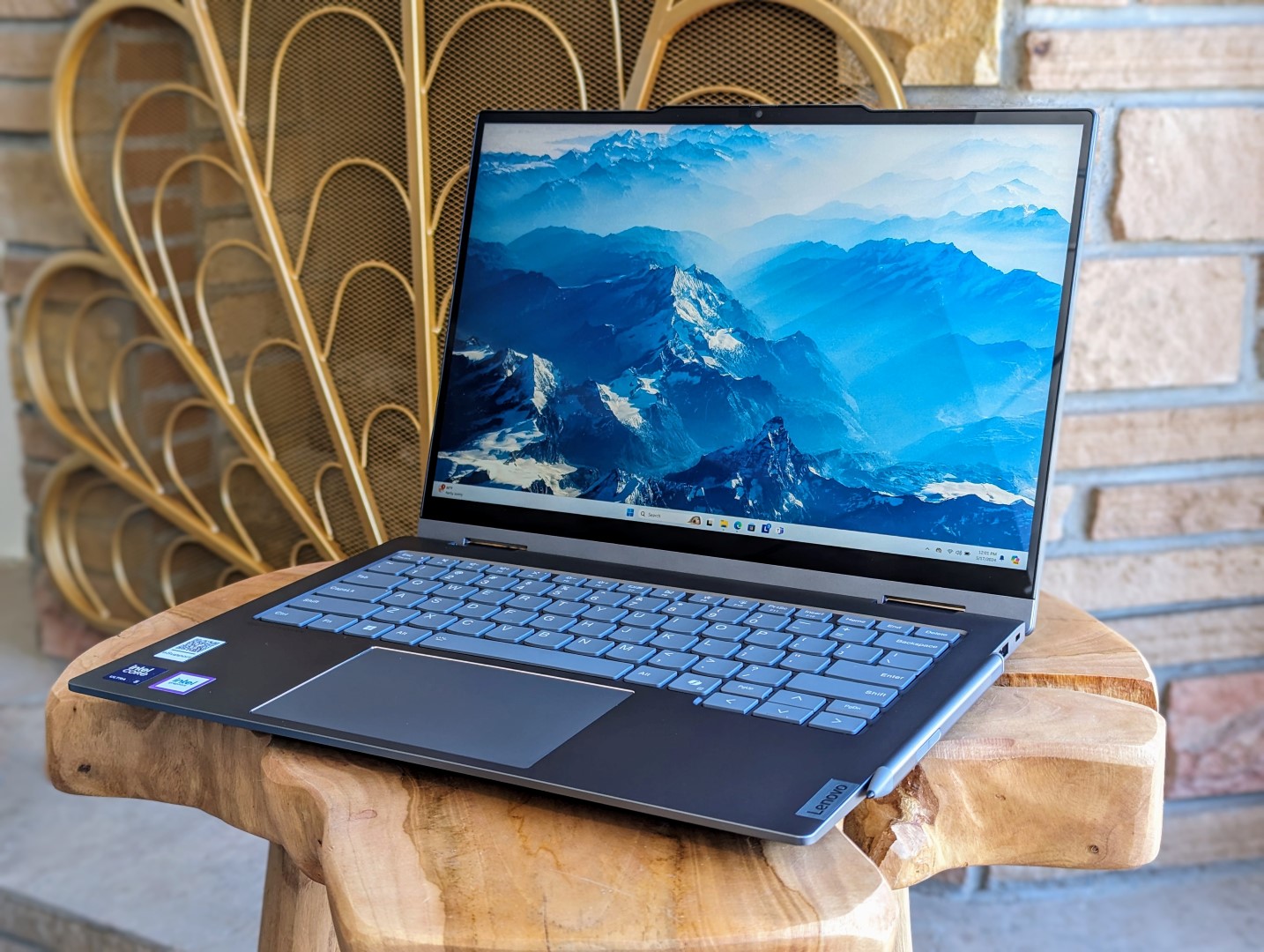
In the dynamic world of laptops, the Lenovo ThinkBook 14 2-in-1 G4 IML stands out with its sleek design and innovative features. This device is equipped with Intel’s Meteor Lake-U processors, marking it as a competitive option in the market for professionals and consumers seeking a blend of performance and versatility.
**Design and Build**
The Lenovo ThinkBook 14 2-in-1 G4 IML showcases a clean and modern aesthetic, suitable for both business environments and personal use. Its 2-in-1 form factor means it can switch effortlessly between traditional laptop mode and a more interactive tablet mode, providing users with flexibility for various types of work and multimedia consumption.
**Performance Insights**
Powering the Lenovo ThinkBook 14 is the Intel Core Ultra 5 125U processor. This CPU is part of the Intel Graphics 4-Cores iGPU (Arc) lineup, which is designed to deliver substantial performance improvements and energy efficiency. This chip allows the laptop to handle everyday tasks with ease and provides enough power to tackle more demanding applications, although it may not be the best fit for intensive gaming or professional-level content creation.
Comparing this model to its peers, it’s clear that the laptop holds its ground well concerning frame rates and graphic performance when matched against devices with similar specifications. With the rising trend towards more graphic-intensive applications, the ThinkBook 14 balances usability and visual quality effectively.
**User Experience**
The ThinkBook 14’s 2-in-1 feature significantly enhances its user experience. This flexibility means that whether you are drafting a report, designing a presentation, or enjoying a movie, the device can adapt to the optimal configuration.
**Recent Trends and Practical Application**
With remote work and digital nomad lifestyles gaining momentum, laptops like the Lenovo ThinkBook 14 2-in-1 are increasingly relevant. They cater to the need for portable, high-functioning devices that can serve multiple purposes. The ThinkBook 14, with its blend of performance and flexibility, embodies what many look for in a modern laptop.
In terms of practical advice, if you’re in the market for a new laptop and find that your day-to-day tasks involve a mix of productivity applications, internet browsing, and light media editing or gaming, the Lenovo ThinkBook 14 2-in-1 G4 IML could be a compelling choice. Always consider the type of tasks you’ll be performing, the environments in which you’ll use your device, and battery life needs when making your final decision.
**Final Thoughts**
The Lenovo ThinkBook 14 2-in-1 G4 IML is an attractive choice within the ultraportable laptop segment. It shines with its 2-in-1 design, earning points for adaptability and overall performance. For professionals and everyday users who value functionality and style, this device could be a worthwhile investment. As always, set your expectations according to your needs and how the device’s specs align with those needs to ensure satisfaction with your purchase.When it comes to selecting a laptop with top-notch graphics capabilities, there are a variety of options featuring both integrated and dedicated GPUs. In today’s market, devices with Intel Iris Xe Graphics and AMD Radeon configurations stand out, providing a range of performance levels for different types of users.
Intel’s Iris Xe Graphics have shown significant improvements over their predecessors, offering competitive integrated GPU performance. For example, the Asus Expertbook B5 Flip B5402F and Lenovo ThinkBook 14s Yoga ITL have Intel Core i7 CPUs paired with the Iris Xe Graphics G7 with 96 execution units (EUs), delivering solid performance for productivity and casual gaming.
On the other hand, AMD’s Ryzen processors paired with Vega or newer Radeon graphics deliver equally compelling results. The HP ProBook 445 G10 and Lenovo IdeaPad Pro 5 14AHP9, equipped with AMD Ryzen CPUs and Radeon graphics, prove to be strong contenders in the integrated GPU market.
For professionals and creators who require even more graphics horsepower, there’s the Microsoft Surface Laptop Studio 2 with NVIDIA GeForce RTX 4060 Laptop GPU and the Lenovo ThinkPad P14s G4 with NVIDIA RTX A500 Laptop GPU. Both of these devices offer dedicated GPUs that significantly outperform integrated options and cater to high-end gaming and intensive 3D tasks.
In the realm of 2-in-1 laptops, the Lenovo Yoga 9 stands out with the Intel Core Ultra 7 155H and the Intel Arc 8-Core iGPU, which demonstrates that convertible laptops can also harness powerful graphics abilities.
Comparing across the whole spectrum, we see that premium laptops like the Microsoft Surface Laptop Studio 2 top the charts in performance, easily surpassing more modestly-configured counterparts. Meanwhile, the ultra-portable yet modestly equipped devices like the Lenovo ThinkBook 14 2-in-1 G4 IML offer a balance between portability and performance, equipped with Intel Core Ultra CPUs and Intel’s Arc Graphics.
For those looking to maximize performance, it’s clear that laptops with dedicated NVIDIA GPUs, such as the Surface Laptop Studio 2 RTX 4060, offer a significant advantage. On the other hand, those who prefer a more balanced offering—the combination of strong CPU performance with an adequate integrated GPU like the Iris Xe—will find versatile machines capable of handling a variety of tasks without the additional weight and power consumption of a dedicated GPU.
When choosing a laptop, consider the kind of tasks you’ll be performing. For graphic-intensive work, gaming, or 3D modeling, you may benefit from the higher performance of a dedicated GPU. For everyday tasks, multimedia consumption, and casual gaming, an integrated GPU such as Intel Iris Xe can be more than sufficient.
Performance metrics, like frames per second (fps), are crucial when assessing the capability of a laptop’s graphics. Higher fps indicates a smoother visual experience, especially in video playback and gaming.
Ultimately, whether opting for Lenovo’s ThinkPad series, the Asus Expertbook, or the versatile Lenovo Yoga 9 2-in-1 laptop, users should prioritize their specific needs and preferences when it comes to selecting the right balance between graphics performance and other features such as portability, battery life, and overall system power.Graphics performance is a crucial aspect for many laptop users, from gamers to professionals relying on graphic-intensive applications. In this detailed guide, we’ll delve into the intricacies of assessing graphics performance and what the numbers mean for your user experience.
Recent performance benchmarks focus on comparing the graphical prowess of various integrated and discrete graphics processing units (GPUs) in laptops. For instance, AMD’s Radeon 780M is spotlighted for its performance against a variety of competitors.
In the realm of integrated graphics, the Intel Iris Xe series frequently appears. The Iris Xe Graphics G7 with 96 EUs and its counterparts with 80 EUs are common in various configurations, such as Intel Core i5-1335U and i7-1360P CPUs.
When parsing benchmark data, look for average frames per second (fps) as a key indicator of performance. This metric helps you understand how smoothly your system will run typical workloads, like rendering video content or running computer-aided design software.
Laptops with discrete GPUs, such as the NVIDIA GeForce RTX 4060 Laptop GPU or the NVIDIA RTX A500 Laptop GPU, tend to showcase significantly higher fps rates. For heavy-duty workloads or gaming, these more powerful GPUs are worth considering.
If you’re evaluating a system like the AMD Ryzen 7 8845HS with a Radeon 780M GPU, you would note from the data that it offers more than double the performance of some Intel 4-Cores iGPUs in certain scenarios, which could be a game-changer for your multimedia projects or gaming sessions.
To apply this information effectively, consider what applications you most commonly use. If they are graphics-intensive, prioritize systems with higher fps benchmarks. Do note that benchmarks are conducted in controlled environments and your real-world usage may yield different results.
Practice discernment when looking at minimum and peak fps as well. Higher minimum fps means the system is less likely to stutter or lag during intense graphically demanding moments. The peak performance shows the potential of the hardware under the most favorable conditions.
In summary, when evaluating laptop GPUs:
1. Look for the average fps in benchmarks to gauge overall performance.
2. Factor in the type of graphics unit—integrated or discrete—based on your needs.
3. Consider the importance of minimum fps for stable performance during demanding tasks.
4. Note any significant advantage or disadvantage in fps compared to your current or desired usage scenario.
5. Remember that real-world usage may differ from benchmark results.
6. Finally, always consider GPU performance in conjunction with CPU capabilities and other system specs such as RAM and storage for a comprehensive view of potential system performance.
By understanding these aspects and staying abreast of the latest trends and data in GPU performance, you can make an informed decision that matches your specific graphics needs.When exploring the performance of modern laptops, it’s evident that their capabilities hinge greatly on the combination of their central processing units (CPUs) and graphics processing units (GPUs). Performance benchmarks, often measured in frames per second (fps), provide a quantitative look at a device’s ability to handle complex graphics tasks, a critical factor for gaming, video editing, and other graphics-intensive applications.
Recent evaluations reveal that variations in CPU and GPU configurations can lead to substantial disparities in performance. Consider the following examples:
– The Lenovo ThinkPad T14s G4, powered by an AMD Ryzen 7 7840U and AMD Radeon 780M, demonstrates solid performance with 107.1 fps. This is indicative of the synergy between AMD’s Ryzen 7 processors and Radeon graphics, delivering over a 100% improvement compared to the average of a certain category of Intel integrated GPUs in the Arc lineup. Thanks to their Vega architecture, AMD Radeon GPUs enhance the computational efficiency alongside Ryzen CPUs.
– In a similar tier, the Lenovo IdeaPad Pro 5 14AHP9 couples an AMD Ryzen 7 8845HS with the same Radeon 780M GPU, achieving 110.5 fps. The slightly varied Ryzen 7 model appears to optimize the integrated Radeon graphics slightly better, leading to a modest increase in frames per second.
– On the other hand, the Lenovo ThinkPad P14s G4 equipped with an Intel Core i7-1370P and an NVIDIA RTX A500 Laptop GPU, shows an exceptional boost with 145.4 fps. This blend of a powerful Intel processor with a dedicated NVIDIA professional GPU demonstrates the advantage of dedicated GPUs in high-performance scenarios.
– Microsoft’s Surface Laptop Studio 2 with an Intel Core i7-13700H combined with an NVIDIA GeForce RTX 4060 Laptop GPU, showcases an even more impressive performance of 153.7 fps. This top-tier performance illustrates how pairing a higher-end Intel CPU with NVIDIA’s RTX series can produce superior graphical output, catering to the most demanding tasks and games.
– Devices like the Lenovo Yoga 9 incorporate an Intel Core Ultra 7 155H and an Intel Arc 8-Core iGPU. This kind of configuration offers balanced performance for users who require efficient multitasking and moderate graphics processing power, underpinning the versatility of Intel’s newer high-performance CPUs and their Arc 8-Core graphics in a single package.
– Budget-conscious users might gravitate towards options like the HP ProBook 445 G10, which, with an AMD Ryzen 5 7530U and AMD Radeon RX Vega 7 graphics, presents a capable yet cost-effective solution for everyday computing needs.
The implications of these varying configurations are vast. While high-end CPUs and premium GPUs cater to power users with performance benchmarks that soar past the 150 fps mark, the mid-range alternatives offer substantial power for everyday users, hovering around the 100 fps threshold. More modest configurations, utilizing integrated graphics solutions like Intel’s Iris Xe or Arc series, may dip below these figures but still provide a satisfactory experience for non-intensive tasks.
Understanding these benchmarks empowers consumers to make informed decisions based on their specific performance needs. It’s important to recognize the intended use case, whether that’s gaming, professional creative work, or general multimedia consumption, as this will dictate the balance between CPU performance, GPU capability, and of course, price considerations. By delving into these performance dynamics, users can pursue a laptop configuration that best aligns with their requirements and optimizes their investment.