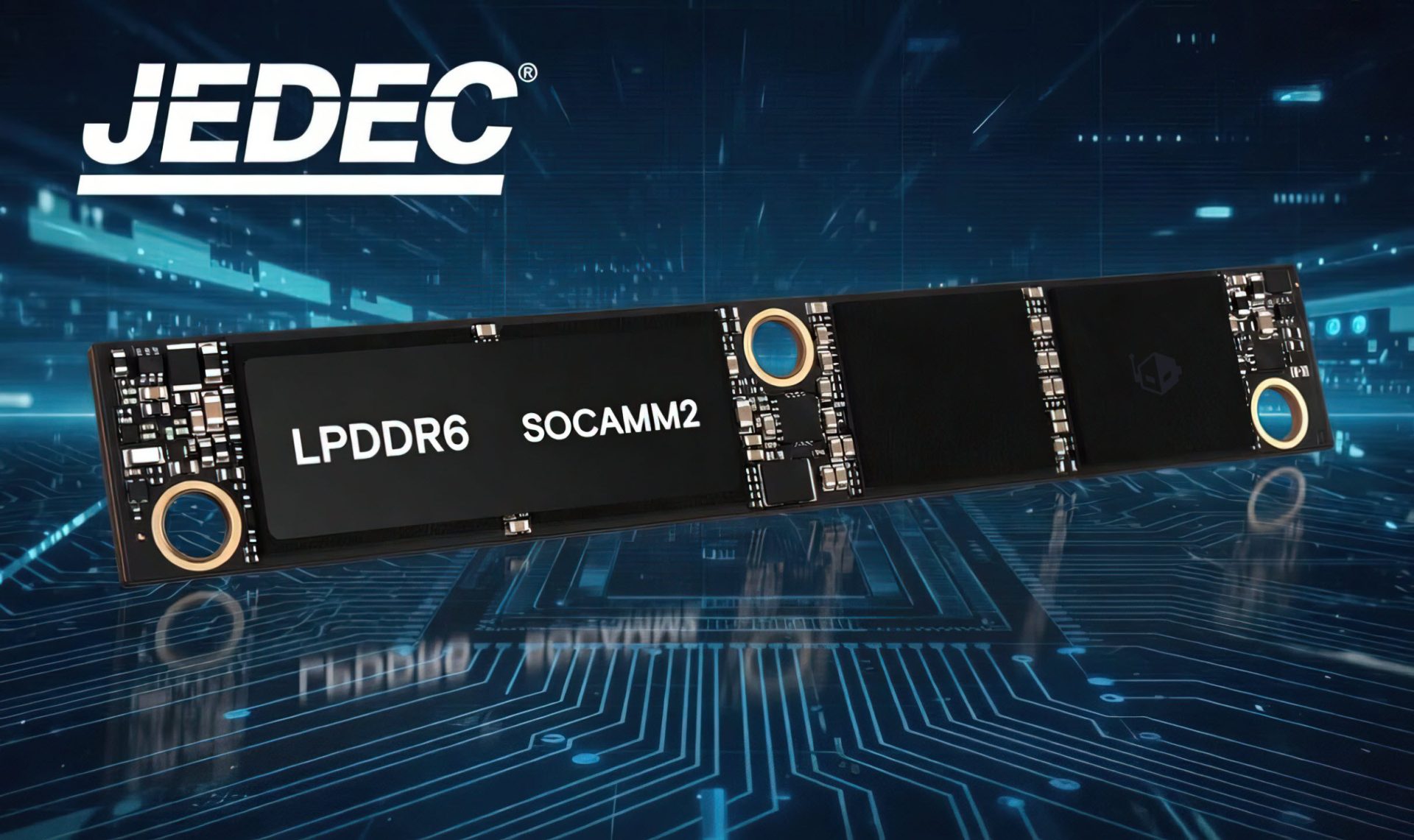
JEDEC has offered an early look at its upcoming LPDDR6 memory standard (JESD209-6), and the message is clear: the next wave of low-power DDR memory is being designed for much more than smartphones. LPDDR6 is positioned to become a key building block for future AI data centers, AI PCs, and next-generation mobile platforms by pushing performance, improving energy efficiency, and dramatically expanding memory capacity.
Compared with today’s LPDDR5 and LPDDR5X, LPDDR6 is expected to deliver higher bandwidth and better power characteristics while also paving the way for much larger memory configurations. Memory vendors are already sampling LPDDR6 to customers ahead of the full rollout, signaling that the ecosystem is ramping up quickly.
One of the biggest changes is how LPDDR6 approaches the physical interface. JEDEC is moving to a narrower per-die interface (x6) and introducing a non-binary approach to interface widths. In practical terms, this means the standard evolves from the traditional x16 style toward x24 sub-channels, with support for x12 and an additional x6 sub-channel mode. The advantage is straightforward but important: it allows more dies to be placed in a single package, increasing the maximum capacity per component and per channel. That matters most in AI environments where memory footprints keep growing as models get larger and more complex.
Capacity is another headline feature. LPDDR6 is designed to unlock densities beyond current LPDDR5/LPDDR5X limits, with 512 GB capacities on the horizon. That level of memory is aimed squarely at AI training and inference workloads, where more memory can reduce bottlenecks, keep larger datasets closer to compute, and improve overall throughput.
JEDEC is also building in options to address reliability and data integrity needs in data centers. A flexible “metadata carve-out” is intended to minimize the impact to peak data throughput while letting customers decide how to balance usable capacity and metadata based on their own reliability requirements. For operators trying to optimize performance per watt and performance per rack, that kind of configuration flexibility can be just as valuable as raw speed increases.
A major part of the LPDDR6 roadmap is the continued push into modular, serviceable memory for servers and high-performance systems. JEDEC confirmed that an LPDDR6-based SOCAMM2 module standard is actively in development. The goal is to carry forward a compact, serviceable module form factor and provide a clearer upgrade path from today’s LPDDR5X SOCAMM2 modules. The expectation is that this will help LPDDR-based designs scale in more data center and enterprise environments, where upgradability and serviceability matter.
In addition, JEDEC says it is nearing completion of a standard for LPDDR6 Processing-in-Memory (LPDDR6 PIM). This technology integrates processing capability directly within LPDDR6 memory to reduce data movement between memory and compute. Since shuttling data back and forth is a major source of latency and power draw—especially in inference-heavy AI applications—PIM is designed to boost inference performance and lower power consumption while retaining the efficiency benefits associated with LPDDR designs. JEDEC frames this as a response to rapidly increasing performance and energy-efficiency requirements across edge deployments and data center inference systems.
JEDEC leadership also noted that more details are on the way as the LPDDR6 standard and related efforts progress, including LPDDR6 PIM and LPDDR6 SOCAMM2. The organization is continuing to evaluate features that may be included when these standards are finalized and published.
With larger capacities, more flexible channel configurations, data center-friendly features, and parallel work on SOCAMM2 modules and processing-in-memory, LPDDR6 is shaping up to be a significant step forward for AI-focused computing—spanning everything from mobile devices to high-density inference infrastructure.