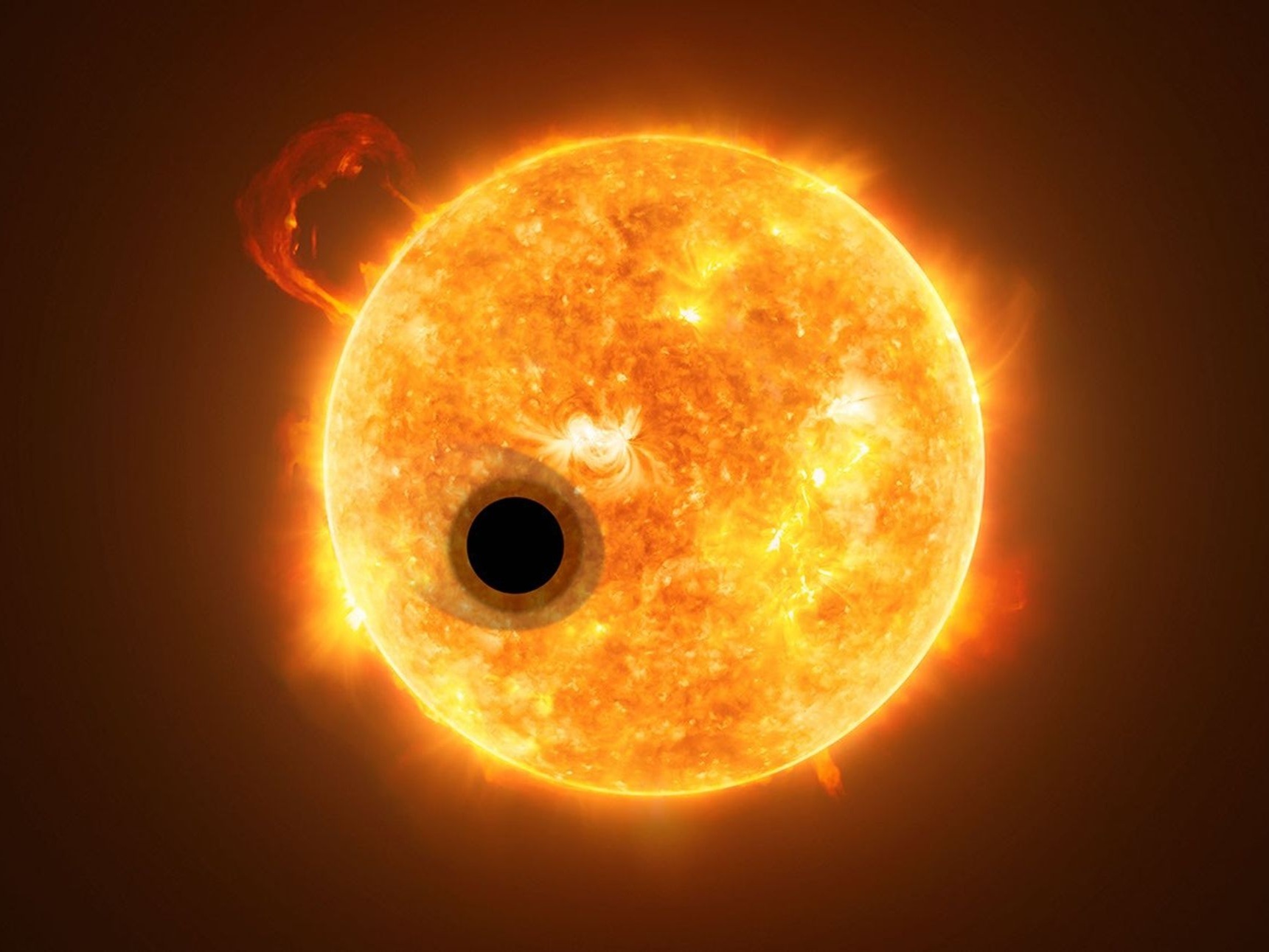
The James Webb Space Telescope has captured an extraordinary scene unfolding around a distant world: the exoplanet WASP-107b is losing its atmosphere so dramatically that a giant stream of helium is blasting into space and racing ahead of the planet as it orbits its star. It’s one of the clearest looks yet at how intense heat can strip a planet down over time, reshaping its structure and future.
WASP-107b sits about 210 light-years from Earth, circling its star at a remarkably close distance. In fact, its orbit is roughly seven times smaller than Mercury’s, placing it in a brutal environment flooded with stellar energy. That extreme heating appears to be supercharging a powerful atmospheric escape, known as a hydrodynamic outflow, where upper layers of gas become energized enough to flow outward into space rather than remain bound to the planet.
What makes this discovery even more fascinating is the planet itself. WASP-107b is about the size of Jupiter, but it’s far lighter—around 88% less massive—earning it the nickname “super-puff” because of its unusually low density. Researchers often compare planets like this to “cotton candy” worlds: big in radius, but with a fluffy, expanded atmosphere that’s easier for a star to erode. Scientists suspect WASP-107b didn’t originally form so close to its star. Instead, it may have migrated inward over time, potentially influenced by the gravitational tug of another planet in the system, WASP-107c.
Using JWST’s powerful instruments, researchers also identified several key chemicals in the planet’s atmosphere, including water vapor, oxygen, carbon monoxide, carbon dioxide, and ammonia. But one expected ingredient didn’t show up: methane. That absence is notable because many chemical models predicted methane should be present in detectable amounts. One leading explanation is that WASP-107b’s high temperature stirs and lifts gases from deeper layers up into the upper atmosphere—regions where methane may be naturally scarce—changing the planet’s atmospheric makeup in a way that doesn’t match simpler predictions.
Beyond the spectacle of a helium plume streaming into space, the real importance of WASP-107b is what it teaches astronomers about atmospheric loss across the galaxy. While this case is extreme, it provides a valuable natural laboratory for understanding how planets evolve when they’re exposed to intense radiation. Over long periods, this kind of erosion can dramatically alter a planet’s chemistry, climate, density, and even its potential to resemble (or diverge from) worlds closer to home. Insights from WASP-107b could help researchers better understand how atmospheres change or vanish entirely—offering clues relevant to the evolution of planets like Venus, as well as countless other worlds orbiting distant stars.


