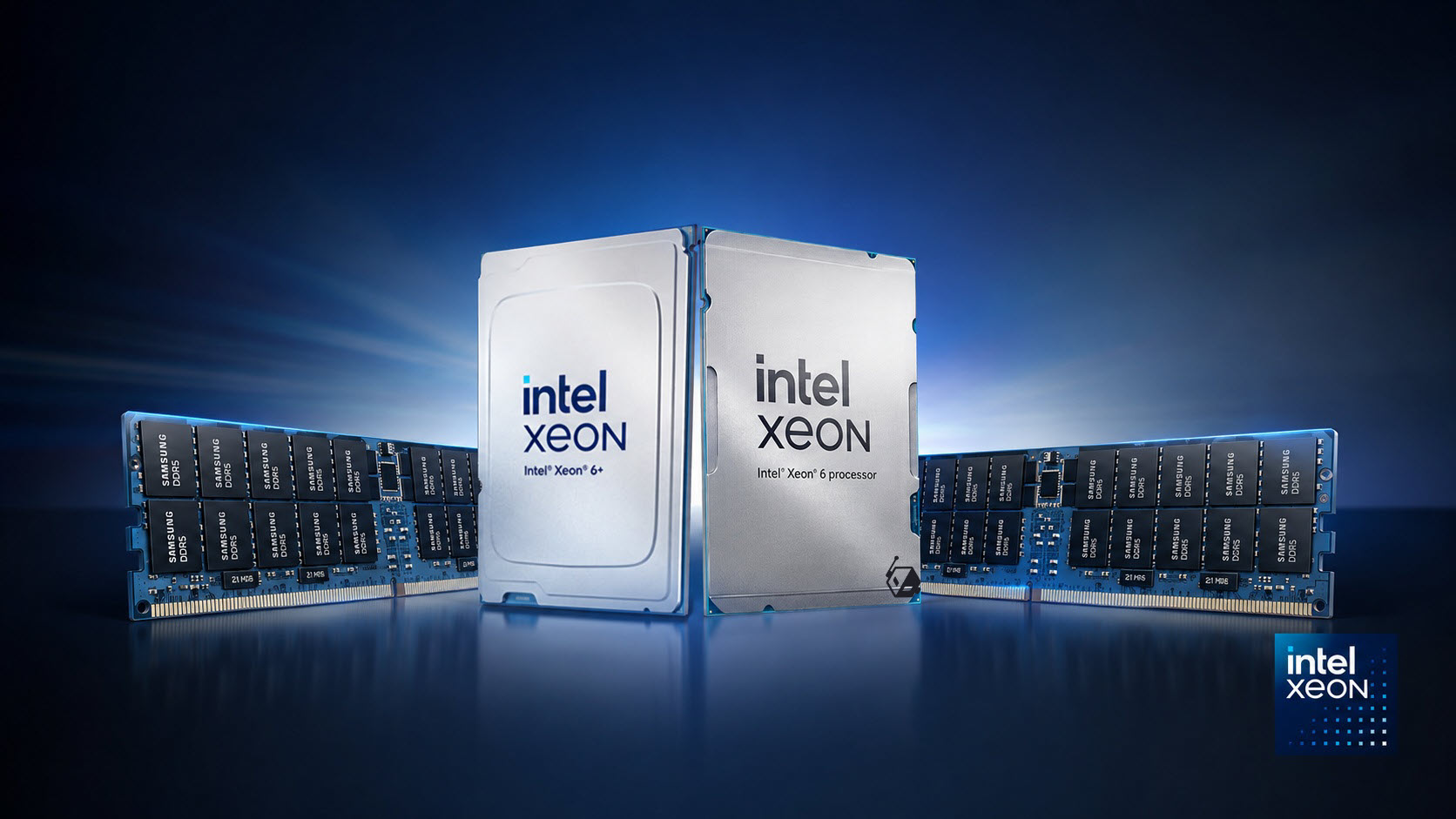
Intel Xeon 6 Brings 8000 MT/s DDR5 RDIMM Support to Data Centers, With Faster MRDIMM on the Way
Intel is pushing data center memory performance forward with new support for 8000 MT/s DDR5 RDIMM memory on its Xeon 6 platform. The company says this makes Xeon 6 the first server CPU platform to support DDR5 RDIMM at this speed, giving enterprises a faster memory option for AI, analytics, high-performance computing, and other bandwidth-heavy workloads.
As modern AI systems grow more complex, memory speed is becoming just as important as CPU core count or accelerator performance. Larger AI models, denser GPU deployments, and increasingly demanding data pipelines all require the host CPU to move information quickly and efficiently. When memory cannot keep up, processors and accelerators may sit idle while waiting for data, reducing the overall efficiency of the entire system.
That is the challenge Intel is targeting with 8000 MT/s DDR5 RDIMM support. Compared to widely used 6400 MT/s RDIMM configurations, the new memory speed represents a 25% increase in transfer rate. Intel says the upgrade can deliver up to 20% more total memory bandwidth, helping servers feed CPUs and AI accelerators with data more effectively.
The real-world performance uplift will depend on the workload, but Intel indicates that broad workload testing shows gains of around 3% to 6%. Applications that are especially sensitive to memory bandwidth may see higher benefits. Intel also points to lower latency, with the 8000 MT/s RDIMM configuration offering around 6% reduced latency compared with current 6400 MT/s deployments.
Support for 8000 MT/s DDR5 RDIMM is planned for select Xeon 6 processors, including Xeon 6700P “Granite Rapids” and Xeon 6+ “Clearwater Forest” models. The feature will be enabled through a UPLR release and BIOS update. Production availability is expected around August to September this year.
Intel is positioning this upgrade as more than a simple memory specification improvement. The company sees faster memory as a key infrastructure decision for organizations investing in artificial intelligence. In AI servers, performance is not determined by one component alone. CPUs, GPUs, accelerators, storage, networking, and memory must all work together without creating bottlenecks.
Intel Fellow Srini Krishna emphasized that memory speed is becoming a competitive advantage in the data center. According to Intel’s view, businesses that treat memory bandwidth as a strategic part of system design may be better positioned to extract more value from AI infrastructure investments.
Intel is also preparing support for second-generation MRDIMM technology, short for Multiplexed Rank Dual Inline Memory Module. Gen 2 MRDIMMs are already in production and are expected to reach speeds of up to 8800 MT/s on the Xeon 6900P “Granite Rapids” platform by the first quarter of 2027.
MRDIMM is designed for high-core-count server platforms, especially systems with 72 to 128 cores. These configurations are commonly used for AI training and inference, advanced analytics, scientific computing, and high-performance computing workloads where memory bandwidth can strongly influence total system throughput.
Looking further ahead, Intel expects MRDIMM speeds to continue climbing. Future modules are projected to reach up to 12,800 MT/s next year, with speeds of up to 17,600 MT/s anticipated around the 2029 to 2030 timeframe. These advancements could extend the relevance of DDR5-based server platforms even as the industry prepares for the eventual transition to DDR6 memory.
For data center operators, the move to faster DDR5 RDIMM and MRDIMM support is significant. AI workloads are becoming increasingly memory-hungry, and simply adding more compute power is not enough if the system cannot supply data fast enough. By increasing bandwidth and reducing latency, Intel Xeon 6 platforms aim to help enterprises build more balanced servers for next-generation AI and data-intensive applications.
With 8000 MT/s DDR5 RDIMM support arriving for select Xeon 6 CPUs and 8800 MT/s MRDIMM planned for future Granite Rapids platforms, Intel is making memory performance a central part of its data center roadmap. For organizations planning AI infrastructure upgrades, memory speed may now become one of the most important factors in choosing a server platform.


