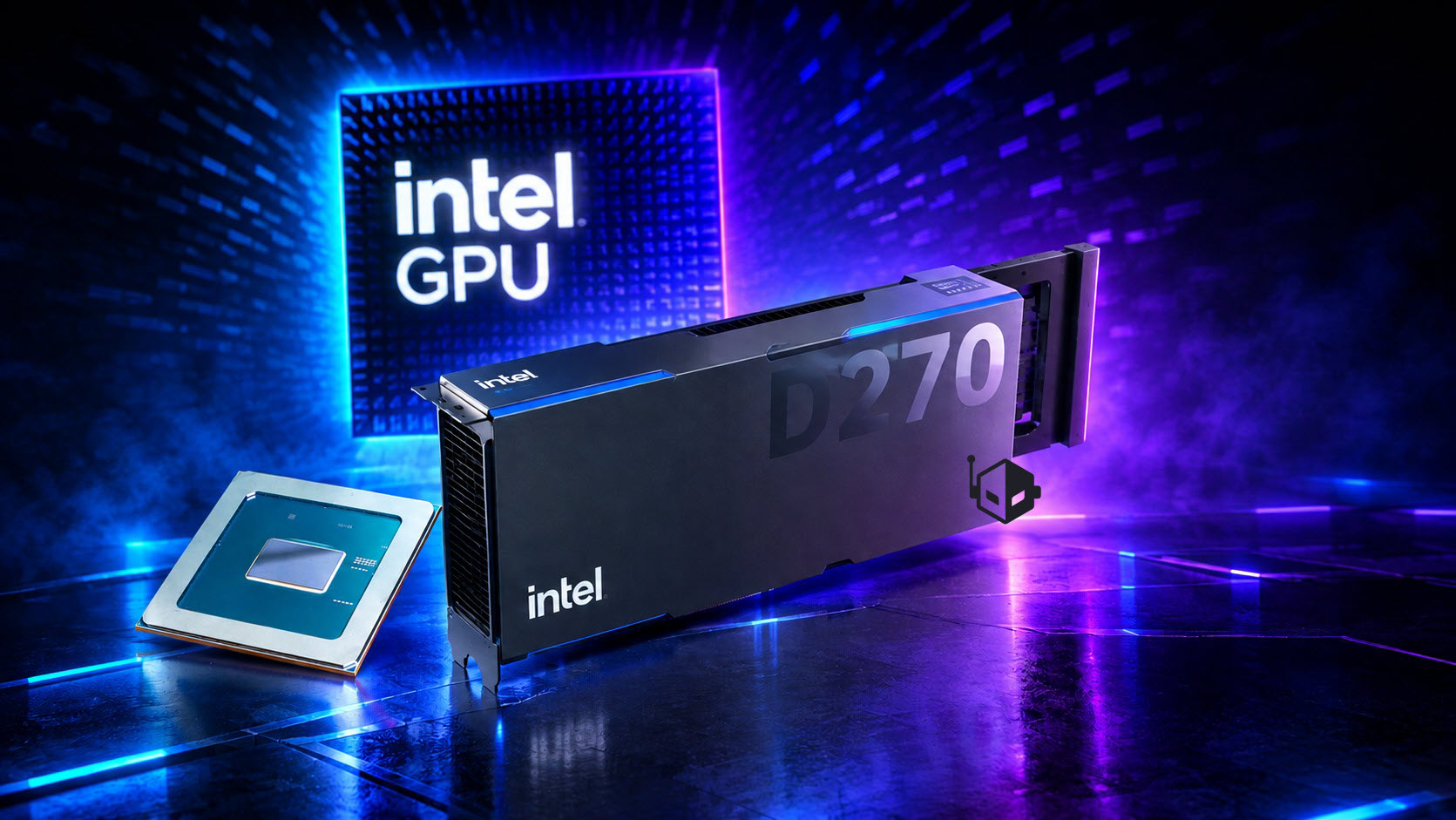
Intel D270 Crescent Island GPU Benchmarks Point to Major Gains in HPC, AI, and FP64 Compute
Intel’s upcoming D270 GPU, codenamed Crescent Island, is starting to look like one of the company’s most important accelerators for high-performance computing, AI, workstation, and scientific workloads. Built on the Xe3P architecture, the GPU is designed to deliver strong double-precision performance, large memory capacity, and competitive efficiency for demanding compute environments.
The first performance figures for Intel’s Crescent Island GPU highlight a major focus on native FP64 compute, also known as double-precision arithmetic. This is especially important for industries where numerical accuracy matters, including scientific research, engineering simulations, financial modeling, oil and gas exploration, and advanced AI workloads.
Intel D270 Crescent Island GPU specifications
Intel has already shared several key specifications for the D270 GPU. The accelerator features 32 Xe3P cores and 256 Xe Matrix Extensions engines, also known as XMX engines. These are designed to support a wide range of compute formats, from low-precision AI inference formats such as FP4 and FP8 to full-rate native FP64 compute for workloads that require maximum accuracy.
The GPU is also expected to support up to 480 GB of memory, using an LPDDR5X memory subsystem. That choice could give Intel an interesting advantage in cost, power efficiency, and scalability compared with solutions based on GDDR or more expensive HBM memory.
Intel is preparing multiple configurations of the D270, including air-cooled 350W versions, liquid-cooled variants, and dual-GPU options. This gives the platform flexibility across different data center, workstation, AI, and HPC deployment scenarios.
Why FP64 performance matters
Double-precision compute is essential for workloads where small rounding errors can grow into major inaccuracies. Financial simulations, scientific modeling, physics calculations, engineering design, climate research, and seismic analysis often rely on FP64 arithmetic to maintain numerical integrity.
With Crescent Island, Intel is positioning the D270 GPU as a strong choice for these accuracy-sensitive workloads. Each Xe core can deliver 64 FP64 fused multiply-add operations, giving developers access to native double-precision compute instead of relying only on lower-precision AI acceleration.
At the same time, the GPU still supports lower precision formats for AI inference, allowing it to serve both traditional HPC and modern AI workloads. That mix of FP64 accuracy and AI-focused lower precision support is a major part of Intel’s strategy with the D270.
Intel D270 versus NVIDIA RTX PRO 6000 Blackwell
Intel has compared the D270 Crescent Island GPU against NVIDIA’s RTX PRO 6000 Blackwell Server Edition in several workloads. One of the most notable differences is power consumption. Intel’s D270 is presented as a 350W accelerator, while the competing RTX PRO 6000 Blackwell Server Edition operates at up to 600W.
In financial services benchmarks, Intel’s D270 showed large performance advantages in FP64-heavy workloads.
In European Monte Carlo testing, the D270 delivered up to 5.9 times higher throughput.
In Black-Scholes European testing, the GPU showed up to 5.6 times higher throughput.
In Binomial financial modeling, Intel’s accelerator achieved up to 4.6 times higher throughput.
In Black-Scholes American testing, the D270 delivered up to 1.92 times higher throughput.
Across these four financial workloads, Intel claims an average performance advantage of around 4.5 times. These results suggest that Crescent Island could be a strong option for financial institutions and enterprises that rely on intensive quantitative modeling, risk analysis, derivatives pricing, and Monte Carlo simulations.
Strong potential for seismic modeling
Intel is also demonstrating the D270 GPU in seismic modeling, a demanding workload commonly used in the oil and gas industry. Seismic modeling requires repeated acoustic wave-propagation calculations across very large 3D datasets, typically using FP32 compute.
The D270’s combination of high memory capacity and strong FP32 performance appears well-suited to this type of task. Intel is also highlighting cache-aware stencil optimizations, which are designed to maximize data reuse and keep large wavefield arrays resident on the GPU. This can help improve efficiency and reduce unnecessary data movement during complex simulations.
For industries working with massive geological datasets, this could make Crescent Island attractive not only for raw performance, but also for memory-heavy workloads where capacity and bandwidth efficiency are critical.
AI benchmark results show lower latency and better throughput
Beyond HPC and financial workloads, Intel is also presenting the D270 as a capable AI accelerator. In early AI benchmark results, the GPU reportedly delivered up to 29% lower latency than the RTX PRO 6000 Blackwell Server Edition when running Drex 2.0, a model associated with decision-making and agentic AI workloads.
Intel also claims that the D270 achieved 1.12 times the throughput of the same competing GPU in Qwen 3 30B A3B testing, while operating at 350W. These results were achieved on pre-production silicon, meaning final performance could change by launch.
The AI results are particularly important because the market is rapidly moving beyond simple chatbot-style generation toward agentic AI systems that can reason, make decisions, and perform multi-step tasks. Lower latency and higher throughput are both valuable for these emerging workloads, especially in enterprise AI deployments.
LPDDR5X could be a key advantage
One of the most interesting parts of Intel’s D270 strategy is the use of LPDDR5X memory. While many high-end accelerators rely on GDDR or HBM, LPDDR5X could help Intel balance capacity, cost, and power efficiency.
With up to 480 GB of memory, Crescent Island may appeal to customers who need large model support, large simulation datasets, or memory-intensive workloads without necessarily moving to the highest-cost HBM-based solutions.
If Intel can deliver competitive pricing, this memory approach could make the D270 a practical option for AI servers, HPC clusters, workstations, and specialized compute deployments.
Launch timing and pricing remain the big questions
While the early benchmarks are promising, Intel has not yet answered the two biggest questions: when the D270 Crescent Island GPU will launch and how much it will cost.
Pricing will be especially important. If Intel can offer strong FP64 compute, large memory capacity, good AI performance, and lower power consumption at an aggressive price, the D270 could become a serious competitor in the HPC and AI accelerator market.
For now, Crescent Island appears to be shaping up as a powerful and efficient GPU aimed at users who need more than standard AI inference acceleration. With native FP64 support, broad precision flexibility, up to 480 GB of memory, and promising early benchmark results, Intel’s D270 could become one of the company’s most compelling data center GPUs yet.