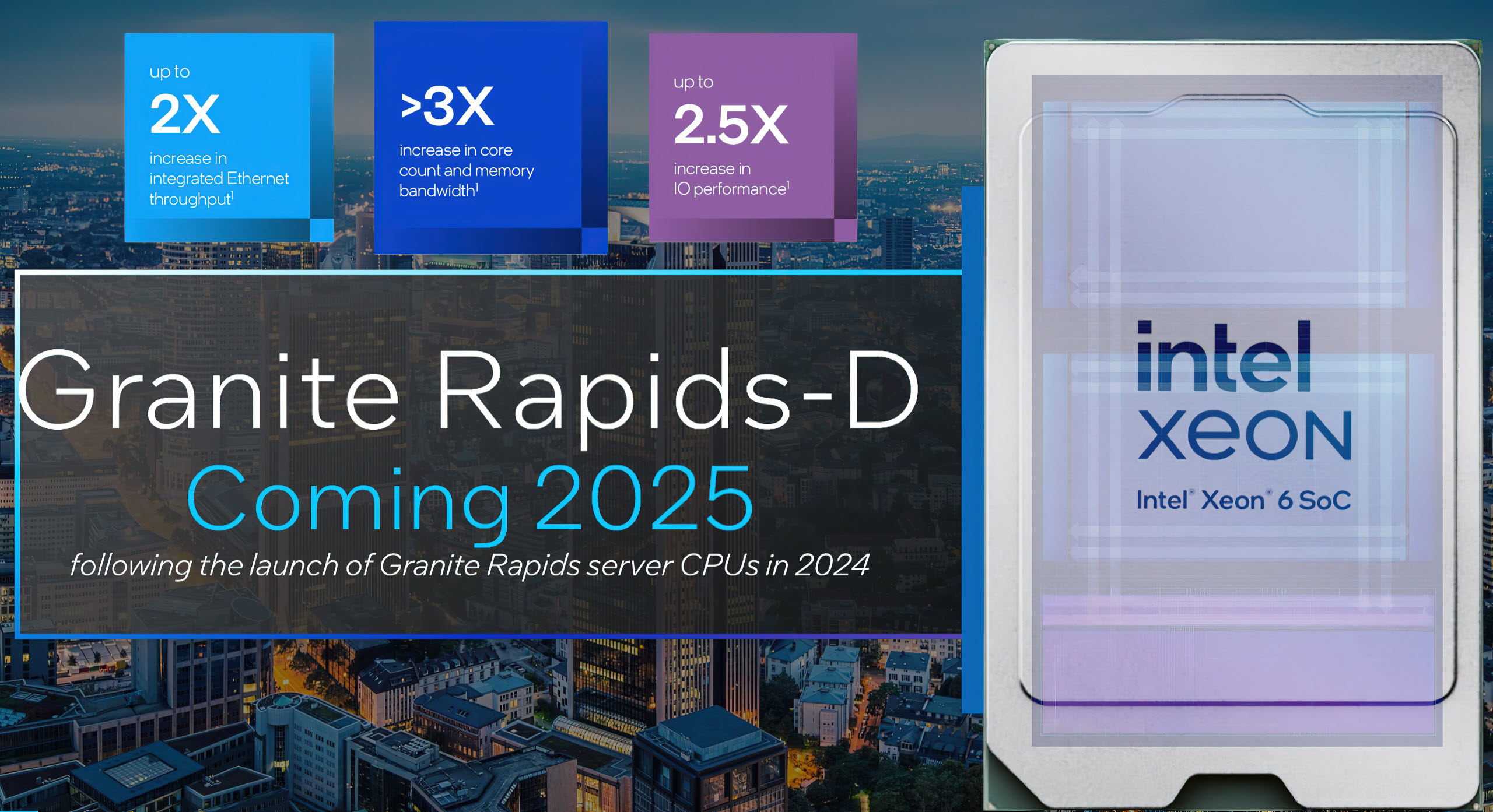
Intel has introduced its next-generation Granite Rapids-D platform, officially named Xeon 6 SOC. Unveiled at Hot Chips 2024, this platform is aimed at edge computing customers and is built to deliver high compute density for artificial intelligence and other demanding workloads while offering robust integrated connectivity. Designed for rugged environments, these processors promise to operate reliably even under challenging conditions.
The Xeon 6 SOC will target two main segments: compute-optimized chips geared toward low-latency, high-bandwidth memory tasks, and edge-optimized chips designed for AI-enabled security and scalability across multiple systems. The platform utilizes the “Intel 3” process for compute tiles and the “Intel 4” process for the IO tiles, offering a modular design with options ranging from just one to multiple compute tiles connected via EMIB die-to-die interconnects.
One of the key features is a unified cache and memory system, which scales from small to large configurations through a mesh interconnect, ensuring low latency and reduced jitter. Highlighted capabilities of the Xeon 6 SOC include the following:
– Redwood Cove P-Core Architecture
– Up to 42 cores demonstrated
– Support for 8-channel and 4-channel memory configurations
– 32 PCIe 5.0 lanes, 16 PCIe 4.0 lanes, and 16 CXL 2.0 lanes
– Integrated accelerators across all models
– Multiple Ethernet ports (ranging from 100G to 100M speeds)
– DDR5-5600 and MCR-DIMM memory support
Performance-wise, the Xeon 6 SOC CPUs aim to deliver significant improvements over previous generations, boasting over a threefold increase in core counts and memory bandwidth, a 2.5x uplift in IO performance, and a doubling of Ethernet throughput. Additionally, the integrated AI accelerator is expected to provide an 8x speed increase in Resnet-50 image processing and a 6x boost in Visual Transformer tasks compared to the older Xeon D 2899NT CPU.
The Xeon 6 SOC will be available in two package sizes, supporting configurations with up to 128 GB of DDR5-5600/4800 memory. Intel plans to launch these CPUs in 2025.