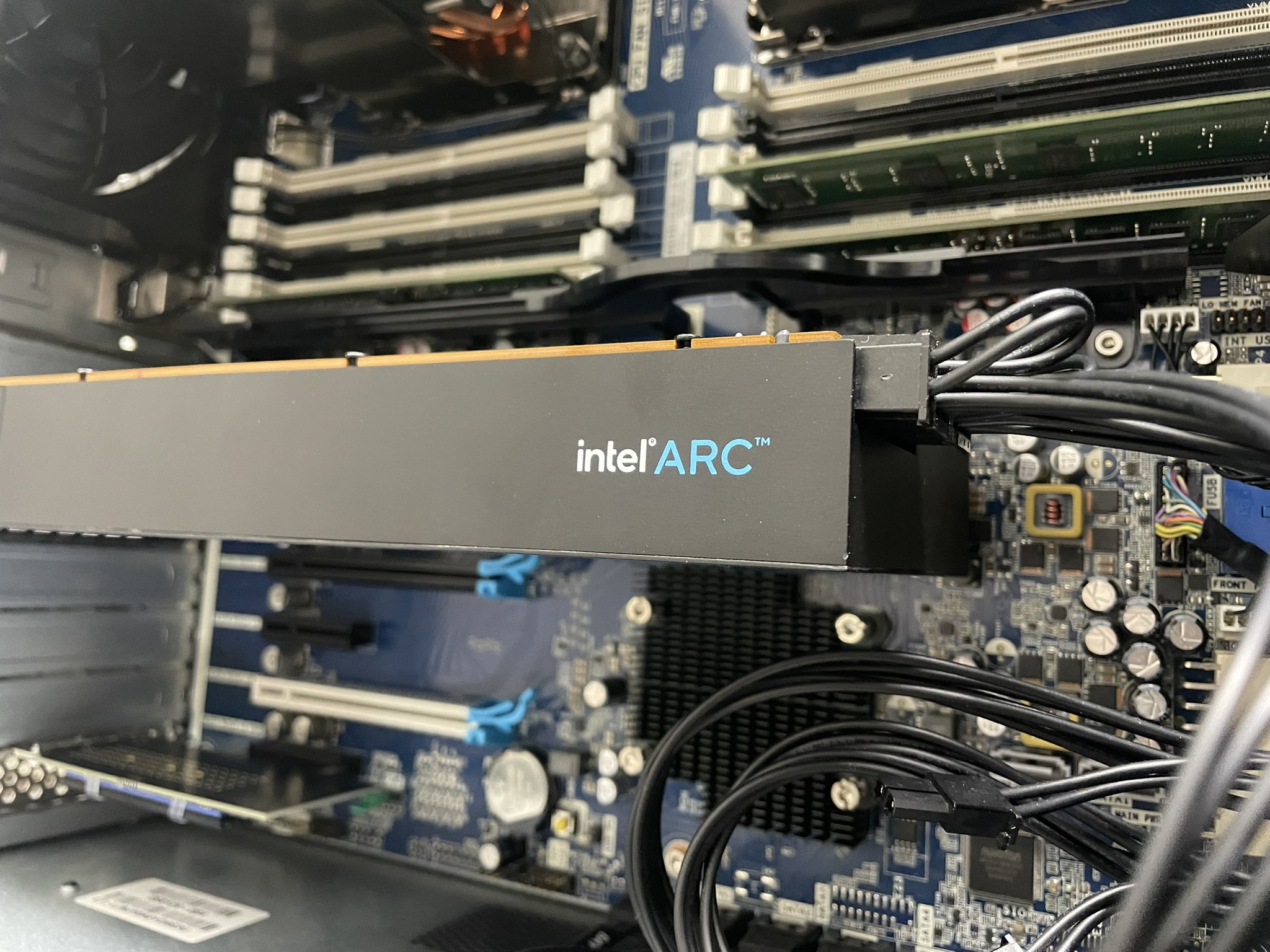
Mysterious Intel Arc A750 sample surfaces with an eye‑popping 512‑bit bus and 16 GB GDDR6
A curious Intel Arc A750 graphics card has appeared online, and it’s not your typical mid-range Alchemist. Shared by X user @komenezumi1006, the GUNNIR-branded sample is labeled as a 16 GB model with a massive 512-bit memory bus and dual 8-pin power connectors—specs far beyond what the retail Arc A750 ever offered.
For context, the Arc A750 launched in 2022 with 28 Xe cores and a 256-bit memory interface paired to 8 GB of GDDR6. The higher-tier Arc A770 stepped up to 32 Xe cores and was available in both 8 GB and 16 GB variants. That’s why this new find stands out: a 512-bit bus on an A750-class card would be double the standard width for the ACM-G10 GPU and would dramatically increase theoretical memory bandwidth at equivalent memory speeds.
Key details spotted on the sample:
– GUNNIR-branded Arc A750 with a 16 GB GDDR6 label
– 512-bit memory bus indicated on the product marking
– Dual-slot blower-style cooler
– Dual 8-pin PCIe power connectors (up to 300 W available), versus the A750’s 225 W TBP reference
– Shows 16.0 GB of VRAM in Task Manager
– PCB inspection suggests a single-GPU design, not a dual-GPU board
The dual-GPU theory—where two chips could “combine” their memory capacities and buses—doesn’t line up with the visible hardware. The PCB appears to accommodate only one GPU, and while there have been dual-GPU solutions in the Arc Pro B60 family with different bus configurations and up to 24 GB total memory, this sample doesn’t resemble those designs.
So what could this be? The most plausible explanation is an early engineering sample or experimental board from the Alchemist era, when Intel and partners may have explored wider buses before standardizing on more cost-effective 256-bit designs. A 512-bit interface significantly complicates board design and increases cost and power demands, which likely outweighed the bandwidth benefits for this market segment. It’s also possible the label doesn’t reflect the final configuration, but if accurate, it offers a rare glimpse at what might have been.
A GPU-Z readout would be the smoking gun, confirming the bus width and memory speeds, but even without it, the card appears operational and reports the full 16 GB VRAM allocation.
Why it matters:
– A 512-bit bus on an A750-class GPU suggests Intel prototyped far wider memory interfaces for Alchemist than what shipped.
– It highlights the trade-offs between raw bandwidth and practical constraints like cost, power, and complexity.
– It adds intrigue as Intel readies its next-gen Arc Battlemage lineup, where the high-end model (often referred to as B770) is expected to pair a 256-bit bus with 16 GB of memory.
Whether this card is a one-off experiment or a remnant of an abandoned plan, it’s a fascinating find for GPU enthusiasts—and a reminder that behind every retail launch lies a trail of prototypes exploring what’s possible.