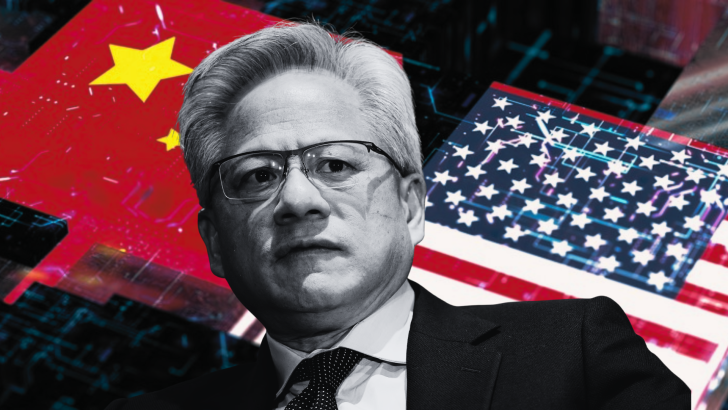
NVIDIA’s Jensen Huang calls Huawei a formidable AI rival as China accelerates its domestic chip ambitions
The AI hardware race is heating up, and China’s homegrown champion is front and center. NVIDIA CEO Jensen Huang has publicly acknowledged Huawei as a serious competitor, pointing to the company’s rapid progress in AI computing and data center hardware as proof that China’s domestic capabilities are advancing fast.
In a recent APAC 2025 Q&A, Huang reiterated NVIDIA’s leadership in AI infrastructure while cautioning against underestimating rivals. He cited Huawei’s mastery of 5G and premium smartphones as evidence of deep engineering breadth, adding that the company’s latest cloud and AI announcements were not surprising. His takeaway was clear: the competition is real, and NVIDIA needs to move even faster.
Huawei’s roadmap shows why it’s being taken seriously. The company has laid out an aggressive AI chip plan through 2027, including:
– New accelerators paired with self-developed HBM memory
– Generational performance gains aimed at large-scale AI training and inference
– Rack-scale systems designed to challenge the top end of data center AI
One of the headline efforts is Huawei’s next-generation Atlas SuperPoD. The company claims a single cluster packing 8,192 Ascend 950 AI chips can deliver performance on par with systems based on NVIDIA’s Rubin architecture. Huawei says it’s achieving this with a stacked rack design and tightly integrated compute, memory, and networking to maximize throughput at scale.
This surge comes as NVIDIA faces headwinds in China. Export restrictions have limited access to the latest NVIDIA silicon, complicating any rollout of Blackwell-based AI chips in the country. While NVIDIA remains the global leader in AI compute platforms, its lack of access to the Chinese market gives domestic alternatives like Huawei an opening to capture cloud service providers and AI leaders within China.
Huang’s comments reflect that dual reality: gaining re-entry to China is one challenge; outpacing a fast-improving Huawei is another. With Huawei positioning products to compete with Rubin-era performance, the gap is narrowing—especially inside China’s borders, where procurement increasingly favors domestic ecosystems.
The outlook is fluid. It’s unclear how NVIDIA–China relations will evolve, but one trend is hard to miss: Huawei’s pace isn’t slowing. As its AI chips, memory technology, and rack-scale systems mature, Chinese cloud providers and AI companies may increasingly prioritize homegrown solutions. For the global AI infrastructure race, that means more competition, faster iteration, and a tighter sprint at the very top of the performance curve.