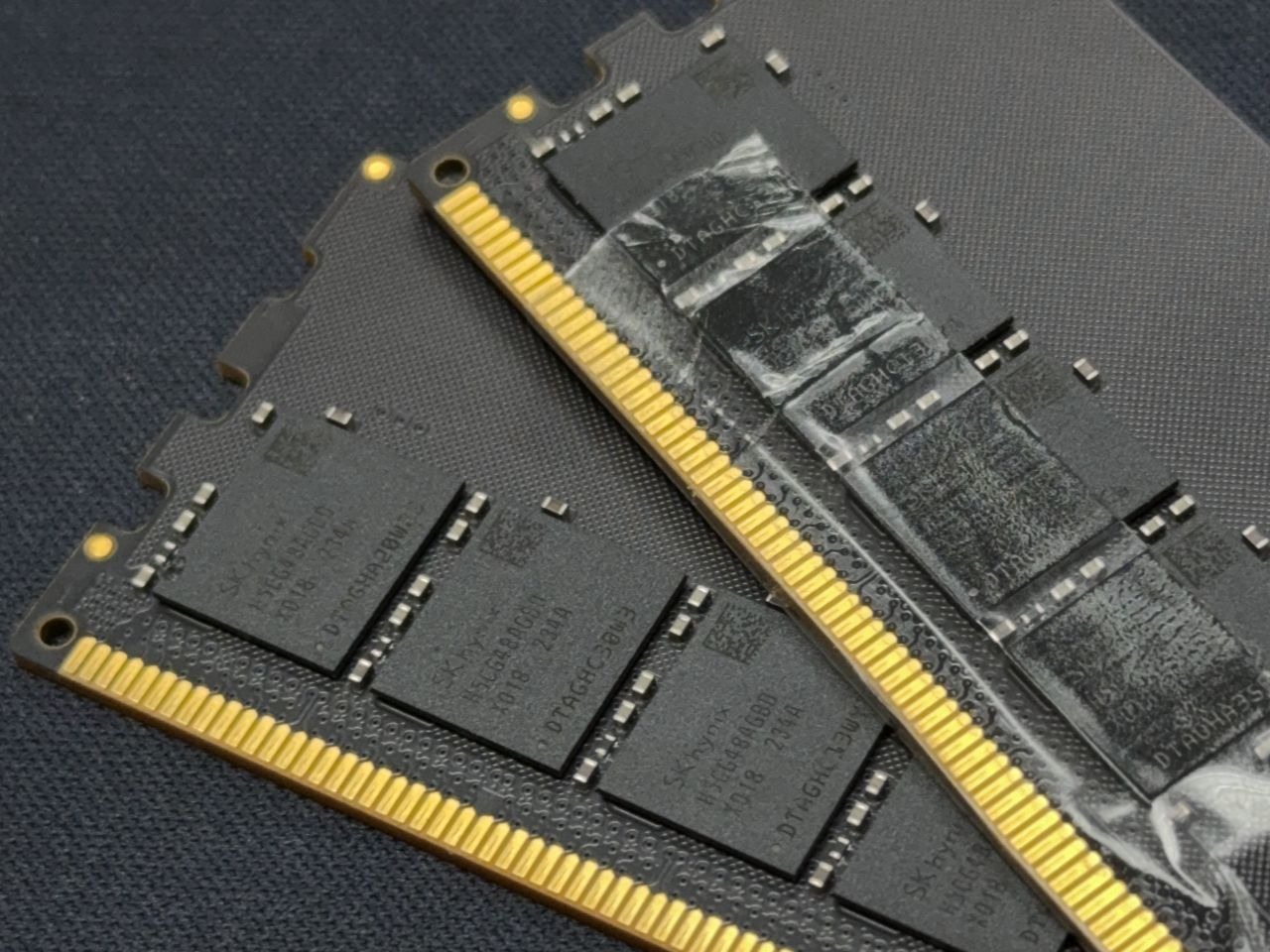
Intel and its partners are preparing a new, budget-minded DDR5 memory format called HUDIMM, short for Half-UDIMM. On paper, it sounds like an easy win for cost-conscious PC builders: cheaper DDR5 modules that could make modern platforms more affordable. The catch is that HUDIMM’s design change can cut memory bandwidth so dramatically that it may erase the advantages of choosing DDR5 in the first place—and in some situations could make DDR4 look like the smarter performance buy.
The key difference comes down to how the memory module is wired. Typical DDR5 UDIMM modules use two 32-bit sub-channels (effectively 2×32-bit). HUDIMM reduces that to a single 32-bit channel (1×32-bit) by populating only half the memory banks. That’s where the savings are expected to come from: less hardware on the module. Early HUDIMM capacities are expected to include 8GB and 12GB options, and the format is intended to be flexible enough that builders can mix and match HUDIMM modules with standard UDIMM sticks, even across different capacities.
However, the real-world performance downside is hard to ignore. In testing performed by HKEPC with assistance from ASUS, a standard DDR5 UDIMM was effectively turned into a HUDIMM-style module by masking off half the banks, converting its layout from 2×32-bit to 1×32-bit. The setup was then benchmarked using AIDA64’s cache and memory test to measure bandwidth and latency.
The results show a massive bandwidth drop when the module is reduced to HUDIMM operation. A 16GB UDIMM running at DDR5-7200 delivered roughly 58.9 GB/s read bandwidth in the tested configuration. After being converted into an 8GB HUDIMM-style module—still at DDR5-7200—read bandwidth fell to about 32.4 GB/s, with write and copy performance dropping similarly. In other words, the bandwidth was nearly cut in half.
The same pattern appeared at higher capacities. A 32GB UDIMM running at DDR5-7200 produced over 106 GB/s read bandwidth in a dual-DIMM configuration. When converted to a 16GB HUDIMM-style setup, bandwidth dropped below 60 GB/s—again, a steep reduction that reflects the loss of that second 32-bit channel.
Interestingly, memory latency didn’t change much in these tests. Latency hovered in the mid-to-high 80ns range across configurations, suggesting the main penalty is throughput rather than responsiveness. But for many real workloads—especially gaming performance consistency, integrated graphics, content creation, and memory-heavy multitasking—bandwidth is a key factor.
That brings up an uncomfortable conclusion for gamers and PC builders chasing value: even if HUDIMM modules cost less, the performance trade-off could be large enough to make the upgrade feel pointless. In fact, the testing notes suggest an especially troubling comparison: a single standard DDR5 UDIMM operating in single-channel mode can outperform a pair of HUDIMM modules in dual-channel, simply because the HUDIMMs are fundamentally bandwidth-limited by design.
The big unanswered question is pricing. If HUDIMM performance is closer to “half a module,” buyers will naturally expect a big discount to match. If HUDIMM modules are only slightly cheaper than standard DDR5 UDIMMs, they could end up being a poor deal for anyone who cares about performance per dollar.
For now, HUDIMM looks like a classic budget hardware dilemma: lower entry cost, but with a performance hit so significant that it may change the value equation entirely. If you’re building a PC where memory bandwidth matters—and for most modern systems, it does—standard DDR5 UDIMM kits may remain the safer choice until pricing proves HUDIMM is truly worth the compromise.