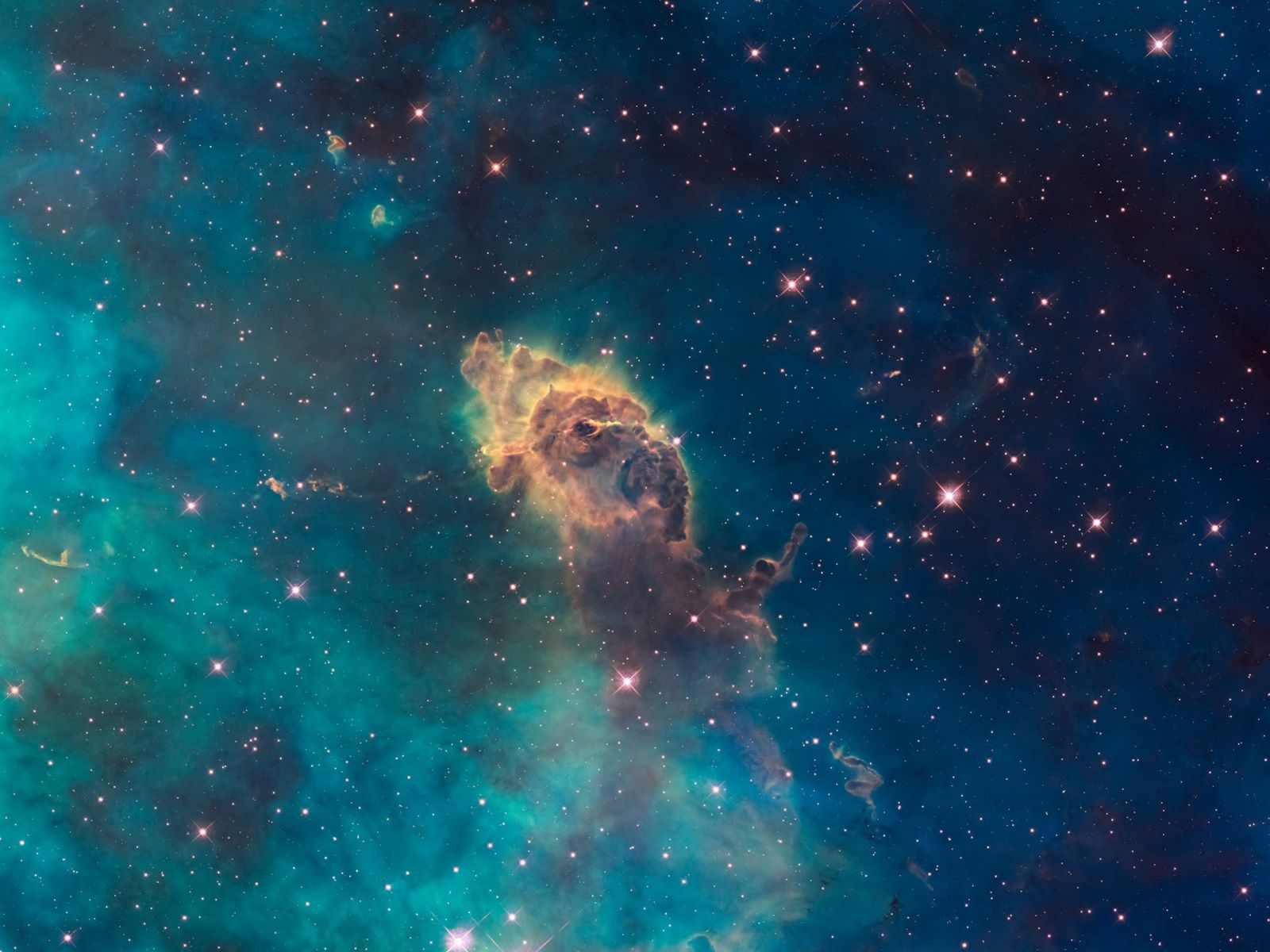
To mark the 36th anniversary of the Hubble Space Telescope on April 24, 2026, NASA has released a striking new image of the Trifid Nebula, one of the most recognizable star-forming regions in the night sky. Located roughly 5,200 light-years from Earth, the Trifid Nebula has long been a favorite target for astronomers studying how stars are born and how young stellar systems evolve.
This latest Hubble image zooms in on a small portion of the nebula, but it’s packed with detail. It reveals vast, billowing clouds of gas along with two prominent spike-like structures on the left side of the scene. Astronomers note that a star appears to sit at the tip of the first spike, the one pointing upward. Surrounding that star is a circumstellar disk, a dense, rotating ring that may contain gas, dust, and rocky debris—key ingredients associated with building planetary systems.
The second spike tells a very different story. Identified as HH 399, it’s a jet driven by a protostar—an infant star still forming. This jet stretches for several light-years, highlighting the powerful outflows that can occur during the earliest stages of star formation. Nearby, a thicker cloud of gas appears on the left, but its exact nature remains uncertain, adding another layer of mystery to an already complex region.
On the right side of the image, the scene darkens dramatically. A heavy, black cloud of dust blocks the light behind it, creating a stark silhouette. Rather than being “empty space,” this darkness points to an exceptionally dense area where new stars can form, hidden from view by thick dust.
While the image captures only a fraction of the Trifid Nebula, it provides valuable clues about the nebula’s structure and the processes unfolding inside it—from circumstellar disks to protostellar jets and dust-enshrouded stellar nurseries. With every new observation, Hubble continues to sharpen our understanding of how stars and planetary systems take shape across the universe.