NASA’s Hubble Space Telescope has released a striking new set of images that pull back the curtain on some of the galaxy’s youngest, still-forming stars. These “baby stars,” known as protostars, are key to understanding how massive stars are born and how they evolve in their earliest stages. By analyzing what these objects look like and how they interact with the material around them, astronomers can better pinpoint where each protostar sits in its development—and why some grow into stars far larger than our Sun.
One of the biggest challenges in studying protostars is that they’re typically wrapped in thick blankets of gas and dust. That cocoon blocks visible light, hiding the newborn star from traditional telescopes. Hubble, however, can pick up near-infrared light that slips through openings in the dust. These openings are called outflow cavities, and they’re carved by powerful jets and flows of gas and dust blasting away from the forming star. The result is a rare look into regions that would otherwise remain almost completely obscured.
Among the star-forming targets highlighted is Cepheus A, a high-mass stellar nursery located about 2,400 light-years from Earth in the constellation Cepheus. The region contains multiple infant stars, but a significant portion of its glow is dominated by one especially large protostar. In the image, soft pink and white cloud structures stand out. The pink glow marks an H II region—hydrogen gas that shines after being energized and ionized by ultraviolet radiation from nearby stars. Although many of the stars in Cepheus A remain hidden behind dust, their presence becomes clear where their light spills outward through those hollowed-out cavities.
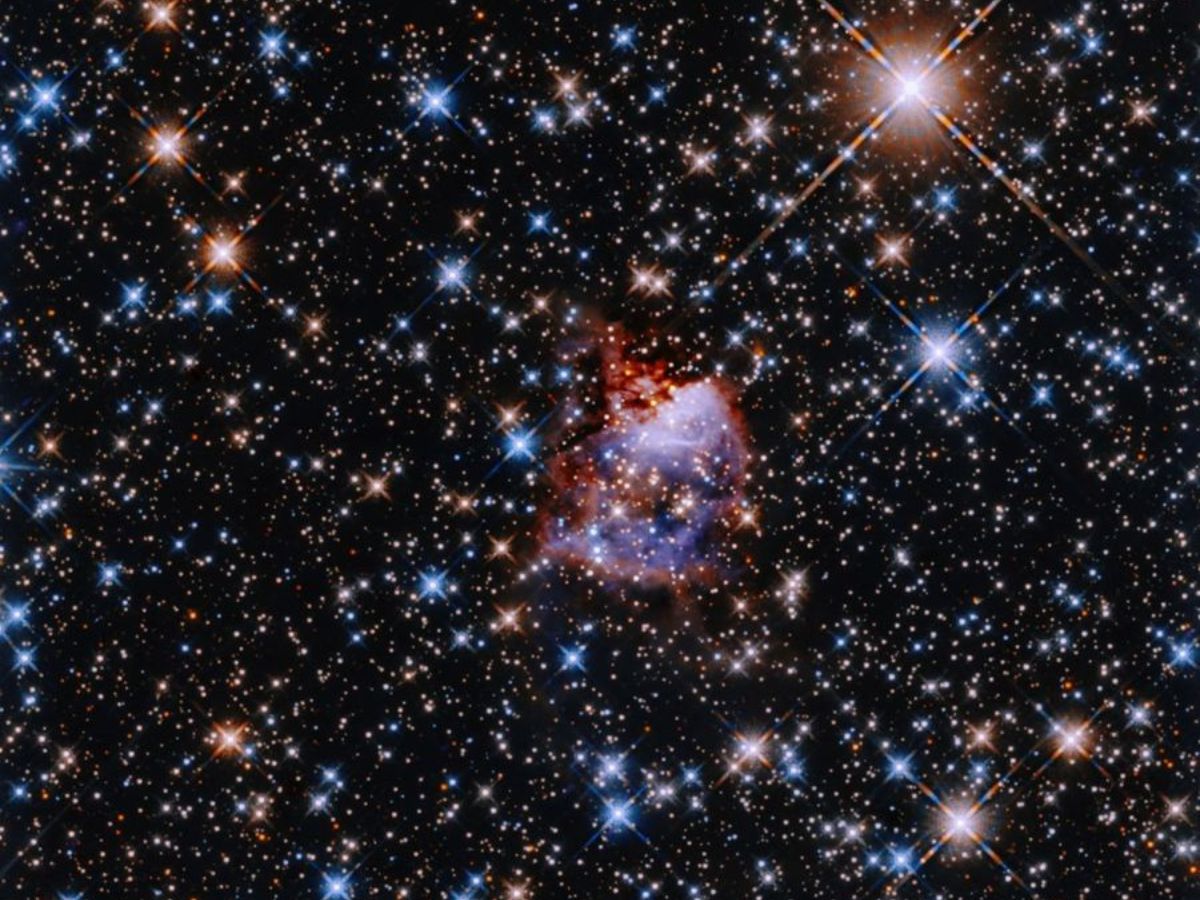
Hubble also turned its attention to a Milky Way star-forming site known as G033.91+0.11. Near the center, a bright, glowing patch appears as a reflection nebula. Instead of producing its own light, a reflection nebula shines by scattering and reflecting light from a star that remains concealed within dust. Images like this help researchers map how dust and gas are distributed around young stars—and how their surroundings shape what we can observe.
Another captured region, GAL-305.20+00.21, reveals a different kind of cloud: an emission nebula. Positioned slightly to the right of the image’s center, this nebula glows because surrounding gas is being ionized by radiation from a nearby protostar. In other words, the protostar’s energy is already strong enough to energize the material around it, causing the gas to radiate and light up the scene. This is one of the telltale signs astronomers use when estimating how intense and developed a forming star may be.
The collection also includes IRAS 20126+4104, a massive B-type protostar in a high-mass star-forming region about 5,300 light-years away in the constellation Cygnus. Objects like this are especially valuable to researchers because they represent a pathway to forming some of the most influential stars in the universe—stars that will eventually shape their environments with powerful winds, radiation, and, in many cases, dramatic supernova endings.
These images are part of the SOFIA Massive (SOMA) Star Formation Survey, a project focused on massive stars—those more than eight times the mass of the Sun. Massive stars are relatively rare, but they play an outsized role in the cosmos, forging heavier elements and transforming nearby space as they evolve. By using surveys like SOMA alongside Hubble’s ability to detect near-infrared light cutting through dust, scientists are working to answer one of astronomy’s biggest questions: exactly how do massive stars form inside such dense, turbulent stellar nurseries?