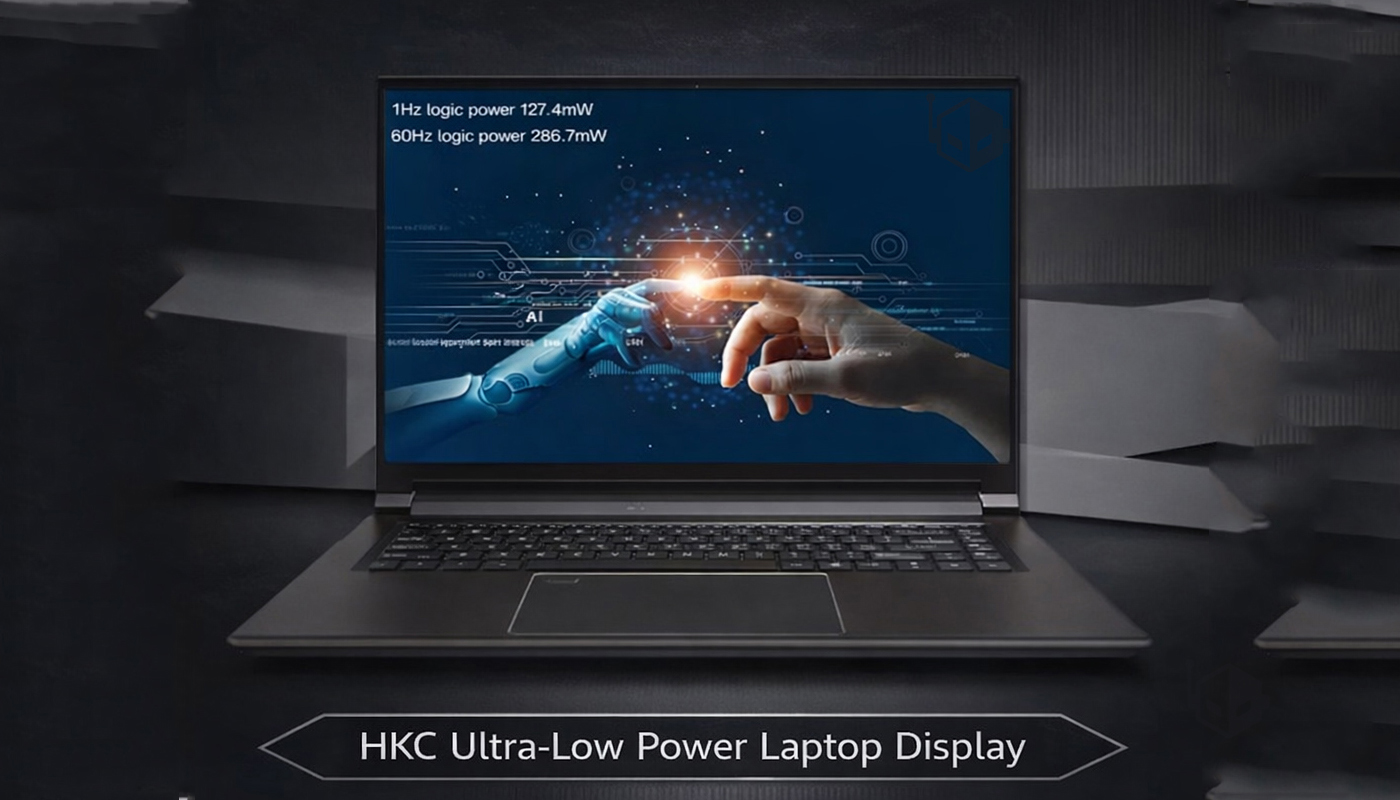
HKC is pushing laptop battery life forward with a new “Ultra-Low Power” display that uses AI-driven refresh rate control to dramatically cut energy use without introducing flicker. The big idea is simple but impactful: when the screen is showing mostly static content—like a document, a web page you’re reading, or a paused image—the panel doesn’t need to refresh dozens of times per second. By intelligently lowering the refresh rate in those moments, the display can save a meaningful amount of power and help laptops run longer on a single charge.
This approach follows a growing industry trend toward variable refresh laptop panels that can drop to extremely low refresh rates when the content doesn’t change. HKC’s version targets a wide 1–60Hz operating range, automatically scaling down to 1Hz when frequent updates aren’t necessary and returning to higher refresh rates when motion or interaction demands it.
HKC isn’t new to ambitious display tech. The company is one of China’s largest panel makers and is heavily focused on high-refresh innovation, including extreme-refresh monitors and specialty dual-mode displays. Now it’s applying that know-how to laptops, where efficiency matters just as much as responsiveness.
What makes this laptop panel stand out is the claimed power draw. At 60Hz, HKC says the display typically operates around 0.27–0.29 watts, which is already impressively low for a laptop screen. When the panel switches into an “Extreme Energy-Saving Mode,” it can reportedly drop to 1Hz and consume about 0.13 watts. In real-world terms, that kind of reduction can translate into longer battery life—especially during common low-motion tasks such as writing, reading, email, spreadsheets, and general productivity work.
HKC also points to indium oxide as a key enabler. Using indium oxide material is said to reduce current leakage, helping the panel remain stable and efficient at very low refresh rates. That’s important because extremely low refresh operation can sometimes introduce visible flicker or stability issues, and HKC is explicitly claiming flicker-free performance across the 1–60Hz range.
Of course, the big question is how it feels in actual use. Ultra-low refresh strategies can come with trade-offs if transitions aren’t handled smoothly. Rapidly switching from 1Hz back up to 60Hz during scrolling, cursor movement, or video playback can potentially cause frame drops, odd pacing, or increased input lag if the panel and control logic aren’t tuned well. For many users, those issues would be dealbreakers no matter how good the battery savings look on paper.
Still, if HKC’s flicker-free claim holds up and the refresh-rate switching is seamless, this could be a major win for future thin-and-light notebooks. A laptop display that sips power during everyday tasks—without compromising comfort or responsiveness—would be one of the most practical upgrades users can actually feel: longer unplugged time, less heat, and better overall efficiency.