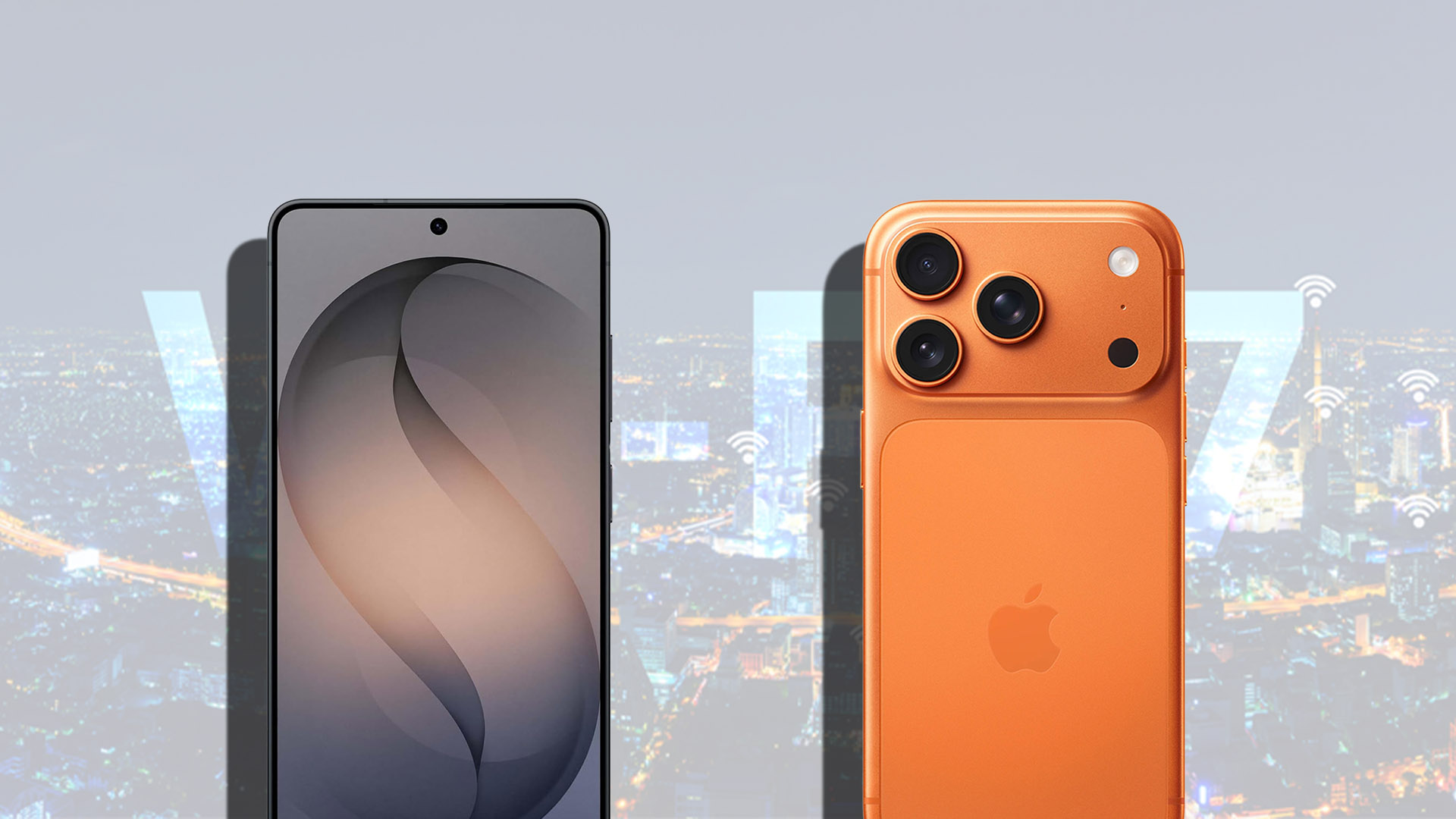
Wi‑Fi 7 has quickly become a must-have feature on today’s top flagship smartphones, promising faster downloads, lower latency, and better performance on crowded networks. But even when multiple premium phones advertise Wi‑Fi 7 support, they don’t all deliver the same real-world speeds. Recent side-by-side testing shows a clear gap between some of the biggest names—largely because not every device supports the full set of Wi‑Fi 7 capabilities.
One key reason for the performance split comes down to channel bandwidth. The iPhone 17 Pro Max uses Apple’s N1 wireless networking chip, which does not support the 320MHz channel. That 320MHz mode is a major pillar of the Wi‑Fi 7 standard and is a big part of how compatible devices can reach extremely high throughput under ideal conditions. Without it, the iPhone can still be fast, but it’s at an inherent disadvantage against phones that can use that wider channel.
In the same round of testing, both the Galaxy S26 Ultra and the Galaxy S25 Ultra outpaced the iPhone 17 Pro Max, highlighting how much the missing 320MHz support can matter. To keep the comparison from being a two-brand showdown, the test lineup also included the Pixel 10 Pro XL and the OnePlus 13.
To reduce variables, the local network test was set up with all phones connecting through the same TP-Link Deco BE95 router, while a separate computer acted as the server. All devices used the same IP address and port to keep conditions consistent.
Local speed test results (same router, same local server)
Pixel 10 Pro XL: 2,134Mbps download, 2,035Mbps upload, 10ms
iPhone 17 Pro Max: 1,971Mbps download, 1,838Mbps upload, 4ms
Galaxy S25 Ultra: 3,563Mbps download, 3,459Mbps upload, 6ms
Galaxy S26 Ultra: 3,963Mbps download, 3,651Mbps upload, 6ms
OnePlus 13: 4,281Mbps download, 3,785Mbps upload, 11ms
In this local test, the Galaxy S26 Ultra delivered nearly double the download and upload performance of the iPhone 17 Pro Max—while the OnePlus 13 went even further, recording the highest download speed of the group. Interestingly, the OnePlus 13 also showed the highest ping in the local test, even with its top-end throughput.
Galaxy S26 Ultra local speed comparisons
Compared to Pixel 10 Pro XL: 79.41% faster download, 85.71% faster upload
Compared to iPhone 17 Pro Max: 98.64% faster download, 101.07% faster upload
Compared to Galaxy S25 Ultra: 5.55% faster download, 11.23% faster upload
Compared to OnePlus 13: 3.54% slower download, 7.43% slower upload
The test also measured internet speeds, which can be influenced by more factors than a local transfer, such as ISP routing and server performance. Even so, the Galaxy models continued to lead overall download performance, and the OnePlus 13 again posted the highest download result of the entire group.
Galaxy S26 Ultra internet speed comparisons
Compared to Pixel 10 Pro XL: 4.04% slower download, 114.80% faster upload
Compared to iPhone 17 Pro Max: 2.26% slower download, 79.82% faster upload
Compared to Galaxy S25 Ultra: 8.01% faster download, 0.24% slower upload
Compared to OnePlus 13: 9.27% faster download, 6.76% slower upload
It’s worth keeping expectations grounded, because these peak Wi‑Fi 7 numbers are not what most people will see day to day. The highest results were achieved under extremely favorable conditions, with the router and the server PC positioned very close to the phones. Increase the distance, add walls, or introduce wireless interference, and the rankings—and the gap between them—can change quickly.
Still, the takeaway is clear for anyone shopping based on Wi‑Fi performance: “Wi‑Fi 7 supported” doesn’t automatically mean “Wi‑Fi 7 at full speed.” Features like 320MHz channel support can be the difference between strong gigabit-class performance and multi-gig speeds that pull far ahead of the pack.