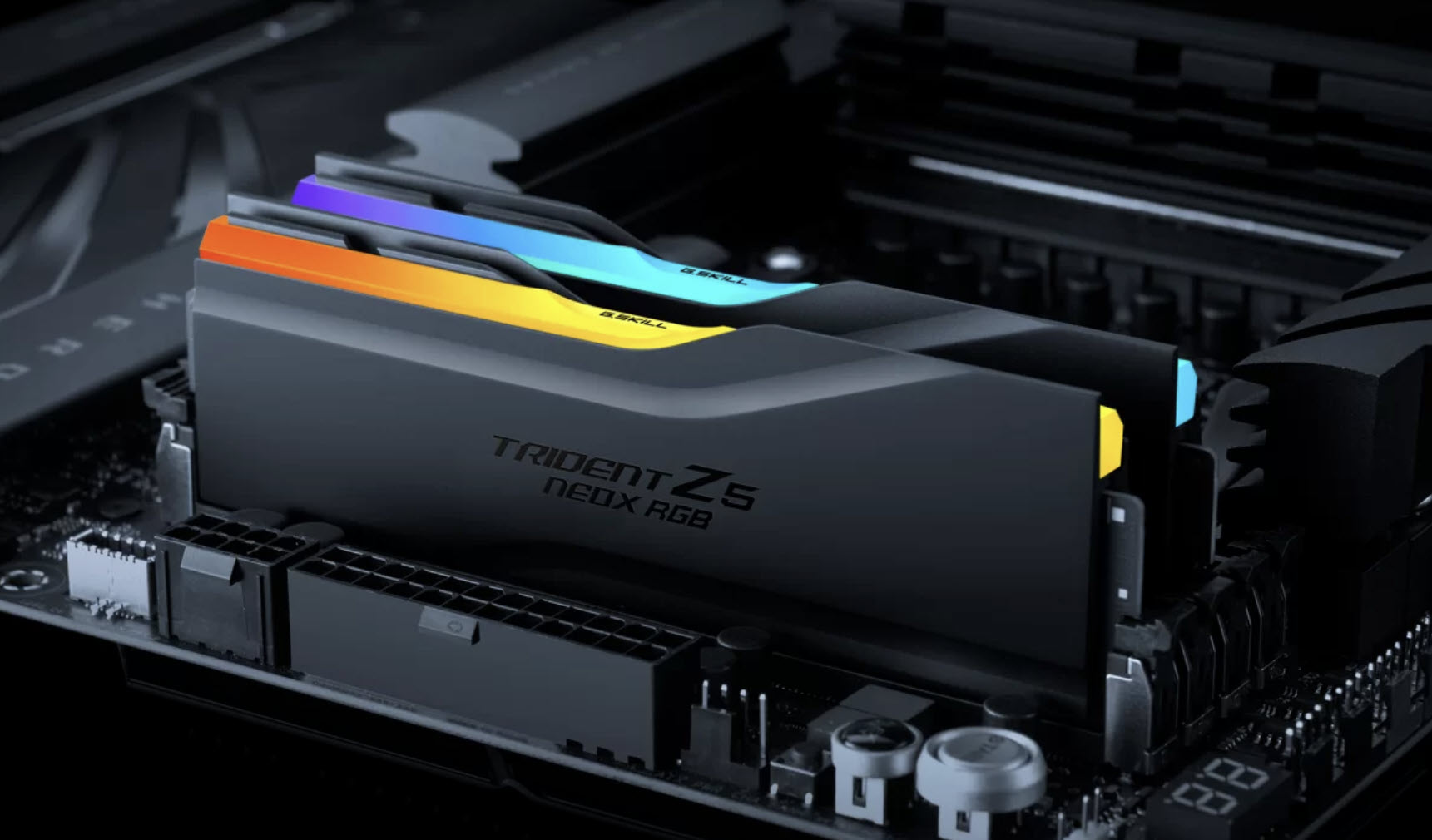
G.Skill has addressed the recent concern over the high prices of its new EXPO ULL DDR5 memory kits, explaining why the latest ultra-low-latency modules are currently selling for much more than standard AMD EXPO DDR5 kits.
AMD introduced EXPO ULL, short for Extended Profiles for Overclocking Ultra-Low Latency, during Computex as a new memory tuning option designed for the AM5 platform. The goal is simple: deliver lower latency on Ryzen systems and improve performance in workloads where memory response times matter, including gaming, content creation, and other demanding applications.
At the time of the announcement, AMD indicated that EXPO ULL memory kits would arrive at pricing close to regular EXPO DDR5 memory. Many PC builders expected a modest premium because of the tighter timings, but recent retail listings showed a much larger gap than anticipated.
G.Skill’s Trident Z5 NeoX DDR5 memory kits, which support EXPO ULL, appeared at retailers with prices noticeably above comparable standard EXPO kits. A 32GB kit with DDR5-6000 speeds and CL36 timings, for example, was listed at around $549 for the EXPO ULL version, while the regular EXPO version was listed at about $499. The difference becomes much more dramatic at the higher end, where some low-latency EXPO ULL kits are priced hundreds of dollars above their non-ULL counterparts.
One of the most expensive examples is a 32GB Trident Z5 NeoX DDR5-6000 kit with CL26 timings, which has been listed at around $1,099. A similar standard EXPO kit with CL26-class performance has appeared closer to $699. Other configurations also show wide gaps, with EXPO ULL kits using tighter secondary timings and newer memory ICs commanding higher retail prices.
The pricing sparked criticism among PC enthusiasts, especially because EXPO ULL was expected to be relatively close in cost to standard EXPO memory. G.Skill has now clarified that the higher price difference is not the result of an intended premium for EXPO ULL branding. Instead, the company points to changing market conditions and rising DRAM IC costs.
According to G.Skill, its pricing strategy for AMD EXPO ULL memory remains aligned with its non-ULL products. However, a major shift in DRAM pricing has created an unusual situation at retail. Many standard EXPO DDR5 kits currently on store shelves were purchased by retailers before the latest increase in memory component costs. Because of that, older non-ULL inventory is still being sold at prices based on earlier, lower DRAM costs.
EXPO ULL kits, on the other hand, are newer products. That means they are being manufactured and stocked using DRAM ICs purchased after the recent price increases. As a result, the new kits reflect today’s higher component costs, while some standard EXPO kits still reflect older pricing.
This explains why the gap looks so large right now. It is not necessarily that EXPO ULL memory is meant to be drastically more expensive long term. Rather, the market is temporarily showing two different pricing realities: older DDR5 inventory bought at lower costs and newer DDR5 inventory affected by the current DRAM shortage and price surge.
The situation may not remain this way for long. Once retailers sell through existing stocks of standard EXPO DDR5 memory, replacement inventory is expected to arrive at higher prices. That means regular EXPO kits could move much closer to EXPO ULL pricing in the coming months.
This is especially important for anyone planning a new AMD Ryzen AM5 build. DDR5 memory prices have already increased sharply compared to earlier this year. A 32GB DDR5-6000 CL36 kit that now sells for around $499 was previously available for roughly $100 to $150 before the latest wave of price increases. That represents a massive jump for one of the most popular memory configurations used in gaming PCs.
Industry expectations suggest that DRAM prices may continue rising through the next several quarters. Some forecasts point to further increases of up to 50% in the third quarter, followed by another possible rise of around 40% in the fourth quarter. If those projections hold, DDR5 memory could become even more expensive, and shortages may continue to affect availability for years.
For buyers, this creates a difficult decision. Standard EXPO DDR5 kits may still look like the better deal today if they are based on older stock, but those prices may disappear once inventory runs out. EXPO ULL kits are expensive now, but they may simply be showing where the broader DDR5 market is heading.
The key takeaway is that G.Skill’s EXPO ULL DDR5 pricing is being shaped heavily by the current DRAM market rather than by an unusually high product markup. As memory component costs rise, the price difference between standard EXPO and EXPO ULL kits could shrink, not because EXPO ULL gets cheaper, but because regular DDR5 kits become more expensive.
For gamers, overclockers, and PC builders, AMD EXPO ULL memory remains an attractive option for squeezing more performance out of AM5 systems, especially with low-latency DDR5-6000 configurations. However, with DDR5 prices climbing fast, timing a memory purchase may now be just as important as choosing the right speed and timings.