One of the original minds behind WeTransfer is sounding the alarm about what he sees as the platform’s shift away from the simplicity that made it a household name in file sharing. Dutch entrepreneur Nalden, who co-founded WeTransfer back in 2009, says he’s frustrated with the changes introduced after the service was acquired last year by Bending Spoons, a Milan-based company known for purchasing popular apps and reshaping how they operate.
In Nalden’s view, the post-acquisition updates haven’t improved the product for everyday users—especially creatives who relied on WeTransfer for fast, no-fuss sharing. He believes the service has become more complicated over time, and says recent decisions have moved it further away from user-first design.
Following the acquisition, WeTransfer drew criticism on multiple fronts. Users noticed confusing changes to how transfer links worked, and the company also went through major layoffs, cutting roughly 75% of its staff. More recently, it faced backlash over the idea of using user content to train AI models, prompting the company to reverse course and revise its terms after public pressure.
Nalden says those controversies didn’t go unnoticed by the community that helped build WeTransfer’s reputation. As complaints piled up—especially from designers, photographers, and other creative professionals—he decided he didn’t just want to criticize from the sidelines. He wanted to build a new option that brings file sharing back to what it used to be: quick, straightforward, and friction-free.
That new service is called Boomerang.
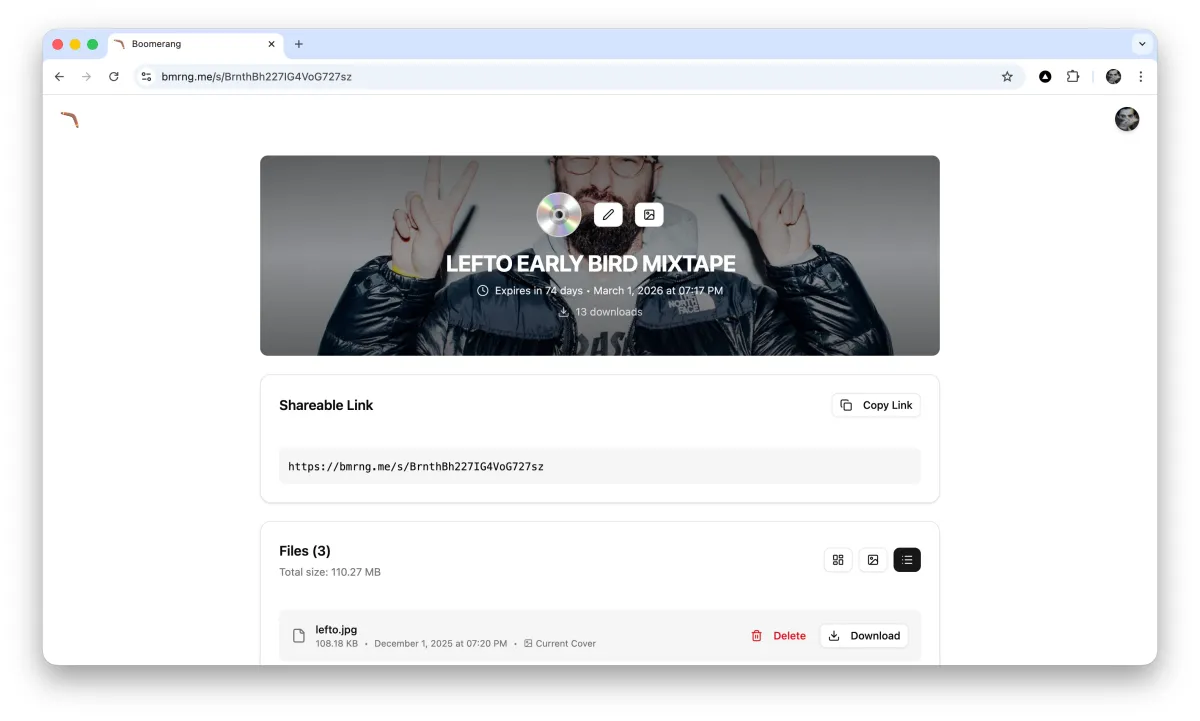
Boomerang positions itself as a simple WeTransfer alternative designed around speed and ease of use. A big part of that philosophy is letting people send files without creating an account or logging in. For many casual users, that’s the entire point: upload, share, and move on—without sign-ups, email verification, or extra steps.
Of course, the no-login approach comes with limits. Without an account, users get up to 1GB of total storage, with a 1GB file size limit and links that expire after seven days. Creating a free account expands those limits to 3GB total storage and a 3GB file size cap, along with useful extras like upload history, the ability to add or delete files whenever you want, and even custom emojis for file-sharing pages.
For users who need more room—such as freelancers juggling large client deliverables—Boomerang also offers a paid plan at €6.99 per month. That tier includes up to 200GB per folder and 500GB total storage, supports files up to 5GB, and adds practical features like password protection, custom folder covers, expiration settings up to 90 days, and unlimited invitations for shared folders.
Beyond storage and pricing, Nalden is making a clear promise about how Boomerang will operate. He says the service won’t include advertising and won’t collect unnecessary user data—arguing that ads often introduce clutter and complexity while pushing products away from what users actually want. His goal is to keep Boomerang feeling like a simple tool: not flashy, not overloaded, just reliable.
That stripped-down approach is reflected in the design. Boomerang’s interface is intentionally minimal, built to feel functional rather than investor-friendly. And while many tech platforms are rushing to add AI features everywhere they can, Nalden says Boomerang won’t force AI into the user experience. He’s open about using AI behind the scenes to help build the product, but he doesn’t want AI-driven features to complicate file sharing for the people using it.
Boomerang is currently available on the web, and a dedicated Mac app is expected to arrive soon—giving creatives and professionals another lightweight option for fast, secure file transfers without the headaches that often come with modern “all-in-one” platforms.