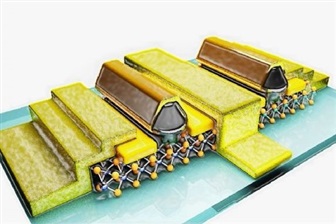
Two-dimensional (2D) materials have been on the semiconductor industry’s radar for years, often described as a potential path to keep chip scaling alive as conventional silicon approaches its practical limits. Because these materials can be as thin as a single atomic layer, they’ve been viewed as a natural fit for building extremely small transistors that could operate with very low power—an appealing combination for everything from smartphones and laptops to data centers and future AI hardware.
The excitement is easy to understand. In theory, an atom-thin channel gives engineers far tighter electrostatic control, which is one of the key requirements for making field-effect transistors (FETs) shrink further while still switching reliably. When transistors get smaller, controlling current leakage and power draw becomes harder. That’s where 2D materials have looked promising: minimal thickness, potentially less leakage, and the prospect of ultra-compact, energy-efficient devices.
But the closer these concepts get to real-world advanced logic manufacturing, the more complex the reality becomes. The central challenge isn’t whether 2D materials can work in a lab setting—it’s whether they can be integrated into cutting-edge chip fabrication at scale. Making FETs from 2D materials demands process control that borders on the single-atom level. At these dimensions, even tiny variations—an extra atomic defect here, a slight inconsistency there—can meaningfully change how a transistor behaves.
This precision requirement becomes a major hurdle for advanced logic nodes, where billions of transistors must be produced with extremely tight tolerances and high yield. Modern semiconductor production already pushes the limits of materials science and manufacturing control. Introducing atom-thin materials raises the bar further: deposition, patterning, interfaces, and uniformity all need to be managed with extraordinary accuracy.
In other words, 2D materials still represent an intriguing vision for the future of transistor scaling and ultra-low-power computing, but moving from “promising candidate” to “production-ready technology” is where the hardest part begins. The path forward hinges on whether chipmakers can achieve the near-atomic process control required to reliably build advanced FETs from these materials—at the speed, volume, and consistency that next-generation logic manufacturing demands.