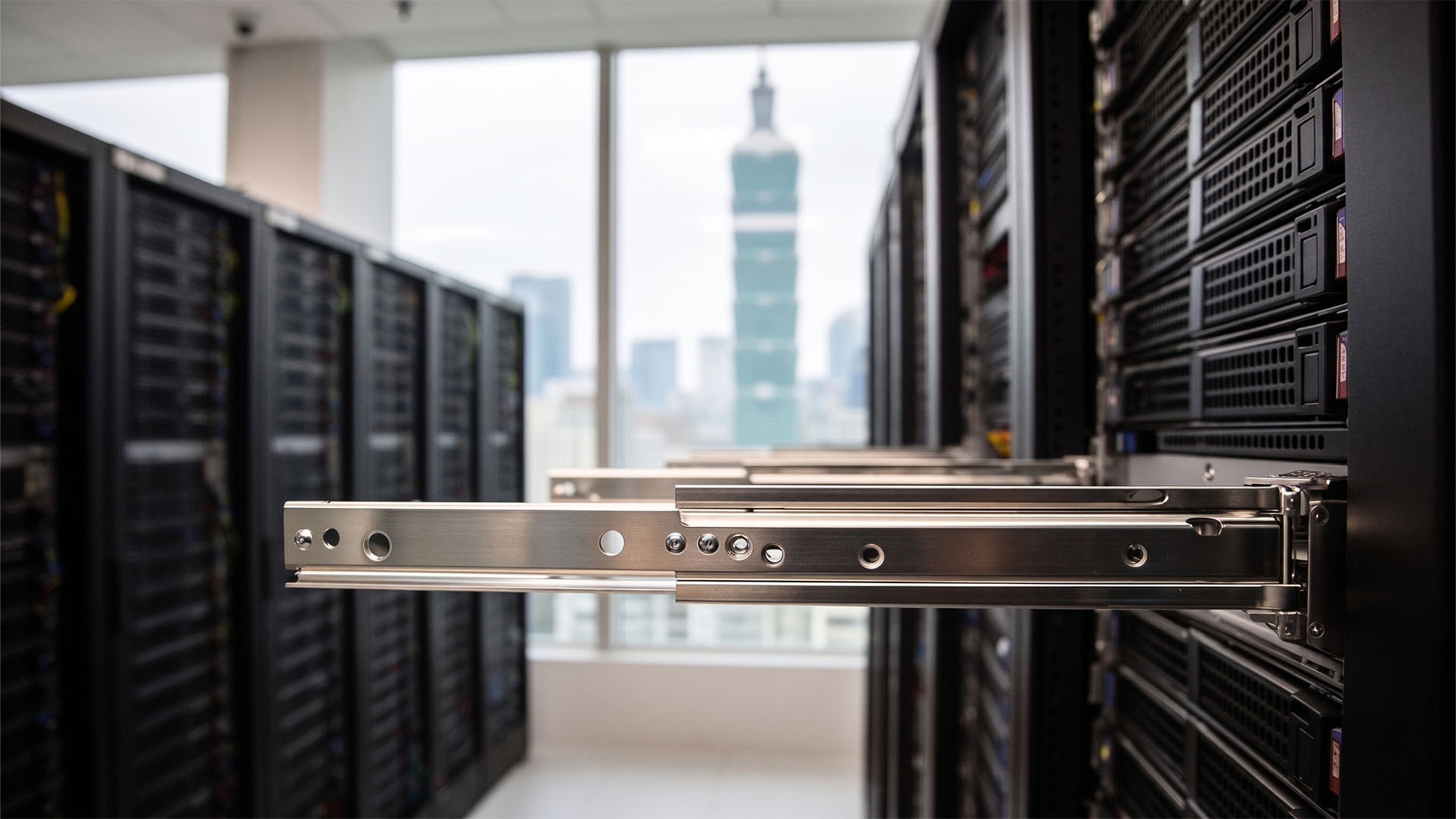
How a Drawer-Slide Maker Became a Critical Player in the AI Server Boom
The global race to build more powerful AI systems has put enormous attention on advanced chips, high-bandwidth memory, data centers, and liquid cooling. But one essential part of the AI hardware supply chain rarely gets the spotlight: the mechanical rails that hold massive AI servers inside data center racks.
Surprisingly, one of the most important companies in this space is King Slide Works, a Taiwanese manufacturer that originally built its reputation making drawer slides for household furniture and kitchen cabinets. Today, the company reportedly controls an estimated 70% to 90% of the market for precision slide rails used in high-end AI server racks.
That may sound unusual at first, but the connection makes sense. A server rail works on a similar mechanical principle to a heavy-duty drawer slide. It uses steel strips and rows of ball bearings to let a heavy chassis slide in and out of a rack for maintenance. However, AI servers push this basic concept to an extreme level of engineering.
Modern AI server racks are becoming heavier, denser, and more complex. A pair of rails for an AI server node can be only about 6.1 mm thick, yet they must support a chassis weighing more than 40 kg when fully extended. These rails cannot flex, jam, or bend, even under heavy load. Each rail assembly can contain more than 100 individual parts, with manufacturing tolerances as tight as 0.02 mm.
That level of precision is especially important as next-generation AI systems become more demanding. Platforms such as NVIDIA’s Blackwell GB200 require dense hardware layouts, advanced liquid cooling, and thick coolant pipes running through the server rack. As a result, rail systems must become thinner while still carrying more weight and surviving repeated maintenance cycles.
A single rail failure could be disastrous. If a fully loaded AI server crashes to the floor, it could destroy hardware worth hundreds of thousands of dollars or more. For hyperscale data center operators and server manufacturers, saving a small amount on cheaper rails is not worth the risk. That is why premium precision rail suppliers have become so valuable in the AI infrastructure market.
King Slide has turned this engineering challenge into a highly profitable business. Industry figures indicate the company achieved an 87.4% gross margin in the second quarter of 2026. That is an extraordinary number for a hardware component supplier, especially considering that a rail kit can sell for under $100 while helping protect computing equipment worth millions.
The company’s strength is not just manufacturing capacity. King Slide has built a deep patent portfolio, reportedly holding around 3,750 patents covering areas such as custom stamping lines, plating techniques, tooling, and locking mechanisms. These patents create a powerful barrier for competitors trying to enter the high-end AI server rail market.
Competition does exist. Taiwanese manufacturer Nan Juen has also expanded into this field and eventually entered NVIDIA’s supply chain as a partner for GB200-related systems. Still, King Slide remains the dominant force, thanks to its long history in precision mechanical design, established customer relationships, and large-scale production know-how.
To keep up with surging demand from AI data centers, King Slide has approved more than $600 million in capital expenditure to build what is expected to become the world’s largest server rail manufacturing plant. This move shows how important mechanical components have become in the AI boom.
The story of King Slide highlights a key reality of artificial intelligence infrastructure: AI is not powered by chips alone. Behind every advanced GPU cluster are cooling systems, power systems, racks, rails, and precision-engineered components that must work perfectly under extreme conditions.
As AI servers grow heavier and more expensive, the humble slide rail has become a mission-critical part of the modern data center. And for King Slide, a business that began with everyday drawers has evolved into one of the quiet winners of the global AI hardware revolution.