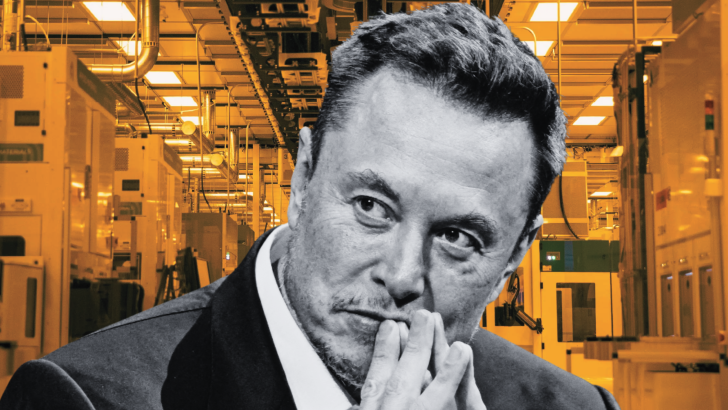
Elon Musk’s plan to build Tesla’s own chip fabrication facilities is about much more than chasing extra supply. It’s a strategic move to secure the company’s long-term AI ambitions and create a safe haven from geopolitical risks that could disrupt the global semiconductor chain.
At a recent shareholder meeting, Musk said Tesla is exploring an in-house “TeraFab” to produce its next-generation AI5 and AI6 chips. While both TSMC and Samsung have reportedly earmarked production lines for Tesla’s custom silicon, the combined capacity still isn’t enough to match the automaker’s aggressive roadmap for autonomy, robotics, and AI infrastructure. That demand-supply gap is only part of the story. The deeper motivation, according to analyst Ming-Chi Kuo, is risk mitigation: Musk is wary of the world’s chipmaking capacity being so heavily concentrated in Taiwan. Even with TSMC expanding abroad, shifting meaningful capacity to the United States is a multi-year process. For a company betting its future on AI workloads, training compute, and edge inference inside vehicles and robots, relying solely on offshore fabs introduces volatility Tesla can’t fully control.
This isn’t a knock on TSMC’s willingness to support new customers. The foundry is known for accommodating orders at scale. But in practice, Tesla would sit behind long-standing, high-volume clients like Apple, NVIDIA, MediaTek, and Qualcomm. That seat further back in the queue can limit co-optimization, engineering support, and the production flexibility needed to iterate fast on cutting-edge designs. By pairing work with Samsung Foundry and standing up its own TeraFab, Tesla gains tighter control over timelines, process choices, and silicon characteristics that directly impact performance, efficiency, and cost.
Musk’s remarks also hinted at a rapid design-to-production cadence: the goal of moving from AI5 to AI6 within roughly a year using the same fab suggests a modular ramp strategy. That kind of agility is essential as AI architectures evolve quickly and as Tesla looks to unify hardware and software across full self-driving, the Optimus robot, data center training, and in-vehicle inference.
Of course, building and running a chip fab is one of the toughest industrial challenges on the planet. It demands tens of billions in capital, deep expertise in process integration, yield learning, and materials science, as well as a robust ecosystem of design tools, IP, packaging, and testing. Even industry veterans continue to wrestle with yield targets and competitive process nodes. But Musk has a history of steering into problems others avoid. That doesn’t guarantee success, yet it does explain why judging the initiative solely on the difficulty of the task misses the strategic upside if it works.
What Tesla stands to gain if the TeraFab vision comes together:
– Supply security insulated from geopolitical uncertainty, particularly around Taiwan
– Faster iteration cycles from AI5 to AI6 and beyond, with process tweaks driven by Tesla’s own priorities
– More leverage in foundry partnerships by reducing reliance on a single supplier
– Potential cost and performance advantages through co-design of chips, packaging, and software stacks tailored to Tesla’s workloads
The stakes are high. AI demand across automotive autonomy, humanoid robotics, and energy products is compounding, and the best-performing systems increasingly come from companies that co-design chips, models, and software. Owning more of the semiconductor stack could let Tesla synchronize its hardware evolution with real-world data feedback and software updates, cutting months from development loops.
There’s still a long path ahead. Site selection, tooling lead times, workforce recruitment, supplier agreements, and regulatory approvals all take time. Public incentives may help, but they won’t eliminate execution risk. Even so, the logic behind the move is clear: create a domestic, resilient pipeline for the chips that will power Tesla’s next decade and reduce exposure to bottlenecks that no single automaker can control.
Whether the TeraFab becomes a full-fledged production hub or a hybrid strategy that complements external foundries, the intent signals where Tesla is headed. If the company can translate its ambition into a functioning, scalable semiconductor operation, it won’t just secure more chips. It will carve out a strategic advantage in the race to build AI-native vehicles, robots, and energy systems—on its own timetable and on its own terms.