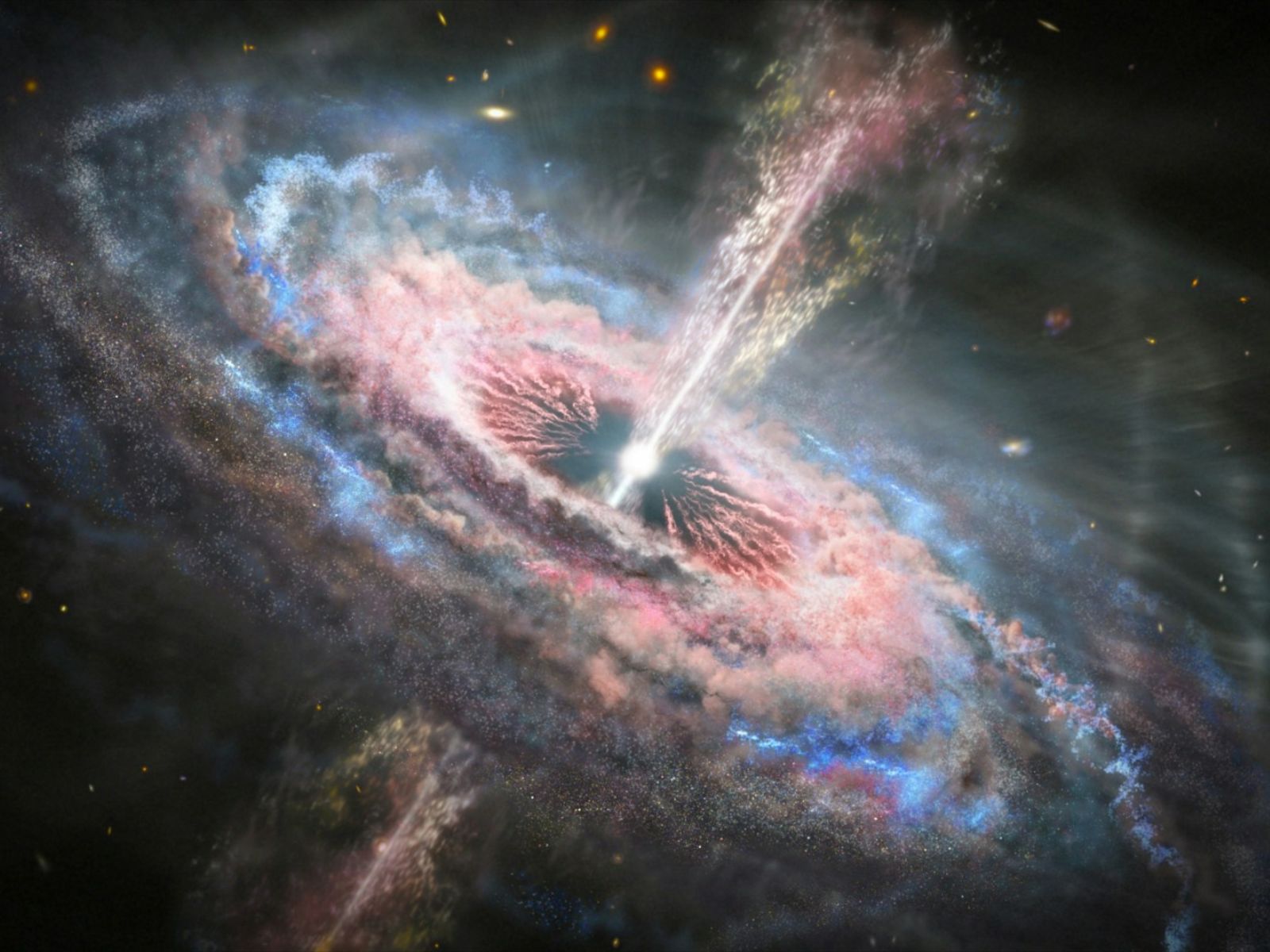
For the first time, scientists have directly measured both the power and the speed of jets blasted out by a black hole about 7,200 light-years from Earth, offering a clearer look at how these extreme objects behave and influence their surroundings.
The target of the research is Cygnus X-1, a famous system in our galaxy that contains the first black hole ever identified along with a massive blue supergiant star. The two objects orbit close enough that the black hole steadily pulls in material from its stellar companion. That steady stream of matter doesn’t simply disappear beyond the black hole’s grasp—some of it ends up being redirected and expelled outward in narrow, high-energy jets.
To pin down just how intense those jets are, University of Oxford researcher Steve Prabu and colleagues examined an enormous archive of data: 18 years of observations gathered from multiple telescopes around the world. With this long baseline, the team was able to quantify the jets’ energy output and motion more precisely than before.
Their results show the jets carry a staggering amount of power—comparable to the combined output of about 10,000 suns. Even more dramatic is their speed: roughly 355 million miles per hour (around 571 million km/h), which is about half the speed of light. Measurements like these help transform black hole jets from a dramatic idea into something scientists can calculate, compare, and use to test models of how black holes feed and expel energy.
So why do these jets form at all? The leading explanation is tied to the black hole’s “diet.” As the blue supergiant feeds the black hole with gas, the infalling material swirls into a hot, fast-moving disk. Under the influence of intense magnetic fields and extreme gravity, part of that material can be launched away from the system along the black hole’s poles, producing the observed jets.
Understanding Cygnus X-1 matters beyond this single system. Black hole jets are thought to play a major role in shaping their environments, from heating surrounding gas to regulating where and when stars can form. By measuring jet power and speed in detail—and then repeating these measurements across other black hole systems—scientists can build a stronger picture of how black holes interact with and help sculpt their host galaxies.