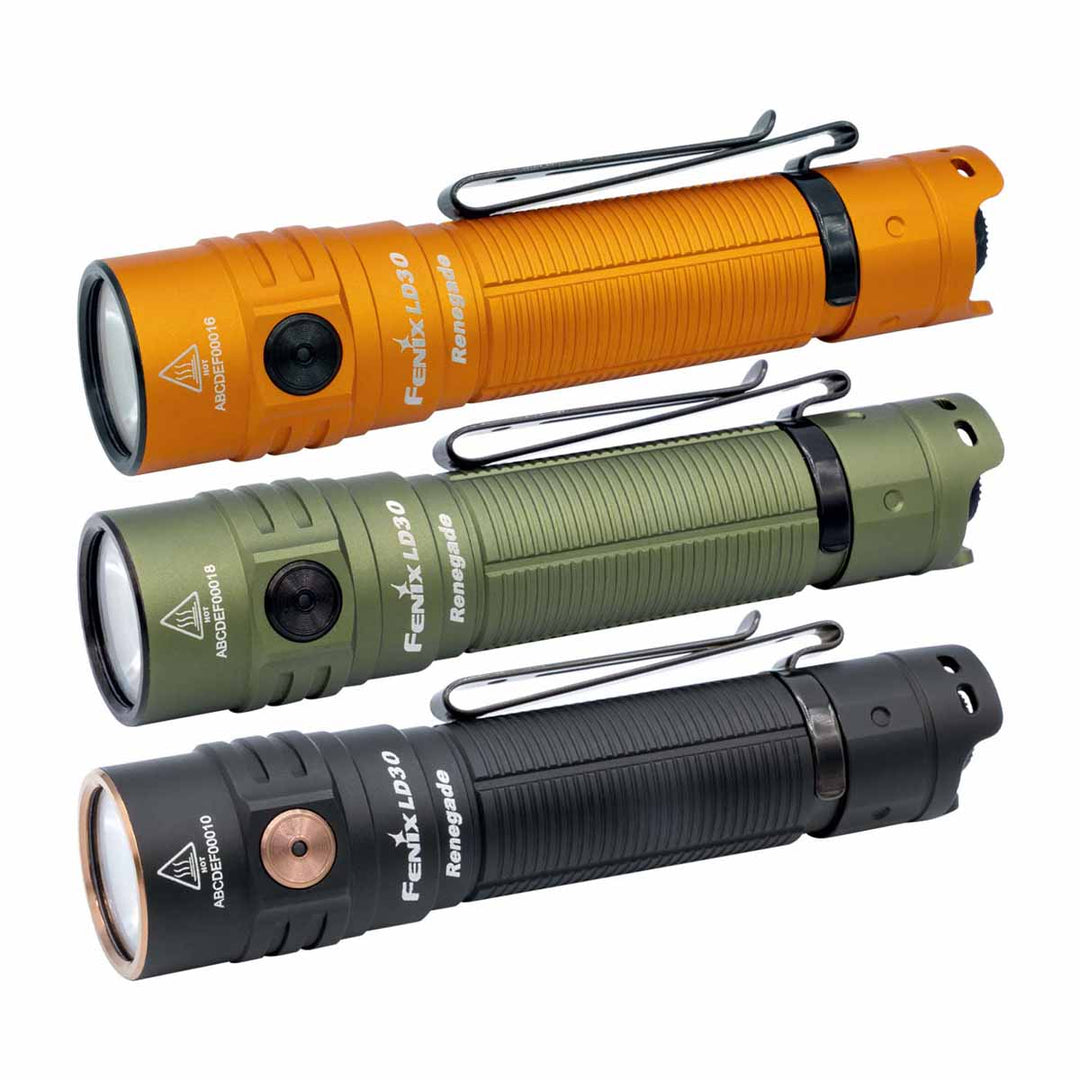
Fenix is expanding its lineup with a fresh batch of everyday-carry lights under a new name: the Renegade series. The idea behind the range is simple and practical—these lights use replaceable batteries, and instead of putting a charging port on the flashlight body, Fenix builds a USB-C port directly into the battery. That means you can swap in a spare cell when you’re out and about, then charge the removed battery separately when needed.
One of the first models out of the gate is the Fenix LD30 Renegade, a compact EDC flashlight that shouldn’t be confused with the older LD30R. In the US, it’s expected to land around the $80 mark and will be available in orange, green, and black.
Compact EDC size with a familiar battery type is a major part of the LD30’s appeal. It runs on an 18650 cell, helping keep the overall weight down to about 4.2 oz. Fenix also includes a pocket clip, and it’s designed to do double duty—attach it to a bag or pocket, or clip it onto a cap for quick hands-free use.
Charging works a little differently than many modern flashlights. Because the USB-C port is on the 14.4Wh battery itself, you’ll need to remove the cell from the flashlight to plug it in. The upside is flexibility: carrying an extra battery can be more useful than waiting for a light to recharge, especially for travel, work, or emergency kits.
On the performance side, the LD30 delivers a turbo mode rated at 1,800 lumens with a beam distance of roughly 220 yards. Fenix lists a runtime of 3 hours and 4 minutes for turbo, but there’s an important detail: like most high-output compact flashlights, it can’t sustain maximum brightness continuously. Output will step down as heat and battery demands increase.
Other brightness levels are designed for longer use. There’s a 1,000-lumen mode rated for 3 hours and 45 minutes with about 164 yards of throw, plus additional modes at 600, 200, 50, and 5 lumens. For extended runtime, the 50-lumen setting is listed at up to 45 hours, while the ultra-low 5-lumen mode can run for nearly 11 days—useful for navigating indoors at night, reading maps, or stretching battery life during outages.
Fenix also leans into versatility with optional accessories. Add a diffuser and the LD30 can function like a small lantern for area lighting, and compatible traffic wands can be attached for directing traffic or boosting visibility during roadside situations.
Durability is another strong point. The LD30 is about 4.7 inches long, built for rugged use, and carries an IP68 rating. It’s designed to handle dust and can be submerged in water up to around 6.5 feet for a limited time, though it’s not intended as a diving flashlight. For daily carry peace of mind, a mechanical lock slider helps prevent accidental activation in a pocket or bag. Even with a rear switch present, the flashlight can still stand upright, which is handy for bounce lighting off a ceiling or using it as an improvised area light.
Fenix isn’t stopping with the LD30. The company has also previewed a slightly more powerful LD31, though a specific release date and detailed specifications haven’t been shared yet. Based on images so far, it appears larger and may use a 21700 battery, a common choice for higher capacity, longer runtimes, or increased output.
For anyone searching for a compact, high-lumen EDC flashlight with a replaceable battery, modern USB-C charging (via the battery), strong waterproofing, and multiple brightness levels tailored to real-world use, the Fenix LD30 Renegade is shaping up to be a practical new option in the Renegade series.