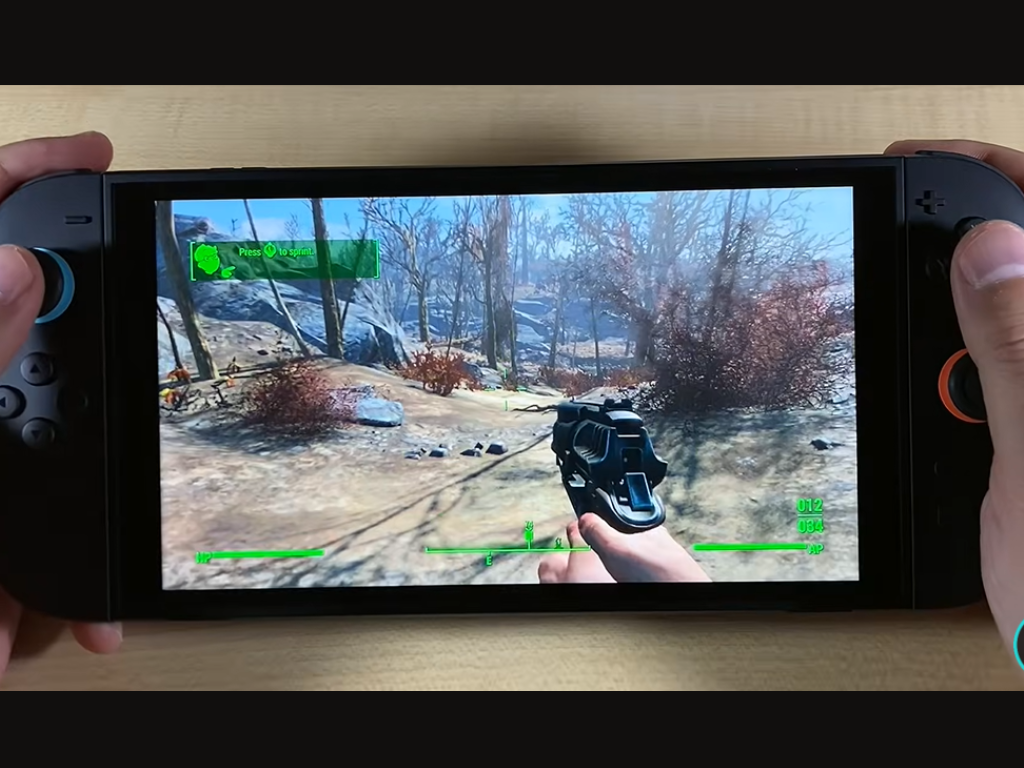
Bethesda’s Fallout 4 Anniversary Edition has officially landed on Nintendo Switch 2, and it’s shaping up to be a much stronger showing than the early footage suggested back in February 2026. While it doesn’t reinvent the game or erase every long-standing Fallout 4 quirk, this release delivers a largely faithful port with noticeably better baseline performance than the last-gen console versions many players remember.
What you’re getting here is the Anniversary Edition package: the base game plus six major DLC expansions, making it an easy all-in-one way to revisit the Commonwealth. That said, some familiar issues still tag along for the ride. Certain visual bugs that have historically appeared across multiple platforms aren’t fully cleaned up, so this version stays true to Fallout 4’s original personality—for better or worse.
Where the Nintendo Switch 2 edition really stands out is how it handles resolution and frame rate options, especially when docked. In docked mode, Fallout 4 can run at a native 1440p while targeting 30FPS, and it generally holds that line well throughout early gameplay, including open-world exploration and even downtown Boston. Compared with the original PS4 and Xbox One era targets, this is a substantial step up in image clarity.
Performance isn’t flawless, though. In heavier moments—think busy combat encounters with multiple enemies, effects, and lots of on-screen activity—the game can dip below 30FPS in rare cases. When the load spikes, dynamic resolution scaling can also kick in and reduce resolution as low as 720p to keep things moving. This behavior can show up across all modes, and it may be even more noticeable in the higher frame rate options.
Switch 2 players can choose between 30FPS, 40FPS, and 60FPS modes, and interestingly, visual settings like lighting, shadows, and textures remain broadly consistent regardless of which mode you pick. The biggest visual compromise is how aggressively the resolution scales in the 40FPS and 60FPS modes, which can make the image look softer than the 30FPS option.
For many players, the current “best balance” appears to be 40FPS while docked, especially if you’re playing on a 120Hz display. This mode targets 1080p and, when paired with VRR, improves motion smoothness and frame pacing enough to feel less jittery than the standard 30FPS presentation.
The 60FPS docked mode is the most demanding and predictably the least stable. In intense fights or when looking across large, detailed areas, frame rates can slip into the sub-50FPS range or lower, and resolution may fall to 720p or 864p under heavy load. VRR can help reduce how distracting those drops feel, but this setting is clearly for players who prioritize responsiveness and can tolerate fluctuating performance.
Handheld mode comes with different trade-offs. To preserve battery life, the system runs at lower clock speeds, yet the game’s general graphical settings remain similar across the FPS modes. The main sacrifice is resolution scaling becoming much more aggressive.
In handheld at 30FPS, Fallout 4 targets a native 1080p and may dip to around 1026p or lower during intense scenes, making it the cleanest portable option overall. The handheld 40FPS mode typically hovers between roughly 810p and 990p. Meanwhile, handheld 60FPS can drop dramatically in demanding moments—down to around 504p in visually intense scenes—though it can climb toward 900p in lighter areas. Even then, VRR helps keep motion smoother than you might expect when the internal resolution is shifting so frequently.
At launch, the Nintendo Switch 2 version uses Bethesda’s temporal anti-aliasing, but there’s more on the way. Bethesda has confirmed that Nvidia DLSS (CNN model) will be added in a future patch, which could improve image clarity and potentially help performance depending on how it’s implemented.
Bottom line: Fallout 4 Anniversary Edition on Nintendo Switch 2 is a welcome port that makes a strong case for replaying (or finally starting) one of Bethesda’s biggest RPGs on new hardware. It looks sharper than last-gen versions in its best docked configuration, offers multiple performance modes for different play styles, and—with DLSS promised—may get even better over time, even if some classic Fallout 4 oddities still remain.