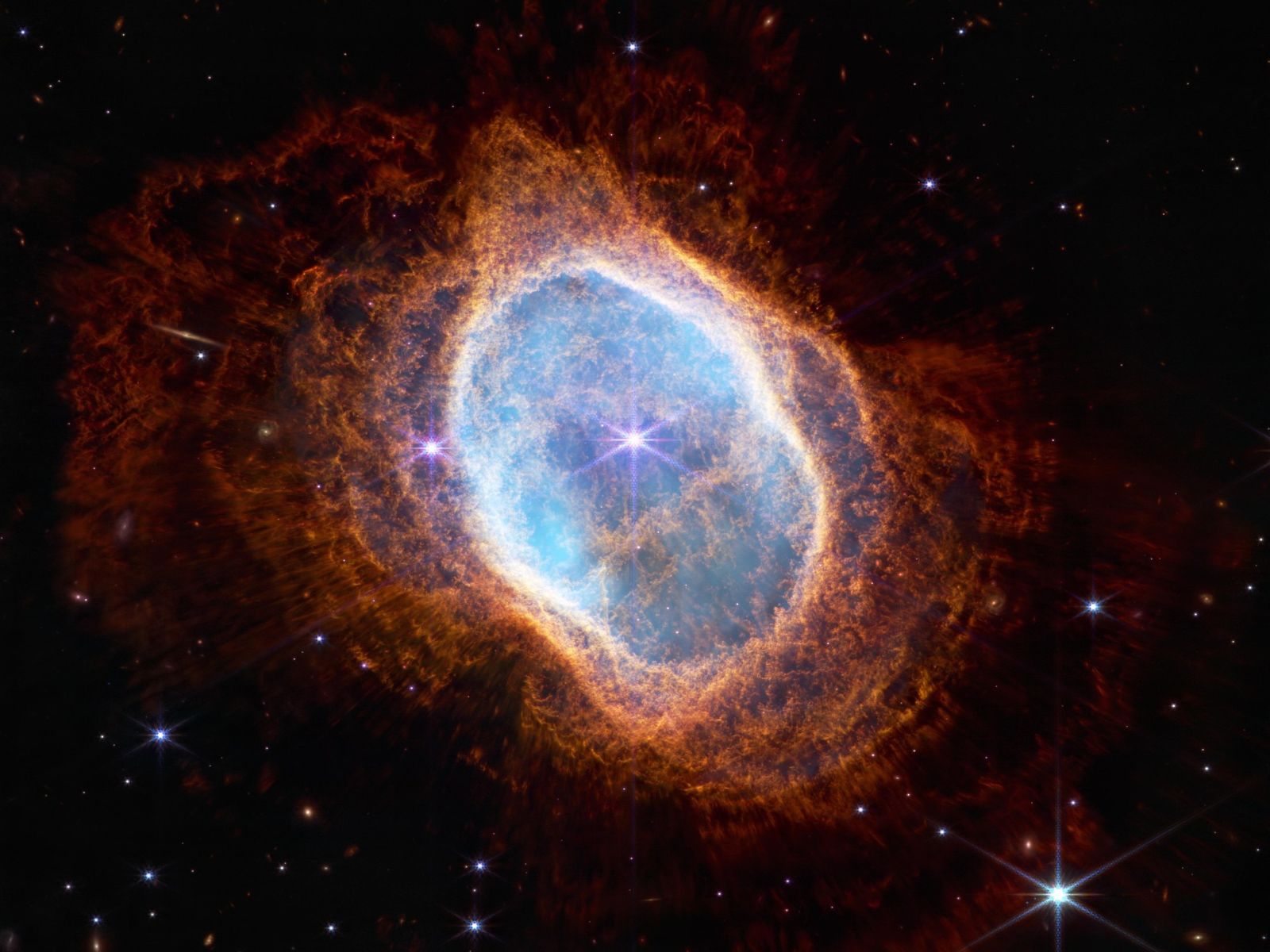
Freshly released images of the Cat’s Eye Nebula from the Hubble Space Telescope and the Euclid space telescope are giving astronomers one of the clearest, most dramatic looks yet at a stellar endgame in progress. Beyond the sheer beauty, the new views could help scientists better understand how planetary nebulae form, evolve, and disperse their material into space.
Nebulae have long fascinated researchers because they capture a star in transition. When a star reaches the end of its life, it sheds layers of gas in complex stages that are still not fully understood. The Cat’s Eye Nebula, officially known as NGC 6543, is one of the best-known examples of this phenomenon. It sits roughly 4,400 light-years from Earth and was first identified in 1864.
Early observations revealed that the nebula’s rounded appearance comes from expanding gas surrounding its dying star. Decades later, in 1995, Hubble observations delivered a major leap in understanding by resolving finer structures and helping astronomers refine their picture of what’s happening inside a planetary nebula.
Now, new imagery from both Euclid and Hubble takes that story even further by revealing striking details at different scales. Euclid’s view highlights a vivid, colorful halo of gas that appears to be spreading outward from the central star, offering a wider perspective on how material is distributed around the nebula. Hubble, in contrast, zooms in on the core, where it captures the turbulent heart of the Cat’s Eye Nebula and reveals fast-moving gas jets. The result is a scene that feels both mesmerizing and chaotic, underscoring that these glowing shapes are powered by a violent, high-energy process.
Together, these new Cat’s Eye Nebula images don’t just create an unforgettable astronomical spectacle; they also give researchers valuable data to better analyze the structure and composition of planetary nebulae, and to piece together the still-mysterious final stages of a star’s life.