Mechanical keyboards have come a long way, but not all of them deliver that “wow” factor people chase—especially when it comes to sound. Many boards still struggle with a consistent acoustic profile, and the ones that truly nail it often cost as much as higher-end alternatives like magnetic switch keyboards. That’s what makes the EPOMAKER Galaxy 100 Lite interesting: it aims to deliver a premium, thocky typing experience and a near-full-size layout while staying around the $109 mark.
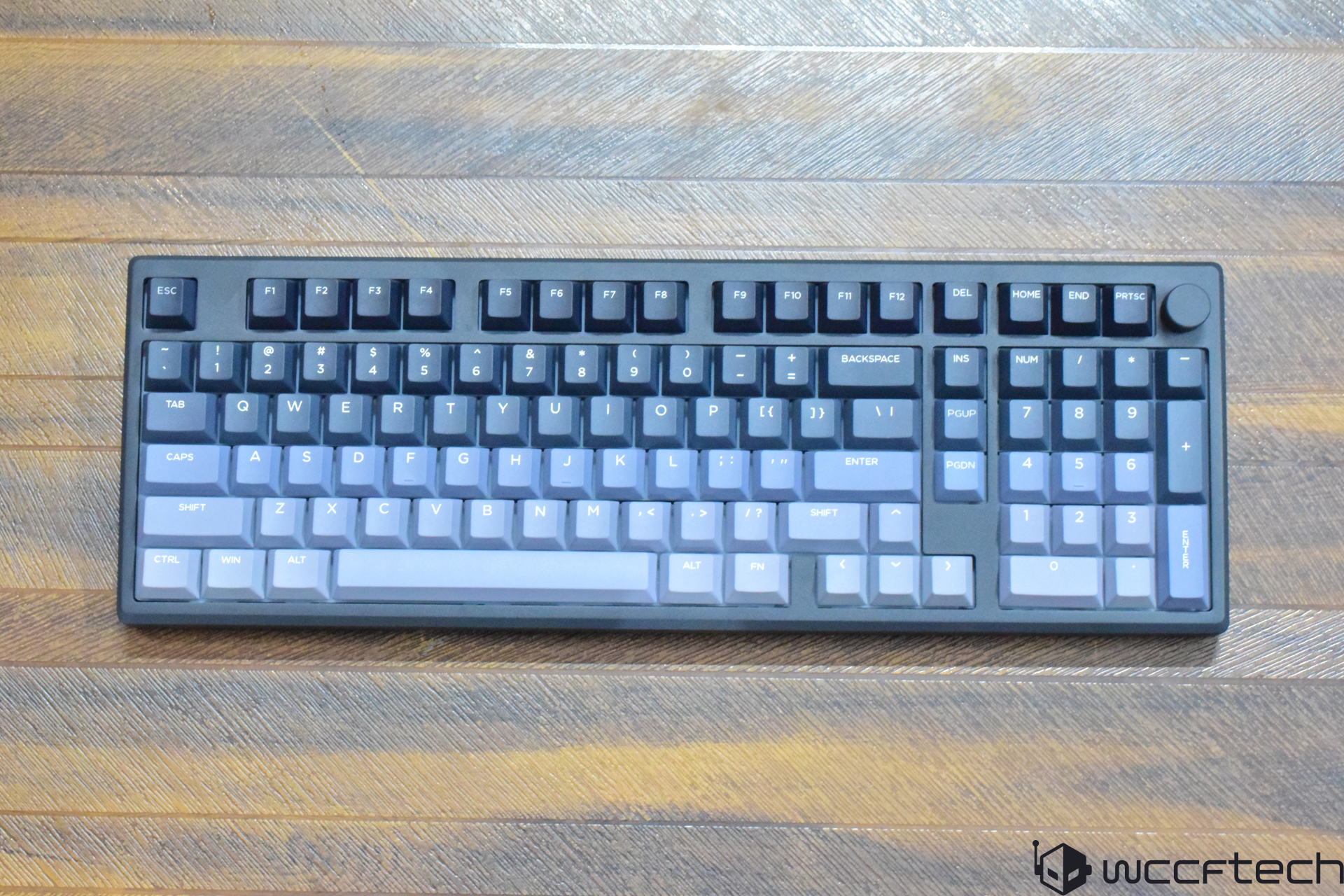
EPOMAKER has built a reputation for offering a wide range of keyboards in different sizes and styles, and the Galaxy 100 Lite is a newer option designed for users who want full functionality in a tighter footprint. It uses a 96% (1800) layout, which keeps the numpad and a familiar key arrangement, but compresses spacing around the arrow and navigation cluster. In day-to-day use, it still feels close to a full-size keyboard, just cleaner and more compact on the desk. A volume knob sits at the top-right corner, adding a nice quality-of-life touch for both work and gaming setups.
Unboxing is straightforward and practical. Inside the box, the keyboard is protected with foam, and the accessories are tucked into a smaller package. You get a long, well-braided cable, and importantly, the 2.4GHz wireless adapter is attached to it. EPOMAKER also includes extras that enthusiasts will appreciate: a keycap/switch puller, two spare switches, three alternate keycaps, and the user manual.
Where the Galaxy 100 Lite starts to stand out is in its core spec list for the price. You’re getting tri-mode connectivity (USB-C wired, 2.4GHz wireless, and Bluetooth 5.0), an 8000mAh battery, hot-swap support for both 3-pin and 5-pin switches, per-key south-facing RGB, and up to a 1000Hz polling rate over wired and 2.4GHz. It also supports major platforms like Windows, Mac, and Android, which makes it easy to move between a desktop, laptop, tablet, or even a phone depending on how you work.
This specific configuration comes with factory-lubed FEKER Marble White linear switches. They’re tuned for a light, fast press, requiring 42gf of force, with 2.0mm pre-travel and 3.5mm total travel. In practical terms, the keystrokes feel quick and smooth, and because the board is hot-swappable, you can easily replace the switches later without soldering if you want a different sound or feel.
Build quality is one of the biggest selling points here. The Galaxy 100 Lite uses a CNC-machined aluminum alloy chassis, and it feels every bit as premium as that sounds. It’s heavy—around 1.6kg—which keeps it planted on the desk with no flex. In a market where many keyboards still rely on plastic cases in this price range, the all-metal construction is a major advantage for durability, stability, and overall feel.
The typing acoustics are also a highlight, thanks to a gasket-mounted structure paired with multiple internal dampening layers. The board uses several sound and feel tuning materials (including Poron foam, an IXPE switch pad, PET sound-enhancement material, and bottom foam), which helps create a richer, more consistent sound across the keyboard. The result is the kind of deeper, “thocky” profile many people look for, without the unevenness or hollowness that can show up on less refined builds.
In use, the smooth factory-lubed linear switches combine with the dampened gasket build to make typing feel almost frictionless. Keypresses are consistent, fast, and satisfying, with a sound that stays impressively even across different sections of the layout. If you care about how a keyboard sounds and feels as much as how it performs, this is the area where the Galaxy 100 Lite makes its strongest argument.
That said, it isn’t perfect. One notable downside is the lack of adjustable kickstands, so you can’t change the typing angle on the fly. Some users won’t mind, but for anyone picky about ergonomics, it’s worth considering.
Connectivity is flexible and refreshingly simple. You can run it wired via USB-C, go low-latency with the 2.4GHz wireless mode, or switch to Bluetooth for pairing with multiple devices. It’s plug-and-play out of the box, so you don’t need software unless you want deeper customization for lighting, macros, or key remapping. The heavier build does reduce portability, but that weight is part of what makes the board feel so solid and premium—an easy tradeoff if it’s mainly living on a desk.
Visually, the Galaxy 100 Lite leans into a clean, modern style. It comes in two color themes, including a black version with a black-and-gray gradient that looks sharp and professional. The legends are easy to read, but they aren’t shine-through, since the Cherry-profile PBT keycaps are opaque. The south-facing RGB still looks great, especially for underglow-style effects around the keys, but if you specifically want bright, glowing legends, this keycap style won’t provide that.
Lighting and macro customization can be handled through keyboard shortcuts for basic effects and brightness changes, but deeper control is available through VIA. Setting it up can be slightly confusing at first because you’ll need to download and extract the correct JSON file, then load it into VIA before the full configuration options appear. Once it’s set, you can test keys, build layers, assign macros, and tailor the layout to match how you work or play.
For around $109, the EPOMAKER Galaxy 100 Lite positions itself as a standout mid-range mechanical keyboard for anyone who wants a premium build, excellent acoustics, and modern connectivity without jumping into much higher price brackets. The combination of a CNC aluminum case, gasket-mounted design with multiple dampening layers, smooth pre-lubed linear switches, tri-mode connectivity, and hot-swap support makes it a strong pick for both gaming and productivity.
If you can live without height adjustment and don’t mind that the RGB won’t shine through the legends, the Galaxy 100 Lite delivers where it matters most: it feels solid, sounds consistently satisfying, and offers the features people actually look for in a daily driver mechanical keyboard.