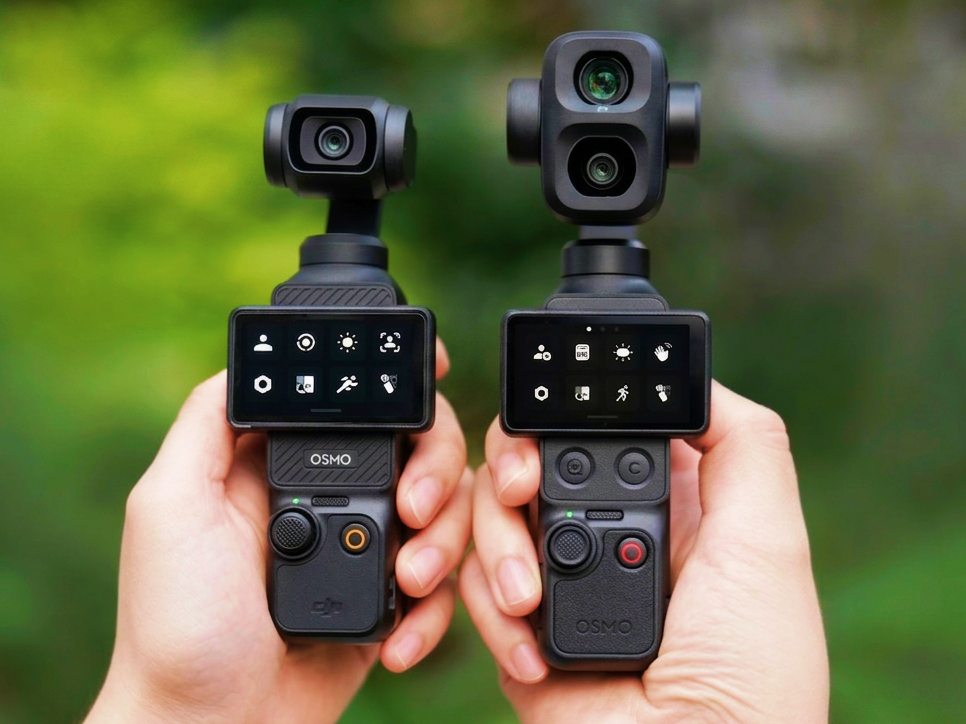
A new full-length review has revealed what could be DJI’s most capable pocket gimbal camera yet: the DJI Osmo Pocket 4P (Pro). While the standard Osmo Pocket 4 refines the familiar single-camera setup with a larger sensor and sharper overall imaging, the Pocket 4P takes a more ambitious step by adding a second camera built specifically for optical zoom. The result is a more versatile, professional-friendly tool aimed at serious creators who want cleaner perspective, more cinematic background blur, and reliable subject tracking—without relying on a smartphone.
The biggest upgrade is the brand-new dual-camera system. For the first time in the Osmo Pocket lineup, DJI moves beyond one lens and pairs the usual wide-angle main camera with a dedicated 3x optical zoom lens, roughly equivalent to a 60mm focal length. That matters because wide lenses, while great for vlogging and landscapes, can distort faces and exaggerate features at close range. The 3x camera fixes that, producing more natural proportions and making interviews, portraits, and “talking head” shots look far more flattering.
According to the review, the 3x zoom camera appears to use a 1/1.5-inch CMOS sensor, similar to the kind of telephoto hardware seen in DJI’s higher-end aerial cameras. This sensor-and-lens combination doesn’t just bring you closer—it also improves the overall look of your footage. The review footage highlights noticeably stronger depth separation, with impressively smooth bokeh that makes subjects stand out in a way many pocket cameras (and even some phones) struggle to achieve.
Zoom options are also expanded significantly. The Osmo Pocket 4P delivers 3x optical zoom, 6x “lossless” zoom using an in-sensor crop, and up to 12x maximum zoom through digital processing. In practical terms, this gives creators a wider range of framing options while filming, making it easier to capture tight shots without physically moving closer. With this kind of multi-level zoom flexibility, the Pocket 4P is clearly positioned as a competitor to the zoom-centric camera systems found on flagship smartphones, including models in the iPhone Pro category.
The zoom camera also improves the Pocket 4P as a stills shooter. The Pocket 4 already made a big jump for photography thanks to its 37MP sensor, and adding a dedicated 3x option makes the Pro model even more useful for photos—especially for portraits, street scenes, and travel shots where a tighter perspective is often more flattering and practical.
Another major highlight from the review is tracking performance. The Pocket 4P reportedly supports ActiveTrack 7.0 at 3x and even at 6x zoom. That’s a big deal because tracking and autofocus become much harder at longer focal lengths, where small movements and focus shifts are more noticeable. If real-world performance matches the review impressions, the Pocket 4P could become one of the most reliable compact “zoom tracking” cameras for solo creators. By comparison, the standard Pocket 4 can track at 2x and 4x zoom.
Of course, the added camera hardware comes with trade-offs. The review notes that the Pocket 4P is heavier than the Pocket 4, mainly because the dual-camera gimbal head is larger and bulkier. That extra weight creates a more top-heavy feel, making accessories like the extension handle and mini-tripod much more useful for comfort and stability during longer shoots.
There’s also an efficiency hit. Because the gimbal motors have to work harder to stabilize a heavier head—especially when shooting at 3x or 6x, where tiny vibrations are easier to see—battery life is expected to drop slightly compared to the single-camera Osmo Pocket 4. Still, the review suggests this won’t be a dealbreaker for most users, given the creative benefits of true optical zoom and improved perspective.
DJI hasn’t confirmed an official launch date yet, but the appearance of such a detailed review suggests the Osmo Pocket 4P (Pro) may be close to release. If you’ve been waiting for a pocket-sized stabilized camera that behaves more like a multi-lens pro setup—complete with optical zoom, advanced tracking, and cinematic depth—this could be the most interesting Osmo Pocket model to date. Meanwhile, competition is heating up as other brands are also preparing new dual-camera creator devices in the same space.