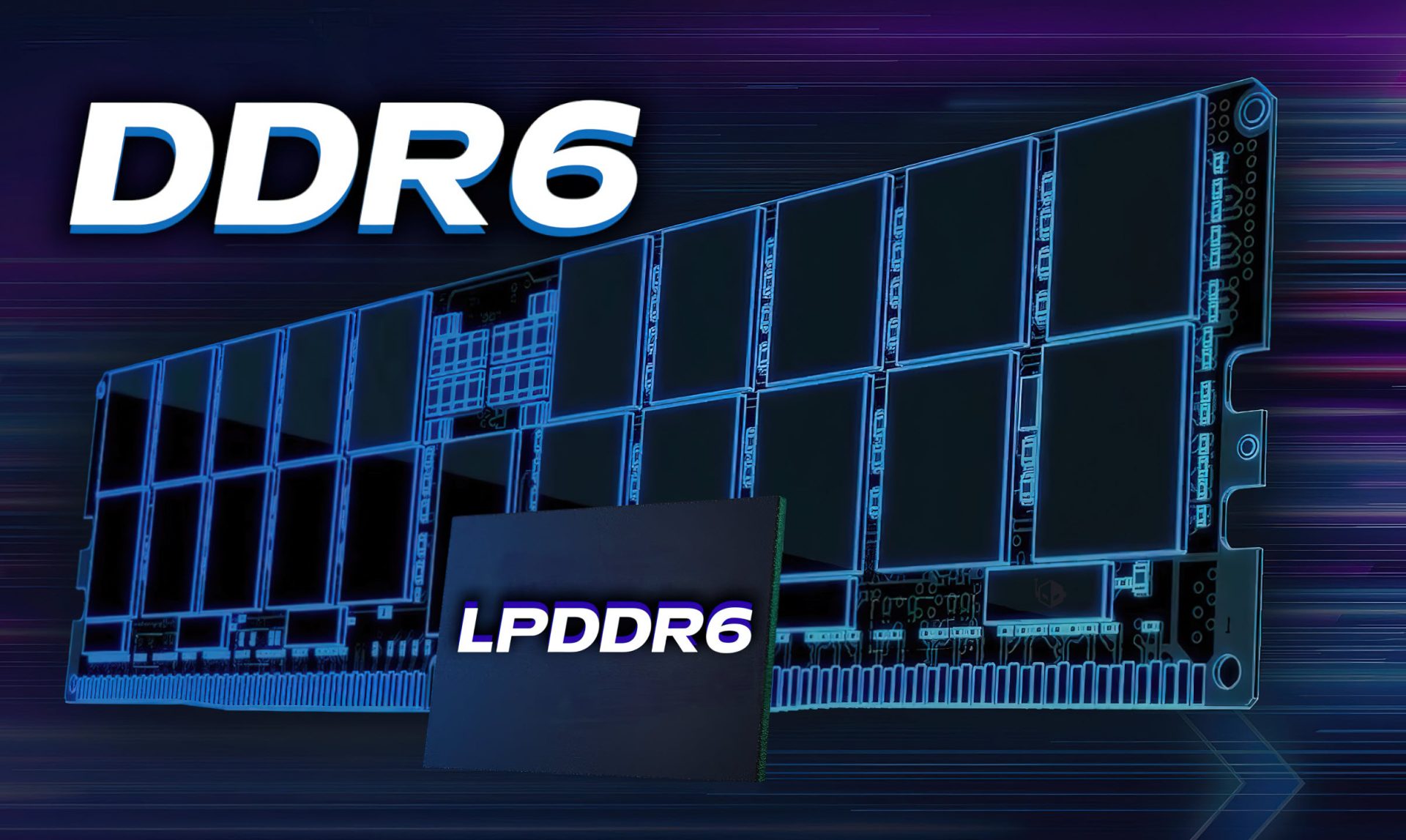
DDR6 memory development is now moving quickly, with the world’s biggest DRAM manufacturers—Samsung, SK Hynix, and Micron—pushing to get the next major memory standard ready as AI workloads keep driving demand for faster speeds and bigger capacities.
The surge in AI training and inference has turned memory bandwidth and capacity into key bottlenecks across modern data centers. That pressure is one reason the industry has already been advancing newer low-power memory options. JEDEC previously introduced the LPDDR6 standard, designed to improve performance and efficiency over LPDDR5. Low-power DDR variants have become increasingly attractive for AI-focused infrastructure because they can deliver high throughput while keeping power use in check—an important advantage when energy costs and thermal limits matter as much as raw performance.
Now attention is shifting to mainstream next-generation DDR. The three leading DRAM makers are reportedly accelerating plans around DDR6, aiming to build on DDR5 with better overall performance, improved scalability, and stronger suitability for future server platforms and AI systems.
A key sign of progress is that work has started upstream with the supply chain. Substrate vendors—critical partners in memory packaging and manufacturing—are being asked to move forward with DDR6-related development. That matters because new memory generations typically require close coordination between memory companies and substrate suppliers well before products reach the market. With early-stage development underway, the competitive race is on, even though no company has publicly shown finished DDR6 modules yet.
This push is also happening against the backdrop of ongoing supply constraints. AI companies rarely rely on just one memory supplier, not because they prefer diversity, but because demand is so intense that even multiple suppliers can struggle to keep up. Both Samsung and Micron have indicated that memory supply tightness may continue for years, with expectations that constraints could worsen in 2027 compared to 2026.
Meanwhile, DDR5 has rapidly become dominant in servers. It currently represents more than 80% of server memory usage and is projected to climb to around 90% within the year, reinforcing how quickly data centers adopt new memory standards once platform support is in place.
So what should we expect from DDR6 itself? Early targets suggest DDR6 could start around 8.4 Gbps and scale up to roughly 17.6 Gbps as the technology and manufacturing processes mature. Alongside speed gains, DDR6 is expected to improve capacity options and maintain strong efficiency characteristics—especially as the broader ecosystem continues pushing toward lower-voltage operation in related standards.
On the low-power side, the industry is also previewing what high-density, compact memory can look like moving forward. JEDEC has recently highlighted next-generation LPDDR6 SOCAMM2 memory designs that can reach massive capacities—up to 512 GB—in space-saving, power-efficient form factors that are well suited for AI servers where density and efficiency are critical.
As for timing, DDR6 commercialization is expected to land first where demand is strongest: AI data centers. Current expectations point to an initial rollout window around 2028 to 2029. Consumer PCs are likely to follow after data center needs begin to stabilize—typically a year or two later—meaning the mainstream upgrade cycle will probably arrive once enterprise deployment ramps and supply improves.
In short, DDR6 is shaping up to be the next major leap for both server and eventually consumer memory, and with Samsung, SK Hynix, and Micron all pushing in parallel, the race to define the next era of high-performance DRAM has clearly begun.