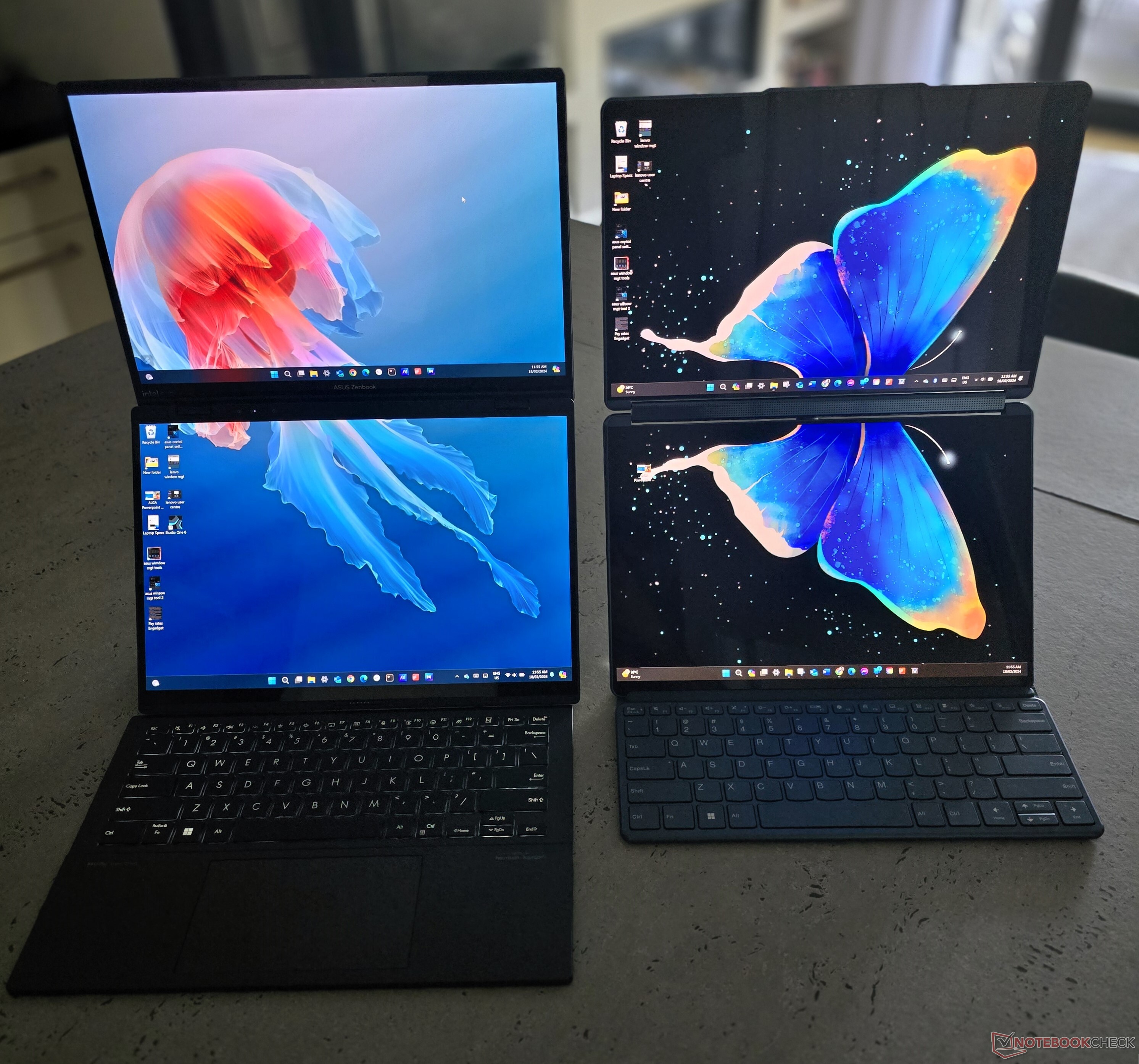
The laptop market has recently been graced with fresh updates via the Lenovo Yoga Book 9i and the ASUS Zenbook DUO, two dual-screen contenders each boasting impressive specs. The Yoga Book 9i has been upgraded with the new Intel Core Ultra 7 processor that incorporates a 4 Execution Unit Arc integrated GPU (iGPU). This device has configurations available with up to 16GB of RAM and a 1TB SSD.
On the other hand, the ASUS Zenbook DUO steps up the performance ladder with the Intel Core Ultra 9 and an 8 Execution Unit iGPU. This enhancement in graphics allows for solid gaming performance at 1080P resolution. Options for this model include up to 32GB of RAM and 2TB of storage. Detailed performance comparisons of these models will be provided shortly.
Both laptops are fitted with beautiful OLED displays supplied by Samsung Display, both boasting a resolution of 2880 x 1800. Lenovo describes its 13.3-inch screens as 2.8K, while ASUS rounds up to 3K for its 14-inch screens. Despite the slight difference in size, the sharpness of both panels appears closely matched. Lenovo has tuned its display to a warmer tone, whereas ASUS has chosen a brighter white appearance. Each panel produces 400 nits of peak brightness, supports HDR 500, and covers 100% of the DCI-P3 color spectrum. Additionally, they are compatible with 10-finger multitouch and pen input.
A notable distinction is that the ASUS panel can switch between 60Hz and 120Hz refresh rates, while the Lenovo’s display is capped at 60Hz. While the difference between these refresh rates might not be as perceptible on a laptop as it is on a smartphone, gaming enthusiasts might appreciate the smoother visuals offered by the higher refresh rate on the ASUS.
In terms of audio, both Lenovo and ASUS have enlisted the help of high-end audio companies. Lenovo teamed up with Bowers & Wilkins to fine-tune the soundbar positioned between the Yoga Book 9i’s displays, whereas ASUS has collaborated with Harman/Kardon to optimize the Zenbook’s sound system located near the cooling ports along the sides of the chassis.
Both laptops offer superior audio quality compared to the average PC laptop, ensuring a satisfying multimedia experience. While they may not match the acoustic fidelity of the speakers found in the likes of the Apple MacBook Pro, they still offer commendable performance. If one had to choose, the ASUS Zenbook DUO might edge out with a fuller sound profile.
An interesting note about the Lenovo Yoga Book 9i is that the placement of its speakers delivers evenly distributed sound when engaging with content on either screen. The architecture of its sound system is particularly well-suited for consumption on the bottom display, offering a balanced audio-visual experience.
Stay tuned for more detailed assessments of these innovative dual-screen laptops to see how they truly stack up against each other in real-world usage.