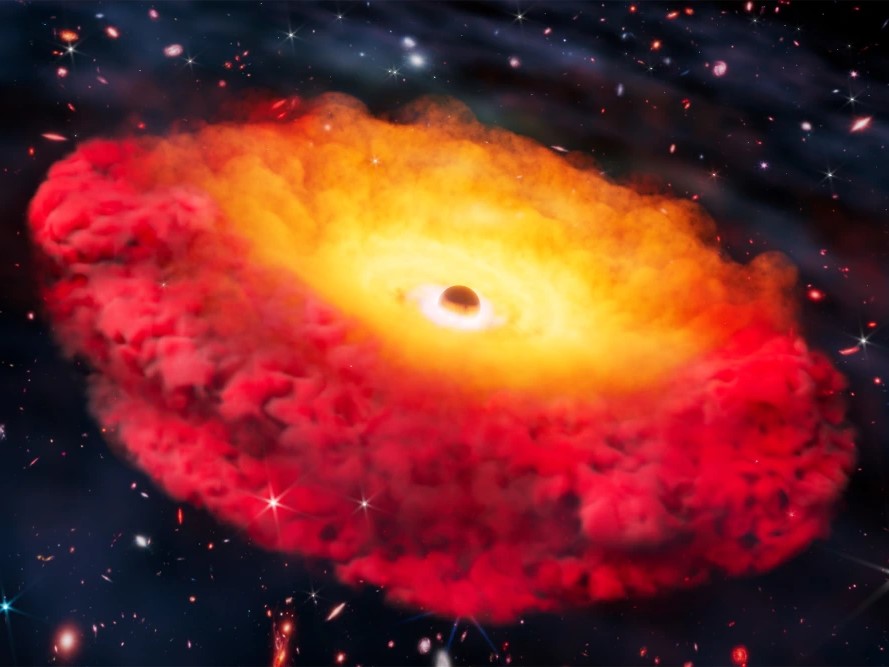
A team of astronomers has made an astonishing discovery with the identification of a black hole that may date back to just 500 million years after the Big Bang, around 13.3 billion years ago. This groundbreaking find offers valuable insights into the early universe and the mysterious formation of black holes.
Led by Anthony Taylor, a postdoctoral fellow at the Cosmic Frontier Center at the University of Texas at Austin, the team employed spectroscopy to detect the black hole within the CAPERS-LRD-z9 galaxy. This galaxy is part of a group known as “Little Red Dots” (LRDs), named for their bright red appearance in telescope images. These early galaxies were formed within the universe’s first 1.5 billion years.
Typically, the intense brightness of LRDs suggests a high number of stars. However, considering the galaxy’s young age, it’s improbable that enough stars could have developed to create such a glow. The likely explanation is the presence of black holes. Gas and dust spiraling into these black holes heat to extreme temperatures and emit intense radiation.
What’s particularly remarkable about the black hole in CAPERS-LRD-Z9 is its sheer size and age. It is up to 1.3 trillion times more massive than Earth and accounts for about half of the galaxy’s stellar mass. Formed relatively soon after the universe’s inception, it stands as an ancient giant.
This discovery was made possible through observations by NASA’s James Webb Space Telescope, which has been exploring every phase of our universe since its launch. This cosmic investigation continues to unravel the wonders of space, deepening our understanding of the universe’s origins.


