Coherent Expands Texas Chip Facility to Boost Optical Technology for NVIDIA AI Data Centers
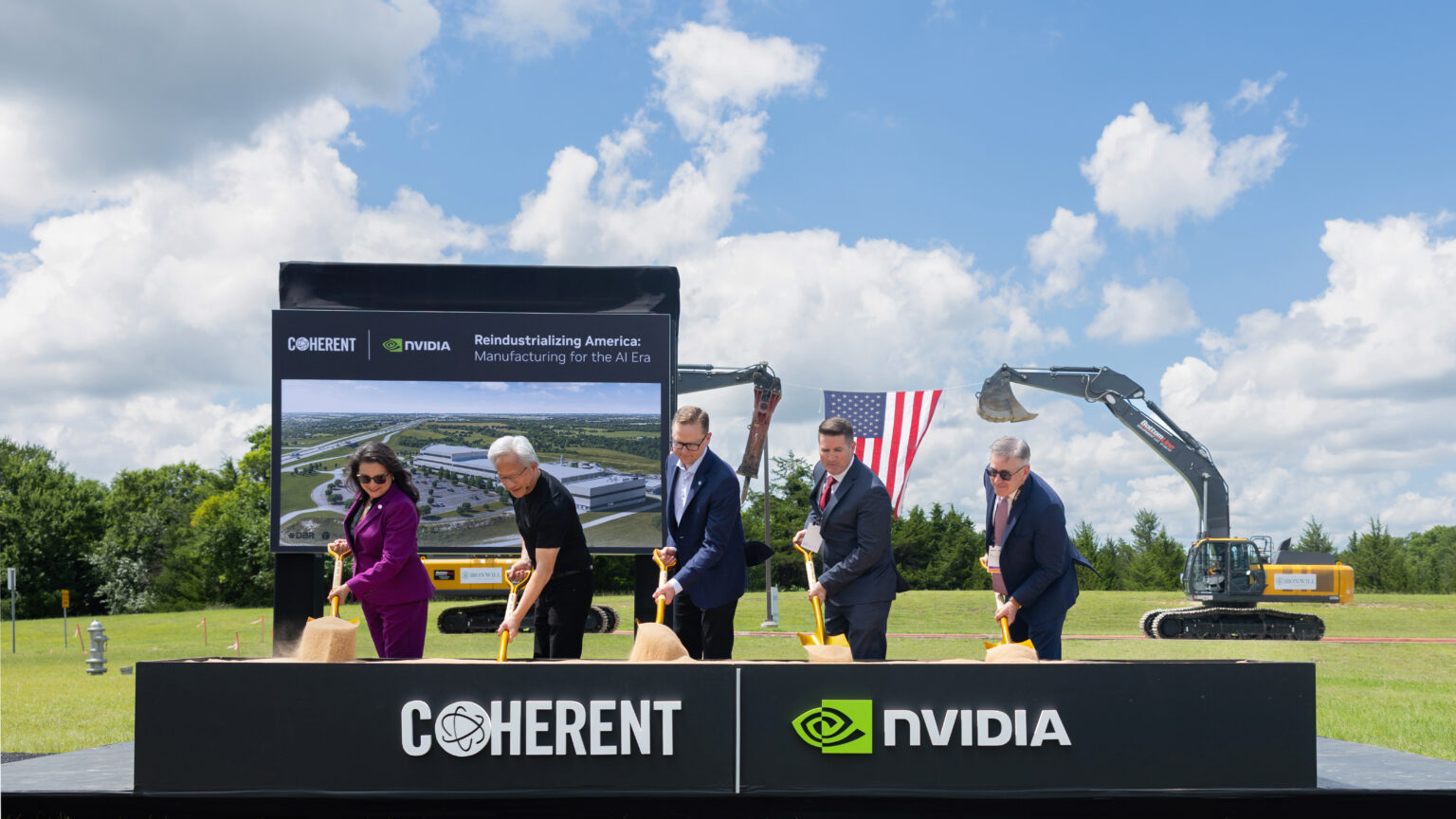
Coherent has started expanding its wafer fabrication facility in Sherman, Texas, marking an important step in the growing U.S. AI hardware supply chain. The project is designed to increase production of advanced optical components used in next-generation artificial intelligence infrastructure, including systems built around NVIDIA’s high-performance data center platforms.
As AI workloads become larger and more complex, the demand for faster and more power-efficient data movement is rising sharply. Modern AI systems are no longer just about individual GPUs. They depend on massive clusters of chips, servers, switches, and racks working together as one unified computing platform. That makes high-speed interconnect technology a critical part of the AI boom.
Coherent plays a key role in this ecosystem by producing lasers, optical components, and compound semiconductors that help connect AI systems at extremely high speeds. Its expanded Texas facility will focus on scaling production of 6-inch indium phosphide wafers, also known as InP wafers. These wafers are essential for optical communication because they help move data between chips, servers, and entire data centers with greater efficiency than traditional copper-based connections.
The expansion is being supported by a $50 million grant through the CHIPS Act, reinforcing efforts to build more semiconductor and AI infrastructure inside the United States. The project also builds on $17 million in support from the Texas CHIPS program and the Sherman Economic Development Corporation. Together, these investments highlight the growing push to strengthen domestic manufacturing for critical AI technologies.
NVIDIA has already signaled major plans to build AI infrastructure in the United States, with commitments that could reach up to $500 billion. Coherent’s Texas expansion fits directly into that strategy by supporting the optical networking technologies needed for larger and more efficient AI data centers.
The reason optical technology is becoming so important comes down to scale. NVIDIA has described AI systems involving hundreds of GPUs spread across multiple racks, operating as one powerful computing unit. A configuration with 576 GPUs across eight racks, for example, requires enormous amounts of data to move quickly and reliably between components.
At that level, copper connections begin to show their limits. Traditional copper links can suffer from signal degradation over longer distances, higher power consumption, and increased system complexity. As AI platforms grow, these drawbacks become more difficult and expensive to manage.
Optical interconnects offer a more efficient path forward. Once the initial conversion to optical signaling is handled, data can travel over optical links with far lower loss and greater energy efficiency. This makes optical technology especially attractive for future AI clusters, where performance, power usage, and data transfer speed are all major concerns.
This is where silicon photonics and co-packaged optics come into focus. These technologies are designed to bring optical communication closer to the chips themselves, reducing bottlenecks and improving efficiency across large-scale AI systems. For next-generation platforms such as NVIDIA’s Vera Rubin Ultra NVL576-class systems, optical connectivity is expected to play an increasingly central role.
Coherent’s pluggable optical modules are already used in NVIDIA networking switches, helping move data at extremely high speeds. Each optical plug includes an indium phosphide laser, a key component that enables fast and efficient data transmission. These optical technologies are being used across NVIDIA’s advanced networking platforms, including Spectrum-X and Quantum-X photonics switches.
The broader industry is now moving toward a future where co-packaged optics become a standard part of high-performance AI data centers. As GPU clusters continue to grow, fast optical networking will be essential to keeping those systems connected, efficient, and scalable.
Coherent’s expanded Sherman facility is more than just a manufacturing upgrade. It represents a strategic investment in the future of AI infrastructure, U.S.-based semiconductor production, and high-speed optical networking. With AI demand continuing to accelerate, the ability to produce advanced optical components at scale will be crucial for powering the next wave of data center innovation.


