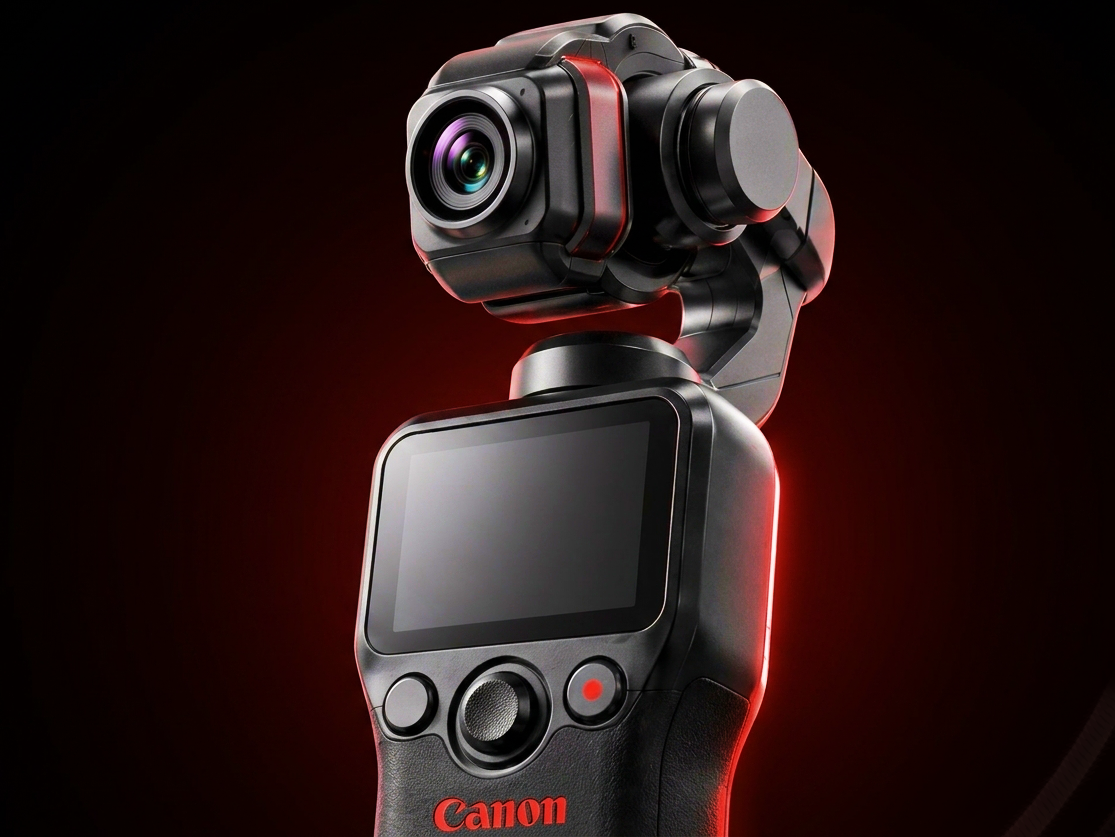
Canon may be preparing to take on the pocket gimbal camera world with a fresh 2026 patent that looks designed to rival the DJI Osmo Pocket 4 and the next wave of dual-lens pocket cameras expected from competitors. The newly published filing points to a more practical, fixed-lens direction—suggesting Canon is moving away from earlier ideas that played with interchangeable-lens concepts and toward something that could better fit the grab-and-go vlogging market.
At a glance, the patented device sounds familiar: a compact grip, a built-in screen, and a stabilized camera head using an integrated 3-axis gimbal system. Where Canon appears to be trying to stand out is not by chasing the flashiest multi-camera setup, but by focusing on durability, reliability, and smarter behavior during everyday use.
One of the most interesting details in the patent is an auto-folding protection sequence meant to reduce long-term wear. Instead of simply cutting power and letting the gimbal “go limp” when the camera shuts down, Canon’s design uses a combination of magnetic sensors and image-based analysis to determine when the user is finished recording. The camera can then initiate a controlled, safe-folding motion before motor power is cut. The goal is to protect the mechanism and reduce the kind of stress that can build up over time in motorized stabilizers.
That emphasis on intelligent power management and protective shutdown behavior could be Canon’s way of competing in a crowded field where rivals are pushing hard on specs like multi-lens designs, optical zoom options, and modular add-ons. Canon’s bet, if this product ever reaches production, may be that creators value a rugged, predictable camera they can trust every day—especially for travel shooting, daily vlogs, and fast setup recording where reliability matters as much as headline features.
Timing, however, is the big challenge. The pocket gimbal category has heated up quickly, with major players already setting expectations around high-end sensors, high frame-rate 4K video, and more ambitious dual-camera concepts. If Canon arrives late, it won’t just need strong hardware—it will need to prove that its approach delivers a better real-world experience. That means pairing stable performance with Canon’s strengths, such as imaging know-how and recognizable color science, while making the device simple and dependable for creators who don’t want to babysit gear.
It’s also worth remembering what a patent does and doesn’t mean. A patent filing is not a product launch, and it doesn’t guarantee a commercial release. Still, this isn’t a one-off. Canon has now filed multiple patents tied to pocket-style gimbal cameras, and this latest one reads like a step forward: more refined, more realistic, and more focused on the kind of engineering decisions that matter when you’re building something to be used daily.
If Canon does bring a compact gimbal camera to market, it likely won’t win by being the most experimental option. It will win by being the one that feels finished—smart in the way it powers down, durable in the way it stores and protects itself, and consistent in the footage it produces. In a market that’s getting louder and more feature-packed every month, Canon’s path to success may be making “smarter and sturdier” more appealing than “flashier and more complex.”


