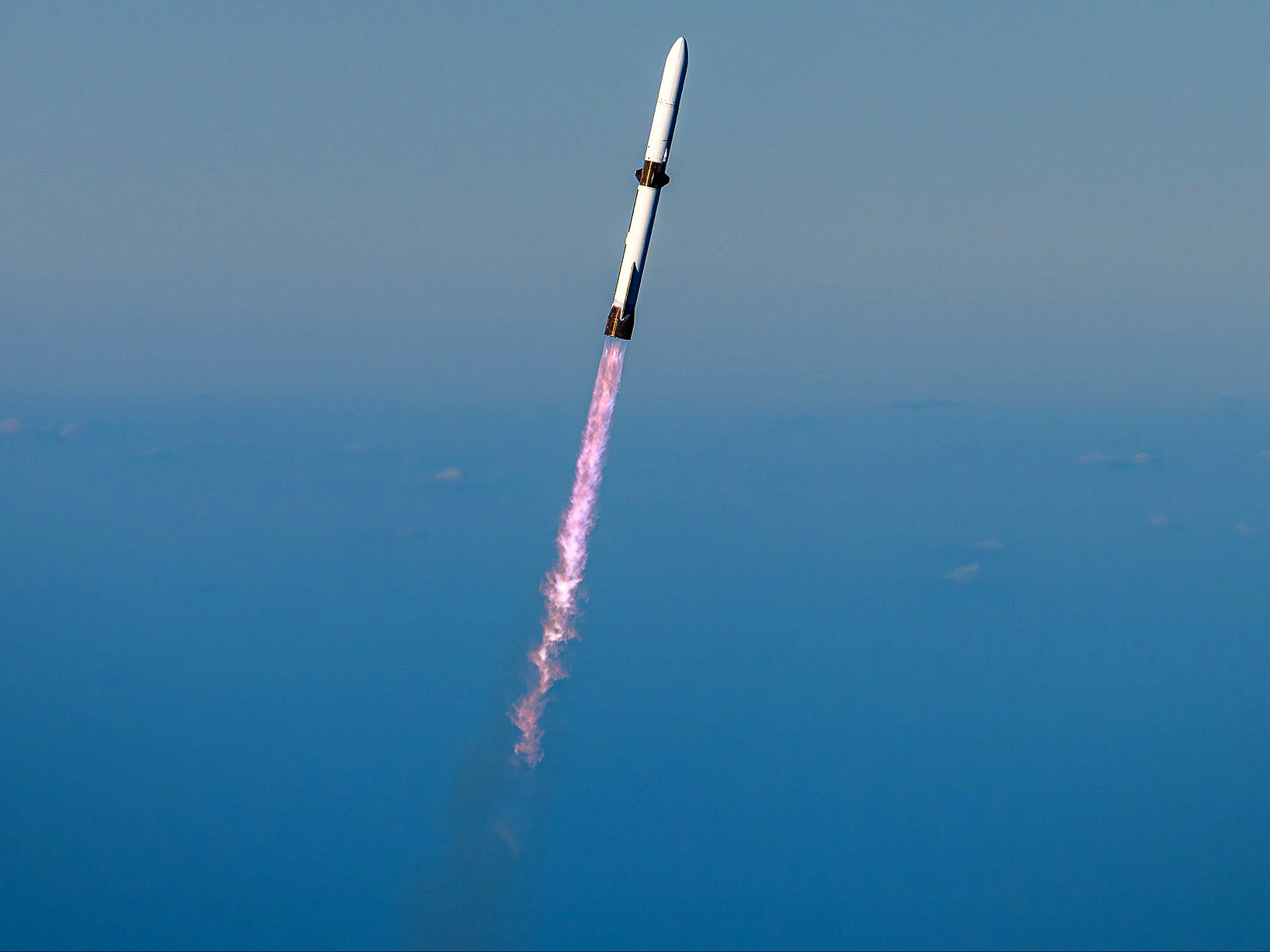
Jeff Bezos’ Blue Origin just notched a milestone that changes the conversation in orbital rocketry and Mars exploration. On its maiden flight, the company’s new heavy-lift rocket successfully landed a reusable first stage on an ocean barge and, on the very same mission, sent a pair of NASA spacecraft on the first leg of their journey to Mars.
The booster at the center of it all is New Glenn, a towering 190 feet tall with a 23-foot diameter. That makes it significantly larger than the 135-foot, 12-foot-diameter Falcon-class rocket that first pioneered barge landings nearly a decade ago, and larger than China’s recently recovered reusable Yanxingzhe-1. Recovering an orbital-class booster is widely regarded as one of the hardest feats in spaceflight, and even competitors offered congratulations, underscoring how far reusable rocketry has come.
Here’s how the flight unfolded. Roughly three minutes after liftoff, New Glenn’s first stage separated and began its return through the atmosphere. A series of engine burns slowed and steered the booster precisely onto a dedicated recovery barge in the Atlantic Ocean, touching down about 375 miles downrange from the separation point. Meanwhile, the second stage pressed on. About 33 minutes after launch, it deployed two NASA spacecraft—twin orbiters nicknamed Blue and Gold—kicking off the agency’s ESCAPADE mission.
ESCAPADE, short for Escape and Plasma Acceleration and Dynamics Explorers, is taking a novel route. Instead of waiting on the ground for the Earth–Mars launch window that opens only once every 26 months, the pair will first cruise to the Earth–Sun Lagrange Point 2, a gravitationally stable spot about 930,000 miles away. There, they’ll loiter until the next optimal window, then swing past Earth for a gravity assist that slingshots them toward Mars. This approach let NASA capitalize on New Glenn’s test flight and expand mission timing options.
Once at Mars, Blue and Gold will study how the planet’s atmosphere escapes into space—erosion driven by the solar wind and other processes that likely turned a once wetter world into the arid planet we see today. The mission, initiated by UC Berkeley’s Space Sciences Laboratory, aims to pinpoint how and where that atmospheric loss occurs, filling in key gaps about Mars’ climate history and habitability.
There’s also a noteworthy engineering twist powering this mission profile. Rocket Lab, which developed the spacecraft for NASA, built high delta‑V systems capable of climbing out of Earth’s gravity well, cruising to Mars, and executing Mars orbit insertion without relying on a direct Mars transfer from the launch vehicle. That flexibility broadens viable launch opportunities and helps control costs.
Cost is part of the story, too. Rocket Lab says ESCAPADE came in at about $18 million per spacecraft, including both build and launch—an exceptionally low price enabled by pairing compact, capable probes with a modern orbital-class reusable rocket.
While another company continues testing its next-generation vehicle for Mars missions targeted for the 2026 window, the NASA probes launched by Blue Origin are likely to arrive first. For Blue Origin, the flight marks a breakthrough in heavy-lift reusability and a strong debut for New Glenn. For NASA and Rocket Lab, it’s a smart, economical path to high-impact science at Mars. And for the rest of us, it’s a glimpse of a future where frequent, affordable, and flexible missions beyond Earth become the norm.


