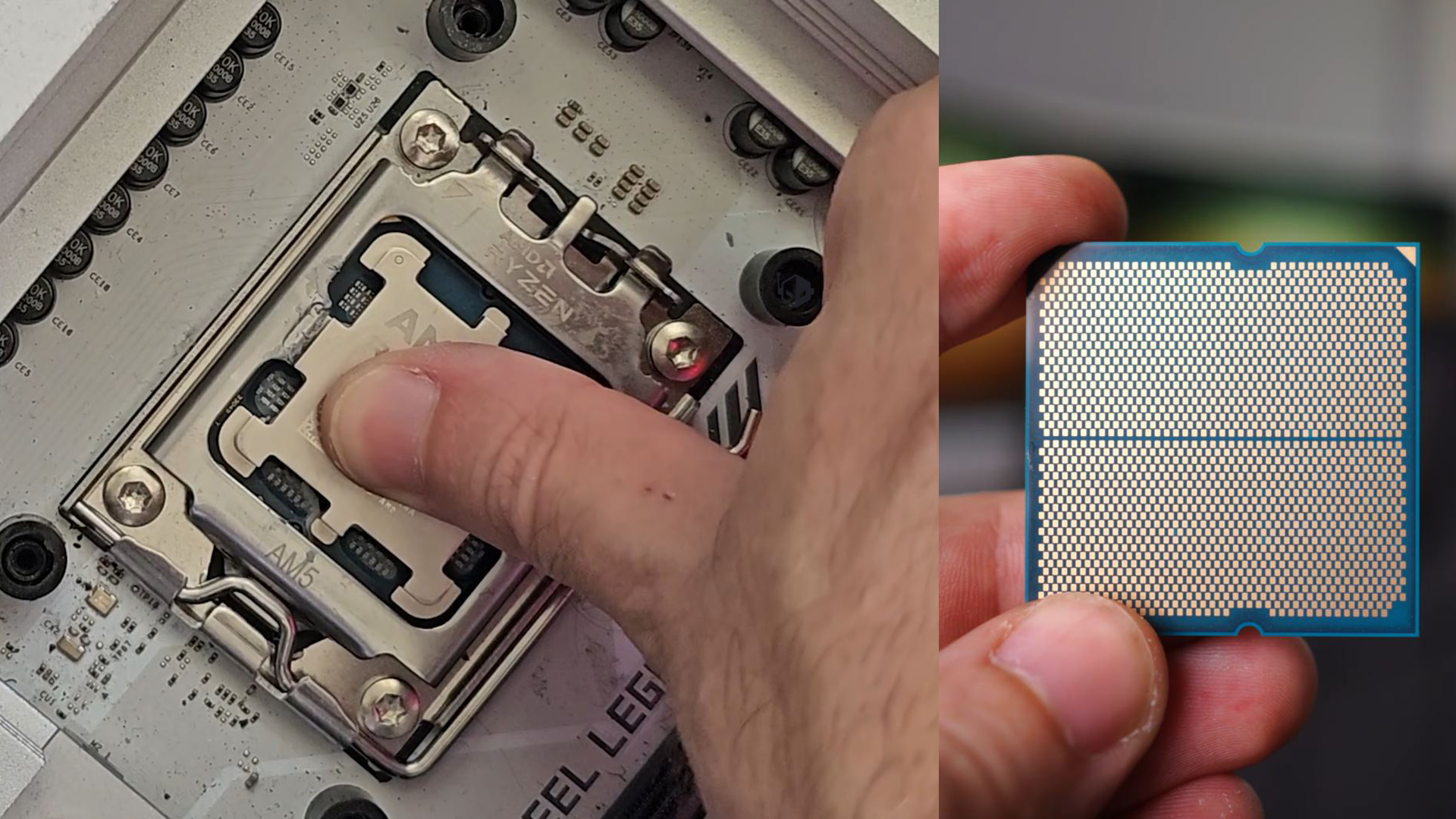
Concerns are growing around certain ASRock AM5 motherboards after a well-known PC hardware creator reported losing not one, but two AMD Ryzen 9 9950X processors on the same board—each lasting only a few months before failing.
In the report, the creator explained that his first Ryzen 9 9950X ran in an ASRock X870 Steel Legend WiFi system for roughly 3–4 months before it suddenly stopped working. Assuming it was an unlucky CPU issue, he purchased a second Ryzen 9 9950X from a completely different source. Unfortunately, the replacement chip followed the same pattern and died after a similar amount of time—again while installed in the same X870 Steel Legend WiFi motherboard.
Because he has access to multiple AM5 motherboards, he was able to troubleshoot the situation more thoroughly than most users. He tested both CPUs across different boards and attempted recovery steps such as updating to the latest BIOS version, including versions that were intended to reduce Ryzen 9000 boot and stability problems. None of those steps brought the chips back, strengthening the conclusion that the processors had genuinely failed rather than suffering from a configuration or firmware issue.
What makes this more interesting is the suggestion that the problem may not be a widespread defect across AMD’s Ryzen 9000 lineup. The creator noted that a major retailer indicated Ryzen 9000 failure rates appeared normal overall. At the same time, the retailer reportedly had reservations about stocking certain higher-end ASRock boards due to motherboard-related failure concerns. That detail adds weight to the idea that the motherboard, not the CPU, could be the common factor in at least some of these cases.
One potential explanation being discussed is a VRM-related regulator issue that could lead to voltage overshoot. Instead of an immediate, catastrophic failure, that kind of behavior can cause slow electrical degradation over time—consistent with CPUs that run for months and then fail without warning. The fact that both processors lived for a similar 3–4 month window on the same motherboard supports the idea of gradual damage rather than a one-off incident.
It’s also worth noting that not every ASRock AM5 motherboard appears affected. The creator mentioned having other ASRock B850 and X870 systems that have been running fine, suggesting this could involve specific models, specific batches, or a particular combination of components and settings that only shows up under certain workloads.
BIOS updates can help with compatibility, boot reliability, and power behavior to a point, but they can’t repair faulty hardware. If the underlying issue is tied to VRM components or power regulation on a specific board, firmware updates may reduce risk but won’t necessarily eliminate it.
For builders and upgraders using Ryzen 9000 CPUs—especially the Ryzen 9 9950X—this is a reminder to take power delivery and motherboard selection seriously. If you experience a CPU failure in a similar setup, the recommendation from the report is clear: consider replacing both the motherboard and CPU rather than swapping only one part and hoping the problem disappears.
As more users build on AMD’s AM5 platform with X870 motherboards and high-core-count Ryzen processors, additional community reports will be crucial in determining whether this is an isolated case or a broader issue affecting specific ASRock boards.


